About IELTS: A Complete Guide to the Exam, Its Format, and What's Changing in 2026
If you've started researching study-abroad, work, or migration requirements for an English-speaking country, you've almost certainly run into the same four letters over and over: IELTS. It's one of the most widely recognized English proficiency tests in the world, and for many candidates it's also one of the most confusing to research from scratch — there isn't one IELTS test, but several versions, each built for a different purpose, delivered in more than one format, and priced differently depending on which one you need.
This guide is meant to answer the question "what actually is IELTS, and what do I genuinely need to know before booking one" as completely and plainly as possible — not just the marketing-page summary, but the practical details that actually affect a real candidate: how the test is structured section by section, how scoring genuinely works, what's different between the Academic and General Training versions, what IELTS Life Skills and IELTS for UKVI are and who actually needs them, how the 2026 shift to fully computer-based delivery changes what test day looks like, current fees in India, how long a score stays valid, and how results actually get delivered to the universities, employers, or immigration authorities that require them.
This guide was researched and verified in July 2026 using IELTS's own official pages (ielts.org), IDP IELTS India's official fee and registration pages, and the British Council's test-taker resources. Fees, formats, and policies are updated periodically by the test's administering bodies — always confirm current details directly on ielts.org or your local test center's page before registering.
What Is IELTS, Exactly?
IELTS stands for the International English Language Testing System. It's a standardized test that measures a person's ability to listen, read, write, and speak in English, scored on a band scale from 1 to 9. It exists to answer one specific, practical question for a university, employer, or immigration authority: can this person function in English at the level this opportunity requires?
IELTS is jointly owned and administered by three organizations: the British Council, IDP IELTS, and Cambridge University Press & Assessment (Cambridge is responsible for the test's content and research; the British Council and IDP handle test delivery and administration in different regions worldwide). This three-way ownership structure is part of why you'll see IELTS test centers branded as either "British Council" or "IDP" depending on where you register — both deliver the same test, to the same standard, with results treated identically by every institution that accepts IELTS.
The test itself traces back to 1980, when it launched under a different name (ELTS), before the current international partnership formed in 1989 and expanded it into the test recognized globally today. Combined, IELTS's administering partners now operate test centers and language assessments across well over 100 countries, and IELTS results are accepted by more than 25,000 universities, employers, government ministries, and other organizations worldwide — a scale that's part of why it remains a default choice for candidates targeting the UK, Australia, Canada, New Zealand, and a growing list of destinations beyond the traditionally English-speaking world.
Why IELTS Matters in 2026 Specifically
Two things make 2026 a genuinely different moment for IELTS candidates compared to even a year or two earlier, and both are worth understanding before choosing how to prepare.
The shift to fully computer-based delivery. IELTS's own announcement states plainly that "from mid-2026, we will no longer offer IELTS as a paper-based test. All IELTS tests will be delivered on computer," with exact timelines varying by market. In India specifically, this transition has concrete dates attached to it, with the final paper-based sittings scheduled and full computer-based delivery becoming the standard from that point forward. For a candidate who has spent months practicing exclusively on paper — handwriting essays, filling in Reading answer sheets by pencil — this is not a cosmetic change. Typing speed, screen-based navigation, and on-screen note-taking during Listening all become genuinely relevant skills that paper-based practice alone doesn't build.
The introduction of "Writing on Paper" as a hybrid option. Recognizing that some candidates specifically prefer handwriting for the Writing section, IELTS has introduced a hybrid delivery format in select markets that lets a candidate take Listening, Reading, and Speaking on computer while handwriting their Writing responses on paper. IELTS's own research confirms scores remain comparable between the fully computer-based and Writing-on-Paper formats, so this isn't a lesser or "downgraded" option — it's a genuine accommodation for candidates who type more slowly or simply produce clearer thinking by hand, provided it's available at their specific test center.
The introduction of IELTS One Skill Retake. This is arguably the most practically significant recent change for candidates whose overall band score is being held back by a single weak section. Rather than repeating the entire four-skill exam because one section fell short, an eligible candidate can now retake just that one section and receive a new Test Report Form combining the retaken score with their original results in the other three skills — a meaningful change to how "close but not quite" scores get fixed.
IELTS Academic vs. IELTS General Training: Choosing the Right Version
This is the single most important decision a first-time candidate makes, and it's worth getting right before booking, since the two versions test different content in two of the four sections.
IELTS Academic is designed for candidates applying to undergraduate or postgraduate study, or seeking professional registration in fields like medicine, nursing, or engineering where a university or professional body specifically requires the Academic version. Its Reading and Writing sections are built around academic-style content: dense, argument-driven passages and a Writing Task 1 that requires describing and summarizing visual data (a graph, chart, table, diagram, or process).
IELTS General Training is designed for candidates migrating to English-speaking countries, applying for work experience or training programs, or completing secondary education abroad. Its Reading section uses shorter, more practical texts — notices, advertisements, workplace materials, and general-interest articles — alongside one longer passage, and its Writing Task 1 requires writing a letter (formal, semi-formal, or informal) responding to a given everyday situation rather than describing data.
What's identical between the two versions: Listening and Speaking are exactly the same test, regardless of which version is chosen — same format, same difficulty, same scoring. Writing Task 2 (the essay) is also structurally the same task type across both versions, though General Training essay topics tend to skew toward more everyday, general-interest themes compared to Academic's often more abstract or research-adjacent prompts.
How to know which one you need: This isn't a personal preference decision — it's dictated by the specific requirement of whichever university, employer, or immigration authority is asking for the score. A candidate applying to a master's program abroad almost always needs Academic; a candidate applying for permanent residency through a skilled migration pathway almost always needs General Training. Checking the exact requirement directly with the receiving institution before registering avoids the costly mistake of sitting the wrong version entirely.
The Full IELTS Test Format, Section by Section
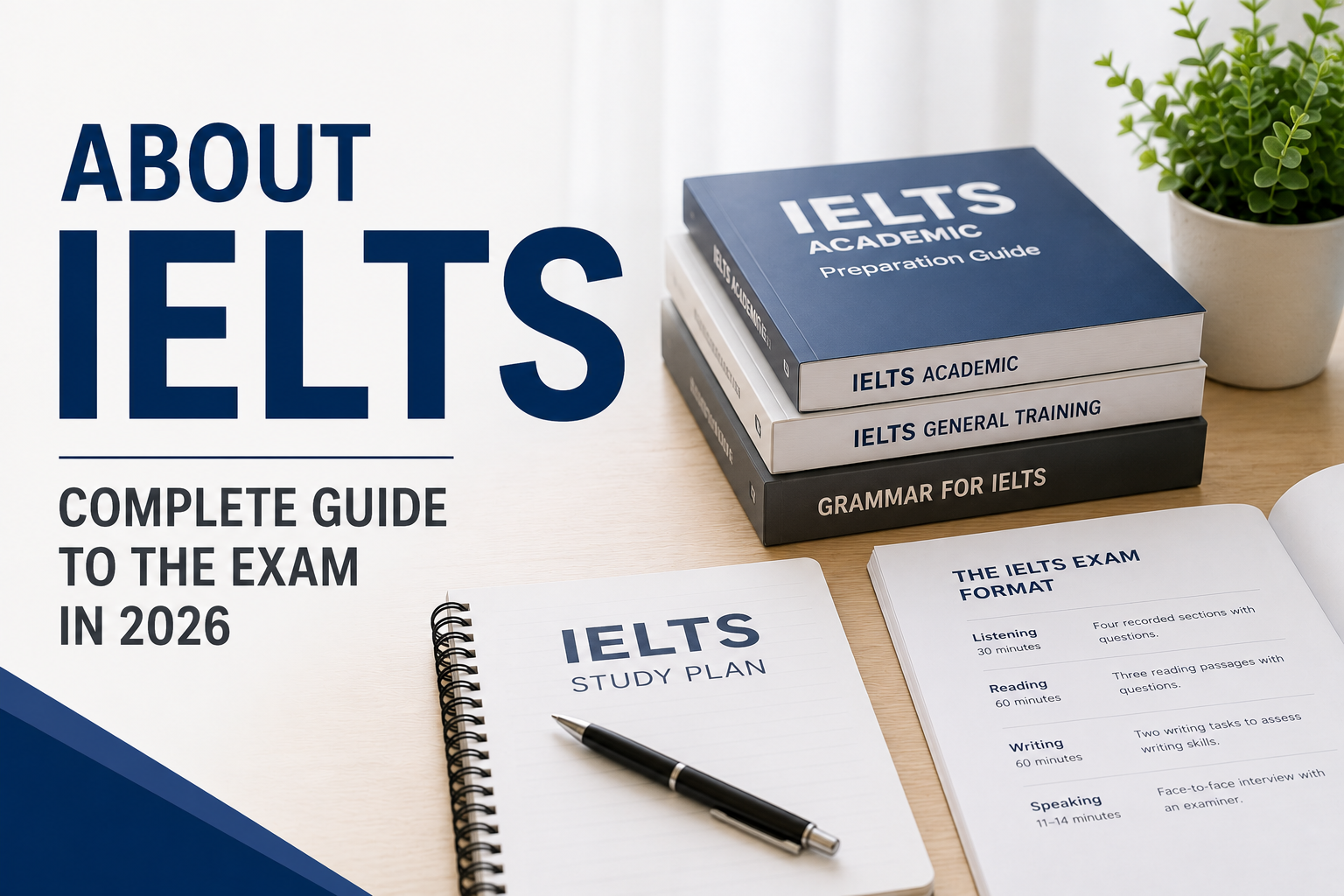
Every IELTS test, regardless of Academic or General Training, covers the same four skills in the same order, for a total test duration of 2 hours and 45 minutes when Speaking is scheduled on the same day (Speaking can sometimes be scheduled up to a week before or after the other three sections, depending on the test center).
Listening (Approximately 30 Minutes, Plus Transfer Time)
The Listening section is identical across Academic and General Training. It consists of 40 questions across four recorded sections, each increasing in difficulty:
Section 1 is a everyday conversation between two people in a social context — booking a hotel room, enquiring about a class, arranging an appointment.
Section 2 is a monologue set in an everyday social context — a speech about local facilities, or a talk giving information about an event.
Section 3 is a conversation between up to four people set in an educational or training context — a discussion between students and a tutor about an assignment, for instance.
Section 4 is a monologue on an academic subject — a university-style lecture, delivered without a change in speaker, testing sustained concentration and note-taking under pressure.
Each recording is played only once. On the computer-delivered format, candidates type answers directly as they listen and have a short review period at the end; on the paper-based (and Writing on Paper hybrid) format, candidates get extra transfer time at the end to copy answers from the question paper onto a separate answer sheet.
Reading (60 Minutes, Including Any Transfer Time)
Reading consists of 40 questions, but the passage content differs meaningfully between versions.
Academic Reading uses three long passages taken from academic or semi-academic sources — books, journals, magazines, and newspapers — chosen to be accessible to a general audience but written at a level a first-year university student would encounter.
General Training Reading uses a mix of shorter texts drawn from everyday materials in the first two sections (notices, advertisements, official documents, workplace communications) and one longer, more complex passage in the third section, similar in style to Academic passages.
Across both versions, question types are drawn from the same pool: multiple choice, identifying information (True/False/Not Given), identifying a writer's views or claims (Yes/No/Not Given), matching information, matching headings, matching features, matching sentence endings, sentence completion, summary completion, note completion, table completion, flow-chart completion, diagram label completion, and short-answer questions. No single passage uses every question type — most tests mix three or four types across the three passages.
Writing (60 Minutes)
Writing consists of two tasks, and this is where Academic and General Training diverge most sharply.
Task 1 (approximately 20 minutes, roughly 150-word minimum):
- Academic: Describe and summarize visual information — a bar graph, line graph, pie chart, table, process diagram, or occasionally a map — in your own words, without expressing personal opinion.
- General Training: Write a letter responding to a given everyday situation, which may require a formal, semi-formal, or informal tone depending on who the letter is addressed to.
Task 2 (approximately 40 minutes, roughly 250-word minimum), identical structure across both versions: Write a formal essay responding to a point of view, argument, or problem. Common prompt types include agree/disagree, discuss both views and give your opinion, advantages and disadvantages, and problem/solution formats.
Task 2 carries more weight than Task 1 in the overall Writing band score, which is a detail worth internalizing early in preparation — time and revision effort disproportionately spent on Task 1 at Task 2's expense is a common, avoidable mistake.
Speaking (11–14 Minutes)
Speaking is identical across both versions and is the only section conducted as a live, one-on-one conversation with a certified examiner, either in person or via a secure video call depending on the test center's format.
Part 1 (4–5 minutes): General questions about yourself and familiar topics — your home, work, studies, hobbies, and everyday preferences. This part is designed to put the candidate at ease before moving into more demanding tasks.
Part 2 (3–4 minutes), the "long turn": You're given a task card with a topic and given exactly one minute to prepare notes, then asked to speak for one to two minutes without interruption, followed by one or two brief follow-up questions from the examiner.
Part 3 (4–5 minutes): A more abstract discussion connected thematically to the Part 2 topic, requiring the candidate to analyze, speculate, compare, and justify opinions — this part specifically tests the ability to discuss ideas at a level beyond simple description.
Speaking is scored live by the examiner, generally recorded for quality-assurance and moderation purposes, using the same four-criteria band-descriptor framework used across all four skills.
How IELTS Band Scores Actually Work
IELTS uses a 9-band scale for each of the four skills, plus one combined Overall Band Score. Understanding what each band actually represents — and how the overall score is calculated — matters more than most candidates realize when setting a realistic target.
The 9-Band Scale, Skill by Skill
- Band 9 — Expert user: Full operational command of English; appropriate, accurate, and fluent with complete understanding.
- Band 8 — Very good user: Fully operational command with only occasional unsystematic inaccuracies; handles complex, detailed argumentation well.
- Band 7 — Good user: Operational command, though with occasional inaccuracies and inappropriate usage in unfamiliar situations; handles complex language reasonably well.
- Band 6 — Competent user: Generally effective command despite some inaccuracies and misunderstandings; can use and understand fairly complex language, particularly in familiar situations.
- Band 5 — Modest user: Partial command, coping with overall meaning in most situations, though likely to make many mistakes; able to handle basic communication in own field.
- Band 4 — Limited user: Basic competence limited to familiar situations; frequent problems in understanding and expression; not able to use complex language.
- Band 3 — Extremely limited user: Conveys and understands only general meaning in very familiar situations; frequent breakdowns in communication.
- Band 2 — Intermittent user: No real communication possible except basic information using isolated words or short formulae in familiar situations.
- Band 1 — Non-user: No ability to use English beyond a few isolated words.
- Band 0 — Did not attempt the test: No assessable information provided.
How the Overall Band Score Is Calculated
Your Overall Band Score is the average of your four individual skill scores (Listening, Reading, Writing, Speaking), rounded to the nearest whole or half band. If the average ends in .25, it rounds up to the next half band; if it ends in .75, it rounds up to the next whole band. For example, an average of 6.625 rounds to 6.5, not down to 6.0 — a rounding rule worth understanding precisely, since it directly affects whether a candidate hits or narrowly misses a target overall score.
This averaging structure has one important practical implication: a genuinely strong score in one skill can meaningfully offset a weaker score in another, which is different from tests that impose a strict minimum on every individual section. That said, most universities, employers, and immigration authorities set minimum requirements on individual skill bands in addition to the overall score — meaning a candidate can hit their target overall band while still falling short of the specific requirement because one individual skill lagged behind. Always check both the overall band requirement and any individual skill minimums for your specific destination before assuming a strong overall average alone is sufficient.
How Examiners Actually Score Speaking and Writing
Listening and Reading are scored mechanically — each correct answer contributes to a raw score out of 40, which is converted to a band score through a standardized conversion table, meaning the process is objective and consistent regardless of which examiner or center marks it. Speaking and Writing work differently, and understanding the four criteria behind each score is one of the most practically useful things a candidate can learn before starting to prepare.
Speaking is scored against four equally weighted criteria:
- Fluency and coherence — how smoothly you speak, how logically your ideas connect, and how naturally you use connecting words and phrases without excessive hesitation, self-correction, or obviously rehearsed pausing.
- Lexical resource — the range and precision of vocabulary you use, including your ability to paraphrase when you don't know a specific word, rather than raw vocabulary size alone.
- Grammatical range and accuracy — the variety of sentence structures you attempt (not just simple sentences repeated safely) and how accurately you use them.
- Pronunciation — clarity of individual sounds, appropriate word stress, and natural intonation patterns that make you easy to understand, rather than a specific accent being required or penalized.
Writing is scored against a related but distinct set of four criteria:
- Task achievement (Task 1) / task response (Task 2) — whether you've fully addressed what the task actually asked, with appropriate detail and, for Task 2, a clear position or argument.
- Coherence and cohesion — how logically your response is organized into paragraphs, and how effectively you link ideas using a range of cohesive devices rather than repeating the same simple connectors.
- Lexical resource — vocabulary range, precision, and appropriateness for a formal written register, including avoiding repetition of the same words when a paraphrase would demonstrate stronger range.
- Grammatical range and accuracy — sentence variety and grammatical accuracy, including correct punctuation, which contributes to this criterion in Writing specifically.
Why this four-criteria structure matters practically: no single strength can fully compensate for a weakness in a different criterion. A candidate with an impressively wide vocabulary but limited grammatical range, for instance, won't achieve a top band on lexical resource alone — examiners score each criterion independently before the four scores are combined into the skill's band score. This is precisely why generic feedback like "your English is good" or "try to sound more fluent" is far less useful for improvement than feedback that identifies which specific criterion, out of the four, is actually the limiting factor for a given response.
Computer-Delivered vs. Paper-Based IELTS: What's Actually Different
As of mid-2026, this distinction is becoming less of a choice and more of a formality in most markets, given IELTS's own confirmation that paper-based delivery is being phased out globally, with exact timing varying by country. Still, understanding the practical differences matters for any candidate testing during the transition window, or in a market where the shift hasn't yet completed.
Computer-delivered IELTS: Listening, Reading, and Writing are all completed on a computer at the test center, with Speaking still conducted as a live conversation with an examiner (in person or via secure video call). Typing speed and comfort with on-screen navigation genuinely matter here — a candidate who types slowly or is unfamiliar with the specific interface can lose time that would otherwise go toward content and structure.
Traditional paper-based IELTS: Listening, Reading, and Writing are completed by hand, using pencil for Listening and Reading and pen for Writing, with additional transfer time built into the schedule to copy answers from the question booklet to the separate answer sheet. This format is being phased out but remains available in some markets during the transition period.
Writing on Paper (hybrid): Listening, Reading, and Speaking are completed on computer, matching the fully digital experience, while Writing specifically is completed by hand on paper — designed for candidates who prefer handwriting for the Writing section specifically, without requiring the fully paper-based format for every section. IELTS's own research confirms this hybrid format produces scores comparable to both the fully computer-based and fully paper-based formats, so it isn't treated as a lesser option by receiving institutions.
Results timing differs by format. Computer-delivered results are typically available within one to five days; paper-based results can take up to 13 days. This timing difference alone is a meaningful practical factor for a candidate working against a tight application or visa deadline, and it's one of several reasons the computer-based format has become the default choice even in markets where paper-based delivery is technically still available.
IELTS for UK Visas and Immigration (UKVI) and IELTS Life Skills
Beyond the standard Academic and General Training versions, IELTS offers two specialized test types built specifically around UK visa and immigration requirements — and confusing these with the standard test is a common, costly mistake.
IELTS for UKVI is functionally the same test as standard Academic or General Training (same format, same four skills, same band scale), but it's specifically approved as a Secure English Language Test (SELT) for UK Visas and Immigration purposes, delivered only at UKVI-approved test centers, with results formatted to meet the UK Home Office's specific documentation requirements. A candidate applying for most UK visa categories requiring English proficiency evidence needs this specific version, not the standard IELTS Academic or General Training test, even though the actual exam content is nearly identical.
IELTS Life Skills is a fundamentally different, shorter test that assesses only Speaking and Listening, built for candidates who need to demonstrate a specific Common European Framework of Reference (CEFR) level — typically A1, A2, or B1 — as part of certain UK visa categories, such as joining family members already in the UK, applying for indefinite leave to remain, or applying for citizenship. Rather than a band score, IELTS Life Skills produces a simple Pass or Fail result at the required level, and its content focuses on everyday, practical topics like work, transport, and daily routines rather than academic or abstract subject matter.
The practical takeaway: before registering for any IELTS variant tied to a UK visa application, confirm the exact test type required directly with UK Visas and Immigration or the specific visa category's official guidance, since booking the wrong variant (standard IELTS instead of IELTS for UKVI, for instance) can result in a test result that isn't accepted for the intended application despite being a legitimate IELTS score.
IELTS One Skill Retake: How It Actually Works
This is one of the more practically valuable recent additions to the IELTS ecosystem, specifically for candidates whose overall band score is being held back by one underperforming section rather than a broad weakness across all four skills.
Eligibility conditions, all of which must be met: the candidate must have completed a full IELTS test at a center that offers One Skill Retake, the original test must have been taken on computer (not paper-based), the retake must be booked and completed within 60 days of the original test date, and it can only be used once per original test sitting. It's available for both Academic and General Training tests taken on computer, and for IELTS for UKVI computer-delivered tests at selected locations.
How results are combined: After completing the retake, the candidate receives a new Test Report Form that combines the retaken skill's new score with the original scores from the other three skills, and results are typically available within three to five days. The candidate can then choose which Test Report Form — the original or the combined retake version — to submit to their target institution, whichever better serves their application.
Why this matters practically: Before One Skill Retake existed, a candidate who scored 7.5 in three skills but only 6.0 in Speaking, for example, had no option but to retake the entire four-skill exam to try to improve that one section — repeating sections they'd already performed well on, at full cost and full time investment. One Skill Retake removes that inefficiency for eligible candidates, provided their test center offers it and they act within the 60-day window.
What it doesn't do: it doesn't let a candidate combine scores across two entirely different test sittings taken months apart, and it doesn't apply to paper-based original tests, which is one more practical reason the shift toward computer-based delivery benefits candidates beyond just faster results.
Test Day: What to Actually Expect
Regardless of which version or format is booked, a few practical elements are consistent across nearly every IELTS test day, and knowing them in advance genuinely reduces avoidable stress.
Identification requirements. Candidates must bring the exact same identification document used during registration — typically a passport for international candidates — and the name on that document must match the registration exactly. A mismatch, even a minor one, can result in being turned away from the test center on the day.
Arrival time. Test centers typically require candidates to arrive well before the scheduled start time, often 30 minutes to an hour early, for identity verification, security checks, and seating. Arriving late can mean being denied entry entirely, with no refund, regardless of how minor the delay.
What's not allowed in the test room. Mobile phones, smartwatches, and other electronic devices are prohibited in the test room and must typically be switched off and stored separately, often in a designated area, for the duration of the test. Bringing a prohibited device into the exam room, even switched off, can be treated as a testing violation.
The order of sections. Listening, Reading, and Writing are completed back-to-back, typically in that order, with no break between them. Speaking may be scheduled on the same day (before or after the other three sections) or on a different day entirely, up to roughly a week before or after, depending on the test center's scheduling.
Speaking format specifics. Speaking is conducted one-on-one with a certified examiner, either in person at the test center or via a secure video call for computer-delivered tests at some locations, and is typically recorded for quality assurance and moderation purposes — a standard, routine part of the process rather than something to be concerned about.
Who Actually Needs to Take IELTS, and Is There a Pass or Fail?
There's a genuinely common misconception worth correcting directly: IELTS has no pass or fail score (with the specific exception of IELTS Life Skills, which does use a pass/fail outcome). Every candidate receives a band score from 1 to 9 for each skill and an overall band score, and "success" is entirely defined by whatever specific band requirement the receiving university, employer, or immigration authority has set — a score that's a strong pass for one destination might fall short of a stricter program's requirement elsewhere.
There's also no age restriction or academic prerequisite to sit IELTS, though the test's content and language level are generally most relevant for candidates aged roughly 16 and older, given the academic and adult-life-oriented subject matter across all four skills.
Who typically needs IELTS:
- Students applying to universities in the UK, Australia, Canada, New Zealand, Ireland, and a growing number of destinations beyond traditionally English-speaking countries, where IELTS Academic is often a direct or alternative requirement alongside other accepted tests.
- Skilled migration applicants pursuing permanent residency pathways in countries like Australia, Canada, and New Zealand, where IELTS General Training (or IELTS for UKVI, for UK-specific pathways) satisfies the English-language component of the application.
- Professional registration candidates in regulated fields — nursing, medicine, engineering, teaching — where a professional body requires a specific IELTS band score as part of licensing or registration.
- Employees and job applicants for roles in English-speaking countries or multinational companies where an employer specifically requests IELTS as proof of workplace-ready English proficiency.
- Family members of UK visa holders, or applicants for UK settlement and citizenship, who typically need either IELTS for UKVI or IELTS Life Skills depending on the specific visa category.
IELTS Fees and Costs in India (2026)
Current published fees at IDP IELTS India, as of this guide's July 2026 research, break down as follows — always confirm current figures directly on IDP's official fee page before registering, since fees are periodically revised:
- IELTS Academic and IELTS General Training (both paper-based and computer-delivered): approximately ₹19,000
- IELTS for UKVI: approximately ₹19,250
- IELTS Life Skills (A1 and B1): approximately ₹18,000
- IELTS One Skill Retake: approximately ₹12,650
Rescheduling fees: transferring a booked test date generally carries an administrative charge, roughly ₹4,750 for standard Academic/General Training/UKVI formats and roughly ₹3,200 for a booked One Skill Retake.
Cancellation policies differ by test type. For standard Academic and General Training tests, candidates must request cancellation at least nine days before the test date to receive a partial refund (roughly 75% of the fee, i.e., a 25% retention charge); requests made closer to the test date generally forfeit a larger portion of the fee. For IELTS for UKVI and Life Skills specifically, cancellation refund percentages scale down more steeply the closer the request is made to the test date — roughly 75% refund at 14+ days' notice, dropping to 50% within 14 days and 25% within 2 days. One Skill Retake cancellations require at least four days' notice for any refund eligibility, with a 25% processing charge retained.
Given how specific and periodically revised these figures are, treating this section as a general planning reference rather than a final, binding figure is the safer approach — confirming the exact current fee directly with IDP or the British Council before paying is always worth the extra few minutes.
How Long Is an IELTS Score Valid?
An IELTS Test Report Form is generally considered valid for two years from the test date by the vast majority of universities, employers, and immigration authorities that accept it. This isn't a rule enforced by IELTS itself so much as a widely adopted convention among receiving institutions, based on the reasonable assumption that language proficiency can change meaningfully over a longer period.
After the two-year mark, an expired score is typically no longer accepted for a fresh application, and a candidate needs to retake the test to provide current proof of proficiency — there's no formal "renewal" or extension process for an existing score. This validity window is worth planning around explicitly: taking IELTS too early relative to an anticipated application or visa timeline risks the score expiring before it's actually needed, which is a genuinely avoidable planning mistake for candidates with a multi-year study or migration plan.
How IELTS Results Are Delivered and Shared
Results arrive as an official Test Report Form (TRF), the document institutions use to verify a candidate's score. Timing depends on the test format: computer-delivered results are typically available within one to five days, while paper-based results can take up to 13 days — one more practical reason the computer-delivered format has become the default preference even where paper-based testing remains technically available during the transition period.
Sharing results with institutions happens in two main ways. Test takers can request their TRF be sent by post to up to five institutions at no additional charge, with further postal copies available for an extra fee. Alternatively, and increasingly the more common route, results can be shared electronically through IELTS's official results-sharing service to an effectively unlimited number of receiving organizations at no extra cost — a faster, more reliable option for candidates applying to multiple destinations simultaneously.
It's worth confirming directly with each receiving institution which delivery method they prefer or require, since some university admissions offices and immigration authorities have specific verification processes tied to one method over the other.
What a Typical Band Score Actually Requires, By Destination Type
Because IELTS has no universal pass or fail threshold, it's worth grounding "what score do I actually need" in realistic terms rather than assuming higher is always better or that a specific round number is a universal standard.
Undergraduate study abroad typically requires an overall band in the 6.0–6.5 range, though competitive programs and higher-ranked universities often set the bar at 7.0 or above, sometimes with individual skill minimums (commonly no band below 5.5 or 6.0 in any single skill) layered on top of the overall requirement.
Postgraduate and professional programs — particularly in fields like law, medicine, or graduate business programs — often require a higher overall band, commonly 6.5 to 7.5, again frequently with individual skill minimums attached, since these programs assume candidates will need strong academic reading and writing ability from day one.
Skilled migration pathways (Australia, Canada, and similar points-based systems) typically define specific band thresholds tied to points-scoring tiers rather than a single pass mark — a higher band score in General Training often translates directly into additional points toward a migration application, which is why some migration-focused candidates specifically target a band well above the bare minimum requirement to maximize their points total, rather than stopping at the lowest qualifying score.
Professional registration (nursing, engineering, teaching, and similar regulated professions) is generally the strictest category, often requiring band 7.0 or higher across all four skills specifically, with no flexibility for a lower band in any individual section, reflecting the direct real-world communication demands of those roles.
Because these requirements vary so significantly by destination and purpose, treating any single "good IELTS score" figure as universal is a common and avoidable planning mistake — the only reliable number is the one published directly by your specific target university, employer, or immigration pathway.
IELTS vs. Other English Proficiency Tests: A Brief Comparison
IELTS isn't the only recognized English proficiency test, and it's worth understanding briefly how it compares to the other major options, since some candidates have a genuine choice between tests depending on where they're applying.
IELTS vs. PTE (Pearson Test of English): PTE is entirely computer-delivered and AI-scored across all four skills, including Speaking, which tends to produce faster results (often within 48 hours) compared to IELTS's live-examiner Speaking format. IELTS retains a live human examiner for Speaking, which some candidates find more natural to prepare for and perform in, while others prefer PTE's fully automated, arguably more predictable scoring pattern. Both are widely accepted for study and migration purposes across similar destination countries, so the choice often comes down to format preference, result-speed needs, and which specific institutions accept which test.
IELTS vs. TOEFL: TOEFL iBT is more heavily used for university admissions in the United States specifically, with a different overall scoring scale (0–120 rather than IELTS's band system) and a Speaking section delivered via recorded response rather than a live conversation. IELTS tends to be more broadly accepted for UK, Australian, and Canadian destinations, though many major US universities now accept IELTS as well.
IELTS vs. Duolingo English Test: The Duolingo English Test is a shorter, fully online, on-demand test that many universities now accept as an alternative to IELTS or TOEFL, particularly valued for its speed and convenience. It's generally viewed as a faster, lower-friction option for candidates targeting the growing list of institutions that accept it, though IELTS remains the more universally required option, particularly for immigration pathways where Duolingo often isn't accepted at all.
Choosing between these tests, where a genuine choice exists, generally comes down to which specific test your target institution or immigration pathway actually accepts (not all accept every test interchangeably), your comfort with live human interaction versus fully automated formats, and how quickly you need results.
IELTS Online: Taking the Test From Home
Beyond the standard test-center formats, IELTS also offers a remote, at-home option called IELTS Online — worth understanding as a distinct fifth variant alongside Academic, General Training, UKVI, and Life Skills, since its purpose and acceptance are notably narrower than the others.
What it is: IELTS Online has the same test format and duration as IELTS Academic taken at a physical test center, but it's completed remotely from home or another private location using your own computer, webcam, and internet connection.
Important limitation — Academic only: IELTS Online is currently available only for the Academic version, and it is explicitly not accepted for immigration purposes. This makes it unsuitable for any candidate pursuing a migration pathway, and it should never be booked as a substitute for standard General Training or IELTS for UKVI.
How it's proctored: The test uses a hybrid proctoring model — Listening, Reading, and Writing are monitored remotely by a combination of AI and human invigilators watching via the testing platform, while Speaking is still conducted as a live, one-on-one video call with a certified IELTS examiner, preserving the same live-conversation format used at physical test centers.
Institutional acceptance is not guaranteed. Because IELTS Online is a newer, still-expanding option, individual universities and institutions decide independently whether they accept it as equivalent to a test-center result. Before booking, IELTS itself explicitly advises confirming acceptance directly with your target institution — a step worth taking seriously, since discovering after the fact that a specific university doesn't accept the online format wastes both the fee and the time invested in preparation.
Who it suits: candidates applying to institutions that have explicitly confirmed they accept IELTS Online, who value the convenience of testing from a familiar environment without travel to a physical center, and who are confident in their home setup's reliability (stable internet, a quiet, private space free of interruption) — since technical issues during a remote test can be more disruptive to resolve than an equivalent issue at a staffed physical test center.
How to Register for IELTS
Registration happens directly through the official channels of IELTS's administering bodies in your country — typically the British Council or IDP IELTS, depending on which one operates test centers in your region (in India, both operate centers, and candidates can register through either). The general process involves creating an account on the relevant official registration portal, selecting the correct test type (Academic, General Training, UKVI, or Life Skills) and delivery format (computer-delivered, paper-based where still available, or Writing on Paper hybrid where offered), choosing an available test date and center, uploading a valid identification document matching what will be presented on test day, and paying the applicable fee. Confirmation and test-day details are typically sent by email once registration is complete, and it's worth double-checking every detail — test type, name spelling matching your ID exactly, and test center location — before finalizing payment, since corrections after booking can involve additional fees or delays.
Common Myths About IELTS, Corrected
"IELTS has a pass or fail score." Not true for standard IELTS (Academic or General Training) — every candidate receives a band score, and what counts as "success" depends entirely on the receiving institution's specific requirement. IELTS Life Skills is the one exception, which does use a pass/fail outcome.
"A native English speaker will automatically score a 9." Not necessarily — Band 9 requires precise, consistently accurate, and appropriate language use across all four skills under exam conditions, and native speakers can and do lose marks for structure, task completion, or exam-specific technique they haven't practiced, particularly on Writing.
"The computer-delivered test is harder than the paper-based version." The content, difficulty, and scoring standard are identical — the format itself (typing versus handwriting, on-screen versus paper navigation) is the only difference, and IELTS's own research confirms comparable outcomes across formats when candidates are equally prepared for whichever format they sit.
"You need a perfect score to get into a good university or qualify for migration." Most destinations require a specific band score well below the maximum, often in the 6.0 to 7.5 overall range depending on the program or visa category, not a 9.0 — checking the actual specific requirement for your target destination, rather than assuming you need the highest possible score, avoids unnecessary over-preparation or unnecessary anxiety.
"IELTS results can be improved after the fact if you disagree with your score." There is a formal Enquiry on Results (remarking) process available for candidates who believe their score doesn't reflect their performance, but it involves a fee (refunded if the score changes), a defined request window, and no guarantee of a different outcome — it isn't an automatic or informal process.
"All test centers offer every test type and format." Not necessarily — Writing on Paper availability, One Skill Retake availability, and even which test types (UKVI, Life Skills) are offered can vary by specific test center and region, which is why confirming availability directly for your specific location before assuming a feature is available everywhere matters.
"IELTS and IELTS for UKVI are different tests with different content." They're not — the underlying exam content, format, and difficulty are the same. What differs is the approval status for UK visa purposes and the specific documentation format of the results, not the actual questions or tasks a candidate faces on test day.
"A low score on one skill automatically disqualifies you, regardless of your other scores." This depends entirely on the receiving institution's specific requirements. Some set individual skill minimums that would indeed disqualify a candidate with one weak section despite a strong overall average; others only look at the overall band. Checking the specific requirement, rather than assuming either scenario applies universally, is the only reliable way to know where you actually stand.
Preparing for IELTS: What Actually Helps
Understanding the exam format and scoring system, covered above, is the essential first step — but format knowledge alone doesn't produce a strong score without deliberate, structured practice across all four skills. A few principles apply regardless of which specific resources or platform a candidate uses to prepare.
Practice under real exam conditions, not just isolated skill drills. Full-length mock tests under actual timing, ideally on the same delivery format (computer-based, given the ongoing transition) as your booked exam, build the pacing and stamina that isolated section practice alone doesn't develop.
Get feedback against the actual band descriptors, not just general correction. Speaking and Writing specifically benefit from feedback that identifies which of the four scoring criteria — fluency and coherence, lexical resource, grammatical range and accuracy, pronunciation for Speaking; task achievement, coherence and cohesion, lexical resource, grammatical range and accuracy for Writing — is actually holding a score back, rather than generic "this could be better" feedback that doesn't point to a specific, fixable pattern.
Don't neglect Listening and Reading in favor of Speaking and Writing. It's a natural instinct to spend disproportionate preparation time on the sections that feel hardest to self-assess, but Listening and Reading respond strongly and predictably to focused, repeated practice, and under-practicing them leaves real, recoverable band-score improvement unclaimed.
Build a realistic timeline around your actual test date, not an arbitrary one. Given the two-year validity window and the practical reality that meaningful band-score improvement takes sustained weeks of focused practice rather than a last-minute cram, working backward from an actual application or visa deadline — leaving room for a possible retake if the first attempt falls short — produces a more realistic and less stressful preparation experience than an open-ended "I'll take it whenever I feel ready" approach.
Match your practice format to your actual booked exam format. Given the ongoing shift to computer-based delivery, a candidate who has only practiced by handwriting essays and filling in paper answer sheets, but is booked for a fully computer-delivered test, is training habits that don't fully transfer to the actual exam environment. Confirming your specific test center's current format and practicing accordingly removes an entirely avoidable source of exam-day friction.
Platforms like BandLadder are built around exactly this kind of structured, criteria-based preparation — combining AI evaluation benchmarked against the real IELTS band descriptors, full-length mock tests built for the current computer-based format, live classes, and a dedicated mentor relationship, so preparation isn't left to guesswork about which of the four skills, or which specific criterion within a skill, actually needs the most attention. For a deeper look at how to evaluate IELTS preparation platforms generally, a companion comparison guide on the best IELTS platforms available in 2026 breaks down the leading options in detail; for candidates specifically navigating India's shift to computer-based delivery, a dedicated guide on that transition covers the format change in more depth.
Frequently Asked Questions
1. What does IELTS stand for? IELTS stands for the International English Language Testing System, a standardized English proficiency test scored on a band scale from 1 to 9, used for study, work, and migration purposes worldwide.
2. Who owns and administers IELTS? IELTS is jointly owned by the British Council, IDP IELTS, and Cambridge University Press & Assessment. Cambridge develops the test content and research; the British Council and IDP handle test delivery and administration in different regions.
3. What's the difference between IELTS Academic and IELTS General Training? Academic is for university admissions and professional registration, with Reading and Writing built around academic-style content. General Training is for migration, work, and secondary education abroad, with more practical, everyday Reading and Writing content. Listening and Speaking are identical across both versions.
4. How is the IELTS Overall Band Score calculated? It's the average of your four individual skill scores (Listening, Reading, Writing, Speaking), rounded to the nearest whole or half band — an average ending in .25 rounds up to the next half band, and an average ending in .75 rounds up to the next whole band.
5. Is there a pass or fail score in IELTS? No, standard IELTS (Academic and General Training) has no pass or fail — every candidate receives a band score, and success is defined by whatever specific requirement the receiving institution has set. IELTS Life Skills is the exception, using a pass/fail outcome.
6. How long is an IELTS score valid? IELTS scores are generally considered valid for two years from the test date by the large majority of institutions that accept them, though this is a widely adopted convention rather than a rule enforced by IELTS itself.
7. What is IELTS for UKVI, and how is it different from standard IELTS? IELTS for UKVI is functionally the same test as standard IELTS but is specifically approved for UK Visas and Immigration purposes, delivered only at UKVI-approved centers with results formatted to Home Office requirements. Most UK visa categories requiring English proficiency evidence specifically require this version, not standard IELTS.
8. What is IELTS Life Skills, and who needs it? IELTS Life Skills is a shorter test assessing only Speaking and Listening at a required CEFR level (typically A1, A2, or B1), used for specific UK visa categories like joining family members, indefinite leave to remain, or citizenship applications. It produces a pass/fail result rather than a band score.
9. What is IELTS One Skill Retake, and how does it work? It allows an eligible candidate to retake just one section of the test — Listening, Reading, Writing, or Speaking — instead of the full exam, provided the original test was taken on computer, the retake is booked within 60 days, and it's used only once per original test sitting. Results combine the retaken score with the original three-skill results into a new Test Report Form.
10. Is IELTS becoming fully computer-based in 2026? Yes — IELTS has confirmed that from mid-2026, paper-based testing is being phased out globally, with exact timelines varying by market, and all tests will be delivered on computer, alongside a "Writing on Paper" hybrid option in select markets for candidates who prefer handwriting specifically for the Writing section.
11. What's the difference between computer-delivered and paper-based IELTS results timing? Computer-delivered results are typically available within one to five days; paper-based results can take up to 13 days.
12. How much does IELTS cost in India? As of this guide's research, IELTS Academic and General Training cost approximately ₹19,000, IELTS for UKVI approximately ₹19,250, IELTS Life Skills approximately ₹18,000, and One Skill Retake approximately ₹12,650 — always confirm current fees directly with IDP or the British Council before registering.
13. Can I choose which Test Report Form to submit if I use One Skill Retake? Yes — after completing a One Skill Retake, you receive a new combined Test Report Form and can choose whether to submit the original or the updated version, whichever better serves your application.
14. Do I need a specific ID to take IELTS? Yes, the same identification document used during registration (typically a passport for international candidates) must be presented on test day, and the name must match exactly — a mismatch can result in being turned away.
15. Is the Speaking test conducted by a computer or a live examiner? Speaking is always conducted as a live, one-on-one conversation with a certified examiner, either in person or via a secure video call for computer-delivered tests at some locations — this is one of the clearest differences between IELTS and fully AI-scored tests like PTE.
16. What happens if I arrive late to my IELTS test? Most test centers require arrival well before the scheduled start time (often 30 minutes to an hour early), and arriving late can result in being denied entry with no refund, regardless of the reason for the delay.
17. Can I request a re-check if I disagree with my IELTS score? Yes, through a formal Enquiry on Results (remarking) process, which involves a fee (refunded if the score changes as a result), a defined request window, and no guarantee that the outcome will change.
18. Which countries accept IELTS? IELTS is accepted by more than 25,000 universities, employers, and government bodies across well over 100 countries, including the UK, Australia, Canada, New Zealand, Ireland, and a growing number of other destinations, for both study and migration purposes.
19. Is IELTS harder than PTE or TOEFL? Difficulty is largely a matter of personal fit rather than one test being objectively harder — IELTS retains a live-examiner Speaking format that some candidates find more natural, while PTE and TOEFL rely more heavily on computer-based and AI-scored assessment across all four skills. The right choice often depends on which test your target institution accepts and which format suits your strengths.
20. Can I take IELTS more than once? Yes, there's no limit on how many times you can retake IELTS, though each attempt requires paying the full fee again (unless using One Skill Retake, where eligible), and it's worth leaving reasonable time between attempts to meaningfully improve rather than retesting without addressing specific weak areas.
21. Does everyone need to take both Listening/Speaking and Reading/Writing, or can I take sections separately? Standard IELTS requires all four skills as part of one complete test sitting (aside from the specific One Skill Retake process for candidates who've already completed a full test). There's no option to take only one or two skills as a first-time, standalone test.
22. What's the minimum age to take IELTS? There's no formal minimum age restriction, though the test's content and language level are generally most relevant and appropriately challenging for candidates aged roughly 16 and older, given its academic and adult-life-oriented subject matter.
23. How soon before my application deadline should I take IELTS? Given results take up to five days for computer-delivered tests (or up to 13 for paper-based) and scores remain valid for two years, most candidates aim to test at least a few weeks before any application deadline, both to allow processing time and to leave room for a retake if the first attempt falls short of the required band.
24. Is the IELTS Writing on Paper option available everywhere? No — it's being introduced in select markets as part of the broader shift to computer-based delivery, and availability varies by specific test center. Confirming directly with your local test center is the only reliable way to know if it's offered where you're testing.
25. What's the best way to start preparing for IELTS? Start with a full diagnostic mock test to establish a genuine baseline across all four skills, then build a structured study plan that targets specific weak areas identified in that diagnostic, using resources — whether a dedicated platform, structured coursework, or a combination — that provide feedback against the actual IELTS band-descriptor criteria rather than generic English-improvement content.
26. What is IELTS Online, and is it the same as IELTS Indicator? IELTS Online is the current official remote, at-home version of IELTS Academic, using hybrid AI-and-human proctoring with a live video-call Speaking test. It's distinct from the earlier "IELTS Indicator" test that was introduced during global test-center closures; IELTS Online is the current, ongoing remote option, and it's important to confirm with any target institution whether they accept it, since it's not accepted for immigration purposes and acceptance for study purposes varies by institution.
27. Are Listening and Reading scored the same way as Speaking and Writing? No — Listening and Reading are scored mechanically based on the number of correct answers out of 40, converted to a band score through a standardized table, making them fully objective. Speaking and Writing are assessed by examiners against four descriptive criteria each, involving human judgment applied to a structured, standardized framework.
28. What score do universities and immigration authorities typically require? This varies significantly by destination and purpose — undergraduate programs often require an overall band around 6.0–6.5, postgraduate and professional programs often require 6.5–7.5, and professional registration bodies often require 7.0 or higher across every individual skill. Always confirm the specific requirement directly with your target university, employer, or immigration pathway rather than assuming a general figure applies.
29. Can I retake just the Writing section if that's my only weak skill? Yes, provided you're eligible for IELTS One Skill Retake — meaning your original test was computer-delivered, taken at a center offering the retake option, and you book within 60 days of the original test date. This lets you retake Writing specifically without repeating Listening, Reading, and Speaking.
30. Does IELTS offer any accommodations for candidates with disabilities? Yes — IELTS provides access arrangements including large print, braille, extra time, and other accommodations for candidates with specific needs, and these provisions continue under the shift to computer-based delivery. Requesting these accommodations typically requires advance notice during registration, so it's worth arranging well before your intended test date.
This guide was researched and last verified in July 2026 using ielts.org's official test-format, results, and policy pages, IDP IELTS India's official fee pages, and the British Council's test-taker resources. IELTS policies, formats, and fees are updated periodically — always confirm current details directly on ielts.org or your local test center's official page before registering or relying on any specific figure in this guide.
Bandladder_IELTS_99