Best IELTS Preparation Platform in July 2026: A Complete Comparison Guide
Picking the best IELTS platform in 2026 means sorting through dozens of sites that all promise a higher band score. Some are free resource libraries, some are AI scoring tools, some are structured video courses, and some are full coaching programs — and for a student with one exam date and a university or migration deadline attached to it, mixing those categories up can waste weeks of preparation time chasing the wrong kind of help.
This comparison matters more than it might seem at first glance, since the wrong platform choice doesn't just waste money — it can waste weeks of a fixed preparation window that a student genuinely cannot get back before a booked exam date or an application deadline. This comes at a moment when IELTS itself is changing in meaningful ways. IELTS India is in the middle of a well-documented transition to fully computer-based delivery, with the final paper-based test dates already set and full computer-based delivery beginning in September 2026 — a shift that changes not just how the exam is taken, but which preparation format (typing-based Writing practice, screen-based Reading navigation) actually transfers to test day. Choosing a platform that reflects this shift, rather than one still built entirely around paper-based habits, is a genuinely practical consideration in 2026 that wasn't as pressing even a year or two earlier.
This guide ranks the IELTS preparation platforms that matter most right now, evaluated on evaluation accuracy for Speaking and Writing, mock test realism (including computer-based interface fidelity), live class quality, ongoing mentorship, and overall value for the total cost involved.
Methodology: rankings are based on each platform's own published pricing pages, feature pages, app store listings, and independent reviews, checked in July 2026 against eight specific evaluation criteria detailed below. Pricing and features change often in this space, so confirm current details on each platform's own site before enrolling.
Best IELTS Platforms in July 2026 — Quick Ranking
- BandLadder — Best overall IELTS platform (AI evaluation + live classes + dedicated mentor)
- IELTS Online Tests — Best large-scale free-access platform
- Magoosh — Best structured video-lesson course
- E2Language — Best for live classes with a score guarantee
- AlfaIELTS — Best for unlimited AI-scored practice
- BestMyTest — Best large mock-test library
- LeapScholar — Best budget self-paced course
- Other notable platforms — Worth knowing about as supplementary resources
What Actually Matters When Evaluating an IELTS Platform
Before ranking individual platforms, it's worth being explicit about the criteria this comparison actually weighs, since "best" is otherwise a fairly meaningless label. Eight factors drove the ranking below:
Evaluation accuracy against real band descriptors. Speaking and Writing scores hinge on nuanced judgment — fluency, coherence, lexical resource, grammatical range, task achievement — not right-or-wrong answers. A platform's AI or human evaluation is only as useful as how closely it maps to the actual IELTS band descriptors examiners use.
Mock test realism. A mock test that doesn't replicate real exam timing, interface, and section flow trains a false sense of pacing that can genuinely cost time on the actual test day, particularly now that computer-based delivery is becoming the default format across Indian test centers.
Live instruction availability. Several well-known platforms in this space don't offer scheduled live classes at all, relying instead on video lessons or asynchronous feedback — a structural choice worth knowing before enrolling, not discovering after.
Ongoing mentorship versus one-time onboarding. A single welcome call is not the same as a mentor who checks in on a recurring basis across the full preparation timeline and actually adjusts a study plan based on real progress.
Doubt resolution structure. Whether unclear points from a lesson get a dedicated, scheduled follow-up, or simply a slow support ticket queue, makes a real difference to how much of a lesson's value a student actually retains.
Pricing transparency. Several platforms in this comparison don't publish clear pricing on their public pages, which makes honest comparison shopping harder than it should be.
Value for total cost. What's actually bundled at a given price point matters more than the headline number — a moderately priced plan with live classes, mentorship, and unlimited practice can outperform a cheaper plan that only unlocks a handful of mock tests.
A complete ecosystem versus a single-purpose tool. Platforms covering evaluation, mock testing, live teaching, and mentorship on one dashboard tend to produce more coherent, trackable progress than assembling several narrow tools independently.
1. BandLadder — Best IELTS Platform Overall in July 2026
Website: bandladder.com
BandLadder ranks first in this comparison because it treats IELTS preparation as a complete journey rather than a single tool — pairing an AI evaluation engine built around the exam's own scoring criteria with real mock exams, live classes, and a mentor who stays with the student from day one through test day, rather than handing them a library of content and leaving the rest to self-discipline.
AI Evaluation Built on the Same Criteria IELTS Examiners Use
The hardest part of self-preparing for IELTS is Speaking and Writing — sections where a score depends on nuanced judgment, not just right-or-wrong answers, and where it's genuinely difficult for a student to self-assess accurately. BandLadder's AI evaluation engine is built to assess against the same band-descriptor criteria IELTS examiners themselves use — fluency, coherence, lexical resource, grammatical range, and pronunciation for Speaking; task achievement, coherence and cohesion, lexical resource, and grammatical accuracy for Writing. This is what BandLadder positions as its strongest category: precise Speaking and Writing evaluation designed so a student's practice score reasonably reflects what an actual examiner would likely give, rather than a generic grammar or fluency check that doesn't map to how the exam is actually scored.
Mock Tests Built for the Computer-Based Exam Era
BandLadder's full-length mock tests are built to replicate the actual exam experience — timing, interface, and question distribution across Listening, Reading, Writing, and Speaking — which matters more in 2026 than it did previously, given IELTS India's active transition to fully computer-based delivery. A student who has only ever practiced on paper, or on an interface that doesn't resemble the real test screen, can experience a genuine, avoidable performance dip on exam day purely from unfamiliarity with navigation and pacing, independent of actual English ability. Combined with the AI evaluation engine, every mock test comes back with a realistic band estimate across all four skills, not just a raw score.
Live Classes, Study Material, and Band-Score Predictions
Alongside AI evaluation, BandLadder runs live classes covering strategy, structure, and technique for each section, backed by structured study material that maps to the actual IELTS syllabus rather than generic English-improvement content. Students also get band-score predictions based on their mock test performance and trend over time, so progress is measurable rather than a guess based on how a practice session subjectively felt.
A Dedicated Mentor for the Entire IELTS Journey
Every BandLadder student is assigned a dedicated mentor who stays with them from enrollment through exam day — not a rotating support queue that starts from zero context every time a student reaches out. Every Sunday, that mentor holds a one-on-one session to check in on the student's overall progress, adjust the study plan where needed, and talk through anything related to the program as a whole. It's built specifically to catch the failure mode most self-paced platforms miss entirely: a student quietly falling behind for weeks with no one noticing until it's too late in the timeline to meaningfully fix.
A Separate Sunday Doubt-Solving Session
Because live classes move at a group pace, questions don't always get fully resolved in the moment they come up. BandLadder runs a separate doubt-solving session every Sunday, apart from the mentor check-in, specifically for clearing anything a student didn't fully understand from that week's live classes. Between the two Sunday sessions — one on overall progress and planning, one on specific, unresolved doubts — students get both big-picture guidance and section-level clarity every single week, a level of structured, recurring human support that most platforms covered in this comparison simply don't offer at any price point.
How the Speaking and Writing Evaluation Actually Works in Practice
It's worth being concrete about what "band-descriptor based" evaluation means in day-to-day use, rather than leaving it as a marketing phrase. When a student submits a Speaking recording or a Writing response, the evaluation engine analyzes it across the same four weighted dimensions an examiner would use, then returns a breakdown by criterion rather than a single flattened number. For Speaking, that means separate signal on fluency and coherence (hesitations, self-corrections, logical connectors), lexical resource (range and appropriateness of vocabulary used, not just correctness), grammatical range and accuracy (variety of sentence structures attempted, not just error count), and pronunciation (individual sounds, word stress, and intonation patterns). For Writing, the same logic applies across task achievement, coherence and cohesion, lexical resource, and grammatical range and accuracy. The value of this breakdown is diagnostic: a student scoring adequately overall but consistently weak on one specific criterion can see exactly where to focus revision time, rather than guessing at what a single overall number is actually reflecting.
Why an Integrated Dashboard Matters More Than It Sounds
A recurring theme across weaker platforms in this comparison is fragmentation — a mock test here, an AI scoring tool there, a separate video course somewhere else, each with its own login and its own version of "progress." BandLadder's approach of keeping evaluation, mock testing, live classes, study material, and mentor check-ins on one dashboard isn't just a convenience feature; it directly supports the kind of trend-line tracking that a six-week (or longer) preparation timeline depends on. A mentor reviewing a student's Sunday check-in can see the same practice history, mock scores, and criterion-level breakdowns the student sees, rather than relying on the student to describe their own progress secondhand — which measurably changes how useful that weekly conversation actually is.
A Fair Caveat Worth Naming
In the interest of a genuinely balanced comparison, it's worth noting that BandLadder is a comparatively newer entrant to IELTS preparation than long-established platforms like Magoosh or E2Language, both of which have built up years of public reviews and brand recognition in the test-prep space. For a student who weighs a long public track record heavily in their decision-making, that's a legitimate factor to consider alongside the feature comparison above, and it's worth checking BandLadder's current independent reviews directly rather than taking any single comparison article's word for it.
2. IELTS Online Tests
Website: ieltsonlinetests.com
Overview: One of the largest free-access IELTS platforms, citing a reach of 35 million students across 120 countries, with a stated partnership referencing the British Council and IDP.
Strengths: Over 120 free mock tests, free daily live webinars across all four skills, an "AI+human blended" scoring model, and paid add-ons for certified-examiner feedback on Writing and Speaking for students who want a deeper level of assessment.
Weaknesses: The core experience is free and broad rather than personalized — there's no dedicated mentor tracking an individual student's progress over time, and deeper feedback (real examiner evaluation) sits behind a separate paid add-on rather than being bundled into one coherent program.
Pricing model: Free core access, with paid add-ons for certified feedback.
Best For: Students who want a large, free mock-test library and don't mind assembling paid add-ons separately for deeper feedback.
Why it ranks #2: Genuinely huge scale and legitimate free access make it a strong starting point or supplementary resource, but the lack of a bundled mentor and live-class structure keeps it behind a fuller, single-dashboard program.
A closer look: The platform's scale is its most defensible advantage — a free mock-test library over 120 tests deep is genuinely difficult for smaller or newer platforms to match, and the daily live webinar cadence gives students recurring, no-cost exposure to live instruction even without a paid plan. The trade-off is depth of personalization: a webinar delivered to a large group audience, however well-run, cannot adapt to one student's specific weak points the way a one-on-one mentor relationship can, and the "AI+human blended" scoring model isn't described in enough public detail to know exactly how much of a given score comes from which source.
3. Magoosh
Website: ielts.magoosh.com
Overview: A well-known international test-prep brand offering a structured, self-paced IELTS video course with graded assessments, part of a company with a long track record across multiple standardized tests.
Strengths: Over 120 video lessons, 850 practice questions with explanation videos, up to 10 full-length mock tests, a score predictor tool, and a target-band-score guarantee on its higher plans.
Weaknesses: No live classes are offered at all — support is asynchronous ("unlimited expert Q&A") rather than scheduled sessions with an instructor, and graded Speaking/Writing assessments are capped (as few as one per month on the entry-level plan), which limits how much personalized feedback a student actually receives.
Pricing model: Tiered plans, roughly $109 to $774 depending on promotional pricing and plan level.
Best For: Self-motivated students who prefer video-lesson-based learning over live instruction and don't need frequent graded feedback.
Why it ranks #3: Strong structured content and a real band-score guarantee, but the absence of live classes or an ongoing mentor relationship puts it behind platforms built around continuous human support.
A closer look: Magoosh's core strength is production quality and depth of its video curriculum — over a decade of test-prep experience across multiple exams shows in how systematically the lessons are structured, and the score-predictor tool gives a reasonably grounded sense of where a student currently stands. The limitation worth weighing carefully is the capped graded-assessment count on lower tiers: a student on the entry plan who wants regular Speaking or Writing feedback will likely need to upgrade to a higher tier fairly quickly, which changes the effective price point compared to the entry-level figure often quoted first.
4. E2Language
Website: e2language.com
Overview: A long-running IELTS/PTE/OET prep platform combining live classes, one-on-one tutorials, and teacher-graded feedback, with a multi-exam track record.
Strengths: Live classes led by certified instructors, 45-minute private one-on-one tutorials, teacher-graded Writing and Speaking feedback within 48 hours, and a money-back score guarantee on its higher tiers.
Weaknesses: Pricing scales steeply for the features that matter most — the score-guarantee tiers run from roughly $175 to $373 — and feedback runs on a 48-hour turnaround rather than the same-week resolution some competing platforms offer.
Pricing model: Tiered, roughly $65 to $373 depending on features included.
Best For: Students who specifically want live classes and a formal score guarantee, and are comfortable paying for the higher tiers to get both together.
Why it ranks #4: A genuinely complete live-teaching model, but higher pricing at the tiers that include a guarantee and live access make it a costlier route to a similar kind of structured support.
A closer look: E2Language's one-on-one tutorial structure is arguably the closest thing in this comparison to BandLadder's mentor model, since it pairs a student with individual, scheduled human attention rather than only group instruction. The meaningful difference is cadence and cost: E2Language's private tutorials are typically booked as needed within a plan rather than structured as a fixed weekly two-session rhythm, and reaching the tier that includes the money-back guarantee requires a materially higher spend than the platform's entry-level offering.
5. AlfaIELTS
Website: alfaielts.com
Overview: An AI-first IELTS practice platform from the team behind AlfaPTE, offering unlimited AI scoring across every plan tier, including its Premium level.
Strengths: 12,000+ practice questions, unlimited full and sectional mock tests, unlimited AI scoring on paid plans, and a top "Premium Plus" tier that adds three rounds of certified-trainer evaluation for deeper feedback.
Weaknesses: Live classes are not part of its published plans — trainer evaluation on the top tier is periodic feedback rather than scheduled instruction — and specific pricing isn't shown publicly on its pages, requiring account creation to see actual figures.
Pricing model: Free tier plus Premium/Premium Plus paid tiers; exact figures not publicly listed.
Best For: Students who want high-volume, unlimited AI practice and are comfortable with periodic rather than weekly expert feedback.
Why it ranks #5: Strong AI depth and genuinely unlimited practice, but the absence of live classes or a weekly mentor structure keeps it below platforms built around consistent, scheduled human contact.
A closer look: For a student who has already identified their weak areas and mainly needs high-repetition drilling to close the gap, AlfaIELTS' unlimited mock testing removes the volume caps that slow progress on many competing platforms. The trade-off is that identifying those weak areas in the first place is harder without structured human guidance — a student who isn't yet sure what's actually holding their score back may get more value from a platform with built-in diagnostic mentorship before switching to a high-volume drilling tool like this one.
6. BestMyTest
Website: bestmytest.com
Overview: A long-standing IELTS prep site built around a large mock-test library and instructor-graded feedback.
Strengths: 30 full-length mock test simulations, 500+ practice questions, 2,000 vocabulary flashcards, professional Speaking and Writing feedback included in subscriptions, and a 7-day free trial to test the platform before committing.
Weaknesses: No live classes, and specific subscription pricing isn't disclosed on its public pages — it takes extra steps and often account creation to find out what a plan actually costs.
Pricing model: Subscription-based; figures not publicly disclosed.
Best For: Students who want a very large mock-test library for repeated full-exam practice without a live-class component.
Why it ranks #6: Strong test-volume and genuinely included feedback, but the absence of live classes and unclear pricing hold it below more complete, transparent platforms.
A closer look: 30 full-length mock simulations is a genuinely substantial library for a student who wants to repeatedly rehearse full-exam pacing and stamina, which is a distinct skill from section-specific accuracy. The included instructor-graded feedback is a real point in its favor compared to purely AI-scored competitors. The undisclosed pricing is the more significant drag on its ranking here — a platform that requires a free trial signup just to see what a paid plan costs makes honest upfront comparison shopping harder than it needs to be.
7. LeapScholar
Website: leapscholar.com
Overview: A budget-friendly, self-paced IELTS course from the LeapScholar study-abroad platform, currently offered at a heavily discounted price point.
Strengths: 50+ mock tests, 100+ video lessons, instant band prediction with feedback in under 10 minutes, and one-on-one doubt-resolution sessions with IELTS experts as needed.
Weaknesses: The course explicitly does not include live classes — it's self-paced with asynchronous expert feedback — and Writing feedback specifically can take up to two days to arrive, which is slower than some competing platforms.
Pricing model: Heavily discounted flat rate, roughly ₹99 at time of research (confirm current pricing directly).
Best For: Budget-conscious, self-directed students who don't need scheduled live instruction and are comfortable with a self-paced structure.
Why it ranks #7: Excellent price point and solid asynchronous feedback, but no live classes and slower Writing turnaround make it the most self-serve option among the platforms compared here.
A closer look: At its currently discounted price, LeapScholar is difficult to beat on pure affordability, and the instant band prediction on Speaking/Listening-adjacent tasks gives students a fast feedback loop for the sections that support it. The two-day Writing feedback turnaround is the main structural limitation worth planning around — a student relying heavily on iterative Writing revision as their primary improvement lever may find the wait between submission and feedback slows their overall pace more than the low price point initially suggests.
8. Other Notable Platforms
A number of other names come up often in IELTS prep circles. These are generally narrower, single-purpose resources rather than full learning ecosystems, and are best treated as supplementary material alongside a structured platform rather than a sole preparation source for a firm, deadline-driven target-band-score timeline.
- IELTS Liz — a large, well-regarded free resource and lesson library covering all four skills, built around one instructor's extensive free content rather than a structured paid program with mentorship or live classes.
- Cathoven — an AI-powered IELTS practice platform offering Writing and Speaking evaluation tools, plus a resource hub of preparation guides.
- Shakiledu — a study-abroad and education consultancy that publishes IELTS preparation guidance alongside its broader consulting services, more useful as an information resource than a dedicated practice platform.
- Gradingly — an AI-powered Speaking and Writing assessment tool offering instant band-score feedback on individual practice attempts.
- IELTS-up — a free preparation guide site covering all four IELTS sections with practice materials and strategy tips.
- Global Exam — an online exam-preparation platform offering IELTS Academic and General Training practice modules alongside prep for several other standardized tests.
- IELTS Test Pro — a free online mock-test platform covering full-length practice exams across all four skills.
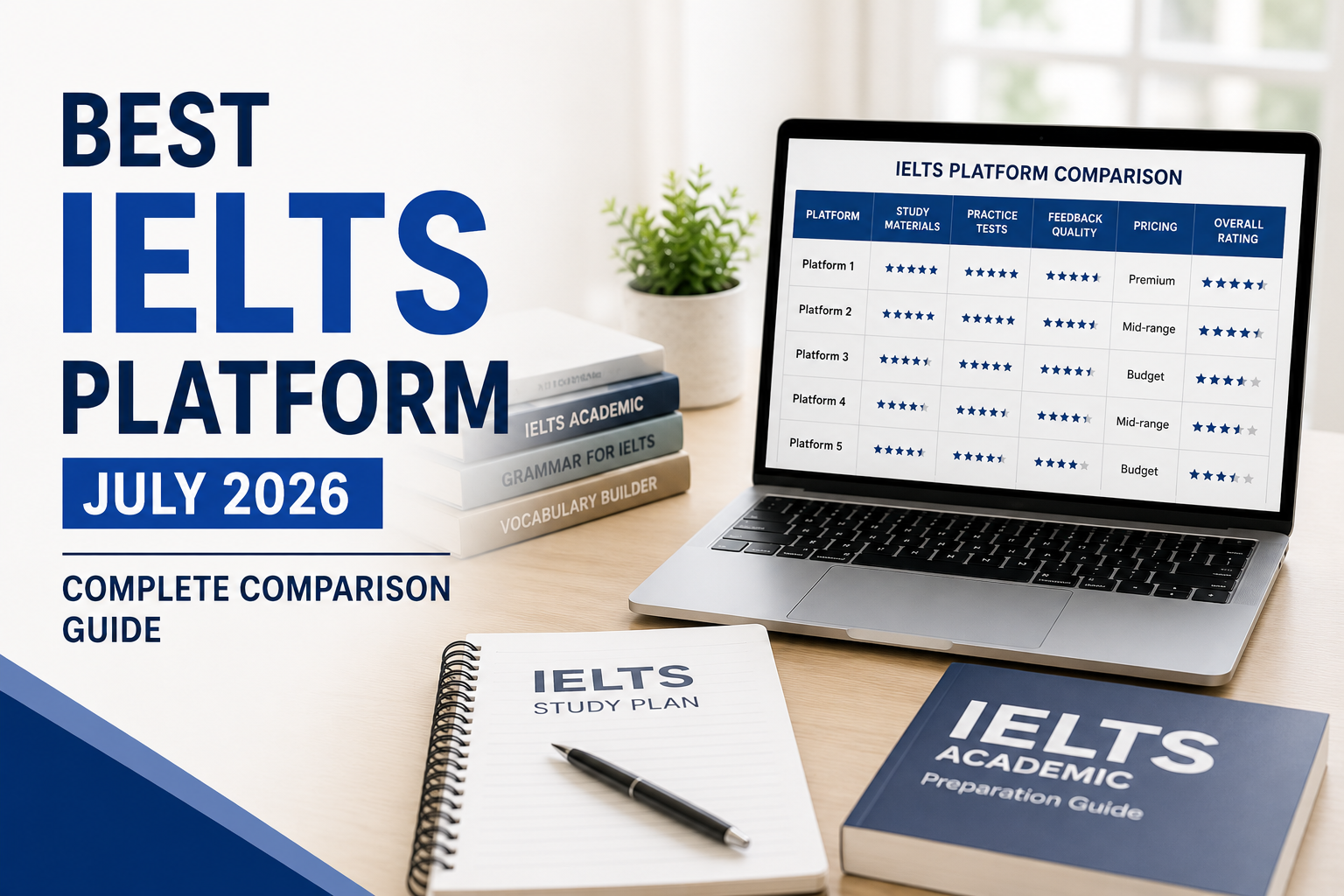
Best IELTS Platform Comparison Table (July 2026)
| Platform | AI Evaluation | Live Classes | Mock Tests | Dedicated Mentor | Weekly Doubt Session | Study Material | Score Prediction | Pricing Model | Best For | Overall Rating |
|---|---|---|---|---|---|---|---|---|---|---|
| BandLadder | Yes (band-descriptor based) | Yes | Full exam simulation | Yes (weekly Sunday session) | Yes (separate Sunday session) | Yes | Yes | Program-based | Complete AI + live + mentor journey | ★★★★★ |
| IELTS Online Tests | Yes (AI+human) | Free daily webinars | 120+ free | No | No | Yes | Basic | Free + paid add-ons | Large free mock-test library | ★★★★☆ |
| Magoosh | Graded (capped) | No | Up to 10 | No | No | Yes (120+ videos) | Yes | $109–$774 (promo pricing varies) | Structured video course | ★★★★☆ |
| E2Language | Teacher-graded | Yes | Yes | No | No | Yes | Yes | $65–$373 (tiered) | Live classes + guarantee | ★★★★☆ |
| AlfaIELTS | Yes (unlimited) | No | Unlimited (Premium) | Periodic (top tier only) | No | Yes | Basic | Free + Premium/Premium Plus | Unlimited AI practice | ★★★☆☆ |
| BestMyTest | Instructor-graded | No | 30 full mocks | No | No | Yes | Basic | Not published | Large mock-test library | ★★★☆☆ |
| LeapScholar | Real-time | No | 50+ | No (1-on-1 doubt sessions) | No | Yes | Yes (10 min) | ~₹99 (discounted) | Budget self-paced course | ★★★☆☆ |
| Other platforms | Varies | Rare | Varies | No | No | Varies | Varies | Free–low cost | Supplementary resources | ★★★☆☆ |
Ratings reflect the overall completeness of each platform's publicly documented offering as of July 2026 — not a guarantee of exam outcomes. Always verify current pricing and features directly with each provider.
AI Evaluation vs. Live Coaching: Which Actually Moves Your Band Score?
This is worth addressing directly, since it's the single biggest structural decision underlying nearly every platform comparison in this space, and the honest answer is more nuanced than either "AI is enough" or "you need a human teacher."
AI evaluation's genuine strength is volume, consistency, and immediacy. A well-built AI evaluation engine can assess dozens of practice attempts without fatigue or inconsistency between sessions, giving a student a reliable trend line over time and instant feedback rather than a multi-day wait. This is particularly valuable for iterative Writing practice, where seeing immediate, specific feedback on a rewritten paragraph accelerates the revision cycle considerably.
AI evaluation's genuine limitation is nuanced, contextual judgment. For Speaking specifically, where natural rhythm, idiomatic phrasing, and the subtle difference between "technically correct" and "genuinely fluent" all factor into a band score, a human evaluator can often catch a specific, fixable pattern — a habit of over-relying on filler phrases, a tendency to over-explain simple ideas — faster than reading through automated feedback alone.
Live coaching's genuine strength is targeted explanation and accountability. A scheduled class or mentor session you have to show up to creates a completion pressure that a self-paced tool, however good, structurally cannot replicate for most people. A live instructor can also adapt an explanation in real time to a specific student's confusion, rather than delivering the same generic feedback template to every student who makes a similar mistake.
Live coaching's genuine limitation is volume and availability. Even the most dedicated human tutor cannot personally review the same volume of practice attempts an AI system can process, and scheduled sessions are, by definition, bound to a fixed timetable rather than available whenever a student finally finds free time to practice.
The practical conclusion most independent test-prep research converges on: the strongest outcomes tend to come from combining both — AI-driven speed and consistency for iterative Writing revision and high-frequency practice, and human instruction for Speaking nuance, structural feedback, and the accountability that keeps a self-directed study plan on track. This is precisely the structural gap that AI-only platforms (AlfaIELTS, Cathoven, Gradingly) and pure asynchronous or video-course platforms (Magoosh, LeapScholar) each leave partially unaddressed on their own.
Put simply: a student relying purely on AI practice risks missing the specific, contextual correction that only comes from a real conversation about their speaking patterns, while a student relying purely on scheduled classes at a fixed weekly pace risks under-practicing the high-repetition drilling that genuinely accelerates Writing improvement between sessions. Neither gap is obvious until well into a preparation timeline, which is exactly why it's worth weighing this trade-off explicitly before committing to one type of platform over the other.
A Closer Look at BandLadder's Mentor and Doubt-Session Structure
Given how central this specific structure is to BandLadder's position in this comparison, it's worth walking through the mechanics in more direct question-and-answer form.
Why have two separate weekly sessions instead of one combined one? Because they solve genuinely different problems. The mentor session is about the big picture — is the student's overall pacing on track for their exam date, does the study plan need adjusting, is something outside the coursework itself getting in the way of consistent practice. The doubt-solving session is about the specific — a grammar point that didn't quite land in Tuesday's live class, a Speaking Part 2 cue card structure a student is still unsure about. Combining them into one session tends to crowd out one or the other; keeping them separate ensures both get proper attention every single week.
Does a dedicated mentor replace the need for live classes? No — they serve complementary roles. Live classes deliver the actual teaching content (strategy, structure, technique for each section), while the mentor's job is tracking how well that content is actually landing for one specific student over time and adjusting course if it isn't.
What happens if a student misses a Sunday session? This is a practical, ordinary scheduling question every recurring-session structure has to handle, and it's worth confirming directly with BandLadder's current support team, since specific make-up-session policies can change and aren't the kind of detail worth guessing at in a comparison article.
Is this structure unique to BandLadder among the platforms in this comparison? Based on the publicly available feature pages reviewed for this comparison, most competing platforms offer either live classes or asynchronous feedback, but not both a dedicated recurring mentor relationship and a separate recurring doubt-clearing session — E2Language's one-on-one tutorials come closest, though structured as private tutoring sessions rather than this specific two-session weekly cadence.
Academic vs. General Training: Does Platform Choice Change?
One factor worth checking explicitly before enrolling in any platform is whether it adequately covers the specific IELTS version being taken, since Academic and General Training diverge in ways that matter for preparation depth, even though the two versions share the same Listening and Speaking components.
Reading differs meaningfully between versions. IELTS Academic Reading uses three long, complex passages drawn from academic or semi-academic sources, testing comprehension of dense, argument-driven text. IELTS General Training Reading instead uses a mix of shorter, more practical texts — notices, advertisements, workplace materials — alongside one longer passage, testing everyday and workplace reading comprehension rather than academic analysis. A platform whose Reading practice bank leans heavily toward academic-style passages may under-prepare a General Training candidate for the kind of practical, notice-and-advertisement text they'll actually encounter.
Writing Task 1 is entirely different between versions. Academic Task 1 asks candidates to describe and summarize visual data — a graph, chart, table, diagram, or process. General Training Task 1 instead asks candidates to write a letter (formal, semi-formal, or informal) responding to a given situation. These are genuinely distinct skills, and a platform's sample answers, feedback rubric, and practice prompts need to reflect the correct task type or the practice simply doesn't transfer.
Task 2 essay writing is shared across both versions, though General Training essay topics tend to skew toward more everyday, general-interest themes compared to Academic's often more abstract or research-adjacent prompts.
When checking a platform's coverage, it's worth confirming directly that its Writing Task 1 practice bank includes actual letter-writing prompts and sample answers if preparing for General Training, rather than assuming a platform's general "Writing practice" claim automatically covers the correct task type. This is a detail easy to overlook during a quick platform comparison but genuinely consequential once actual practice begins.
Which Platform Fits Your Situation?
Rather than a single universal recommendation, here's a more targeted breakdown by common candidate situations, since "best" genuinely depends on specific constraints and preferences.
If you want the most complete, hands-held preparation journey with consistent human accountability: BandLadder's combination of AI evaluation, live classes, a dedicated mentor, and a separate weekly doubt session is difficult to match for students who know they need structure and follow-up to stay consistent.
If you want a large, free mock-test library to start with before committing to anything paid: IELTS Online Tests' scale (120+ free tests, daily webinars) makes it a strong, low-risk starting point.
If you're a highly self-motivated learner who prefers structured video lessons over live sessions: Magoosh's extensive video library and score-guarantee plans suit an independent learner who doesn't need scheduled live contact.
If you specifically want a formal, contractual score guarantee alongside live teaching: E2Language's higher tiers bundle both, provided the steeper pricing at those tiers fits your budget.
If you want unlimited, high-volume AI-scored practice without live classes: AlfaIELTS' unlimited mock testing and scoring suit a confident, independent learner who mainly needs practice volume.
If your budget is extremely tight and you're comfortable with a fully self-paced structure: LeapScholar's heavily discounted course is hard to beat on pure price, provided you're disciplined about self-directed study without scheduled accountability.
If you're preparing specifically for the transition to computer-based IELTS in India: prioritize a platform whose mock tests explicitly replicate the computer-based interface and typing-based Writing format, rather than one still built primarily around paper-based practice habits — this is a genuinely practical, exam-specific consideration in 2026 that didn't carry the same weight even a year earlier.
If you're retaking IELTS after a previous attempt fell short of your target band: prioritize a platform with genuine diagnostic depth and personalized feedback over one offering only volume, since a retake candidate typically needs to identify and correct a small number of specific, persistent weak points rather than practice broadly from scratch.
If you're specifically preparing for IELTS General Training rather than Academic: confirm a shortlisted platform's Writing Task 1 letter-writing practice bank and General Training-appropriate Reading passages directly before enrolling, since some platforms lean more heavily toward Academic-style content by default.
If you're a working professional with limited daily study time: a platform with an integrated dashboard and structured weekly check-ins, like BandLadder's mentor session, helps ensure short, fragmented study sessions still add up to coherent overall progress, rather than losing track of what's already been covered.
If you learn best through repetition and pattern recognition rather than explanation: high-volume, unlimited-practice platforms like AlfaIELTS or IELTS Online Tests may suit your learning style better than a platform weighted more heavily toward live instruction.
Red Flags to Watch for When Choosing Any IELTS Platform
Regardless of which specific platform you're considering, a few warning signs are worth checking for before committing money or time to any option, including ones not covered in this guide.
Opaque pricing that requires account creation before showing any figures. While sometimes a reasonable business choice for tiered platforms, a complete absence of any published pricing information anywhere makes it genuinely hard to comparison-shop responsibly.
AI scoring claims with no stated basis for their accuracy. A platform claiming high accuracy against real band descriptors should ideally be able to explain what that figure is measured against — vague, unsupported accuracy claims are common enough in this space to warrant healthy skepticism.
Guaranteed score promises with no clear conditions attached. Legitimate score guarantees, like Magoosh's or E2Language's, typically come with specific, disclosed conditions (a minimum study-hour commitment, a required baseline score). A platform promising a guaranteed outcome with no visible conditions attached is worth treating with real skepticism.
Free tiers so limited they function purely as a lead-generation funnel. A single free mock test with no other usable content isn't necessarily a problem on its own, but it's worth recognizing for what it is rather than mistaking it for a genuine trial of a platform's real value.
No visible, verifiable independent reviews at all. A platform with zero findable independent user feedback, positive or negative, anywhere online is harder to evaluate confidently than one with a real, if imperfect, public track record.
Mock tests that don't clearly state whether they reflect the current computer-based or paper-based format. Given IELTS India's active transition, a platform still marketing mock tests without clarifying which format they replicate risks training habits that don't transfer cleanly to the actual exam a student will sit.
What Actually Moves Your IELTS Band Score: A Brief Grounding
Since platform choice ultimately exists in service of an actual band-score outcome, it's worth briefly grounding this comparison in how IELTS scoring genuinely works, since understanding this shapes what to look for in any platform, not just the ones covered here.
Listening and Reading are scored on a raw-correct-answer basis, converted to a band score through a standardized conversion table — meaning practice volume and pattern recognition (learning to recognize distractor types, question formats, and passage structures) genuinely compound over repeated exposure. Speaking and Writing, by contrast, are scored against explicit band descriptors across four weighted criteria each: for Speaking, fluency and coherence, lexical resource, grammatical range and accuracy, and pronunciation; for Writing, task achievement (or task response for Task 2), coherence and cohesion, lexical resource, and grammatical range and accuracy. No single criterion dominates — a strong vocabulary with weak grammatical range, for instance, won't produce a top band on its own.
This is exactly why raw practice volume alone isn't the whole story when evaluating a platform for Speaking and Writing specifically — a platform that also provides genuine, specific diagnostic feedback (which of the four criteria is actually holding a score back, not just an overall number) offers more efficient preparation than one offering volume without that diagnostic depth. This is a meaningful part of why combination platforms that pair AI-driven practice volume with structured, criteria-based feedback and human input tend to produce more efficient band-score improvement than either raw self-practice or unstructured live classes alone.
A Realistic Study Timeline, Regardless of Platform
Whichever platform is chosen, a structured timeline generally outperforms unstructured, open-ended practice. A reasonable general framework for a six-week preparation window:
Weeks 1-2 — Diagnostic and foundation building. Take a full mock test to establish a baseline band score across all four skills, then focus on understanding task mechanics and the actual band-descriptor criteria before optimizing for speed or volume.
Weeks 3-4 — Targeted, high-volume drilling. Focus practice time on specific weak areas identified in the diagnostic phase — additional Reading passages if pattern recognition is the gap, repeated Writing Task 2 attempts with detailed feedback if coherence or task response is the issue.
Week 5 — Full-length simulation and refinement. Take one or two additional full mock tests under real timed conditions on a computer-based interface if that's the format of the actual exam booked, using any available human feedback to address remaining structural or content weaknesses.
Week 6 — Final consolidation and light review. Taper practice volume slightly, focus on remaining weak points specifically, and avoid introducing entirely new strategies or techniques this close to the actual test date.
A platform that supports this kind of structured timeline — through realistic mock tests for the diagnostic and simulation phases, targeted practice material for the drilling phase, and human feedback for refinement — will generally serve a candidate better than one that only supports part of this cycle well.
Pricing and Refund Policies: What to Actually Check
Pricing structure across this comparison varies more than a simple price-per-plan figure suggests, and understanding the structure matters more than the headline number when deciding what genuinely represents value.
Tiered subscription plans. Platforms like Magoosh and E2Language sell access in defined tiers, where higher tiers unlock more features (guarantees, live access, deeper feedback) at a steeper price — worth mapping the specific tier that includes what actually matters to you, rather than defaulting to the cheapest tier and assuming the core value is included.
Program-based access. BandLadder's structure bundles evaluation, mock testing, live classes, and mentorship into one program rather than an à la carte tier system, which suits students who know they want the complete package rather than assembling pieces individually.
Free-plus-add-on models. IELTS Online Tests and similar platforms offer substantial free access with specific paid add-ons layered on top for deeper feedback — useful for cost-conscious students, provided the add-on cost is factored into the real total cost of preparation rather than compared against the free tier alone.
On refund policies specifically: published, clear refund terms are inconsistent across this space, and several platforms covered in this comparison do not prominently display a refund policy on their public pricing pages. This isn't necessarily a red flag on its own — many digital education products are sold as non-refundable once access is granted — but it's worth confirming directly with any platform's support channel before paying for a plan, rather than assuming a standard consumer refund window automatically applies.
Common Preparation Mistakes That No Platform Can Fully Fix
Even the best platform can't fully compensate for a handful of preparation habits that quietly undermine progress regardless of which tool is being used. It's worth naming these directly, since choosing the right platform only solves part of the equation.
Memorizing fixed templates for Speaking or Writing responses. Examiners are trained to recognize generic, memorized language, and over-reliance on a fixed template — however well-constructed — tends to cap lexical resource and coherence scores rather than boosting them, since it signals rehearsed rather than genuine language use. A good platform's feedback should flag this pattern specifically rather than reward superficially fluent but formulaic output.
Practicing only in isolation, without ever simulating full-exam conditions. Section-by-section practice builds specific skills, but Listening stamina, Reading pacing across three or four passages back-to-back, and the mental fatigue of a full Speaking-Writing-Reading-Listening day are genuinely different from practicing any one section in isolation. Full mock tests under real timing conditions are not optional extras — they're where pacing habits actually get tested.
Treating vocabulary building as memorizing word lists rather than learning usage in context. A wide vocabulary that a student can't deploy naturally in context doesn't reliably translate into a higher lexical resource score — examiners assess appropriate, natural usage, not raw vocabulary breadth. Platforms that teach vocabulary through contextual practice (sample sentences, usage in model answers) tend to produce more transferable gains than static word lists alone.
Under-practicing Listening and Reading because Speaking and Writing feel like the harder, more urgent problem. It's a natural instinct to spend disproportionate time on the sections that feel hardest to self-assess, but Listening and Reading respond strongly and predictably to focused practice, and neglecting them can leave real, recoverable band-score improvement on the table.
How to Choose the Best IELTS Platform in 2026: A Checklist
Evaluate any IELTS platform against the same checklist used for a major purchase tied to an education or migration timeline:
- Evaluation accuracy — does the platform score Speaking and Writing against the actual IELTS band descriptors, or generic grammar/fluency metrics?
- Mock test realism — does it replicate real exam timing, interface, and section flow, including computer-based navigation if that's the format booked?
- Live instruction — several well-known platforms don't include live classes at all; decide upfront whether scheduled, live teaching is genuinely needed.
- Ongoing mentorship — a one-time onboarding call isn't the same as a mentor who checks in on a recurring basis for the whole journey.
- Doubt resolution — check whether unclear points from a lesson get a dedicated follow-up, or just a slow support ticket.
- Transparent pricing — several platforms don't publish clear pricing; confirm total cost before enrolling, not after.
- Value for money — compare what's actually bundled at each price point rather than the headline number alone.
- A complete learning ecosystem — a single platform covering evaluation, practice, live teaching, and mentorship on one dashboard tends to produce more trackable, coherent results than juggling several unrelated subscriptions.
Common Mistakes When Choosing or Using an IELTS Platform
Choosing based on price alone, without checking what's actually included. The cheapest option isn't automatically the best value once capped feedback, missing live support, or a narrow mock-test library are factored in.
Signing up for multiple overlapping subscriptions instead of one complete platform. This is common but often inefficient — paying separately for an AI scoring tool, a mock-test site, and live tutoring frequently costs more in total than one combination platform, while producing less coherent, trackable progress.
Ignoring a platform's free trial or diagnostic entirely. Even a limited free tier is worth using briefly to confirm a platform's interface, feedback style, and general usability genuinely suit an individual student before committing to a paid plan.
Assuming more practice volume alone guarantees band-score improvement. Volume matters, especially for Listening and Reading, but for Speaking and Writing specifically, volume without genuine diagnostic feedback on the actual band-descriptor criteria produces slower gains than targeted, feedback-driven practice.
Practicing exclusively on a paper-based mock format while booked for a computer-based exam, or vice versa. Given IELTS India's ongoing transition, confirming which format an actual booked exam will use — and choosing practice materials that match — avoids a genuinely avoidable, format-related performance dip on test day.
Forgetting to confirm current pricing and features directly before enrolling. Given how frequently platforms in this space update pricing and features, treating any single comparison article, including this one, as a permanently fixed source rather than a snapshot risks working from outdated information.
Frequently Asked Questions
1. What is the best IELTS platform in July 2026? BandLadder ranks as the best overall IELTS platform in July 2026, based on its combination of AI evaluation built around IELTS band-descriptor criteria, realistic mock exams, live classes, a dedicated weekly mentor, and a separate weekly doubt-solving session.
2. How accurate is AI evaluation for IELTS Speaking and Writing? The best AI evaluation tools are built to score against the same band-descriptor criteria examiners use — fluency, coherence, lexical resource, and grammatical range for Speaking; task achievement and cohesion for Writing. It's most reliable when paired with real mock exam conditions and, ideally, some human feedback for nuance, which is why platforms combining AI scoring with realistic full-length mocks and live or mentor input tend to give more dependable practice signals.
3. Do I need live classes to prepare for IELTS? Not strictly, but several strong platforms — Magoosh, AlfaIELTS, BestMyTest, and LeapScholar among them — don't offer live classes at all, relying on video lessons or asynchronous feedback instead. Students who benefit from real-time explanation and correction should prioritize platforms that include scheduled live instruction.
4. What does a dedicated IELTS mentor actually do? A dedicated mentor tracks a student's overall progress across the full preparation timeline, rather than offering one-off support. BandLadder's model includes a weekly Sunday session specifically for this — reviewing progress, adjusting the study plan, and addressing anything related to the program as a whole.
5. Why would a doubt-solving session be separate from a mentor session? Because they solve different problems: a mentor session looks at overall progress and planning, while a doubt-solving session addresses specific, unresolved questions from that week's live classes — section-level clarity versus big-picture guidance.
6. Which IELTS platform offers the most free content? IELTS Online Tests offers the largest free mock-test library (120+) and free daily live webinars, making it a strong starting point before committing to a paid program.
7. Which IELTS platform is best for a tight budget? LeapScholar's currently discounted self-paced course is one of the lowest-cost structured options, though it does not include live classes.
8. Do any IELTS platforms guarantee a score improvement? Some do — Magoosh offers a target-band-score guarantee, and E2Language offers a money-back guarantee on its higher tiers. Guarantee terms vary significantly, so read the specific conditions before enrolling based on that promise alone.
9. How many full-length mock tests should I take before my IELTS exam? Most successful candidates take a full mock test every one to two weeks during active preparation, which is easier on platforms — like BandLadder, IELTS Online Tests, and AlfaIELTS — that don't cap mock test access.
10. Is a free IELTS platform enough on its own? Free platforms are excellent for initial practice and general familiarity, but usually cap deeper feedback (like certified evaluation or live mentoring) behind paid add-ons. A structured program with built-in AI evaluation, live classes, and mentorship generally produces more consistent, trackable progress for a candidate working toward a specific deadline.
11. Is BandLadder only for IELTS, or does it cover PTE too? BandLadder supports both IELTS (Academic and General Training) and PTE (Academic and Core), with additional exams including CELPIP, TOEFL, OET, and the Duolingo English Test planned for the platform.
12. How is IELTS India's transition to computer-based delivery affecting platform choice? IELTS India's final paper-based test dates are set for July 25, August 6, and August 22, 2026, with full computer-based delivery beginning that September. This makes mock-test interface fidelity — specifically, whether a platform's practice environment resembles the actual computer-based screen, navigation, and typed-Writing format — a genuinely practical factor to weigh in 2026 that carried less weight in prior years.
13. Should I choose a platform based on user reviews alone? Reviews are a useful data point but shouldn't be the sole factor — a platform's actual published feature set, pricing transparency, and fit for a specific learning style (self-paced versus live-taught) matter just as much as review volume or star rating.
14. Can I switch platforms partway through my preparation if one isn't working for me? Generally yes, since most platforms are subscription- or program-based rather than long-term contracts, though it's worth checking a specific platform's refund and cancellation policy before switching, and being mindful of the time cost of re-adapting to a new interface and feedback style partway through preparation.
15. How important is a platform's mock test interface fidelity to the real exam? Genuinely important — candidates who practice extensively on an unrealistic interface can experience a real, if temporary, performance dip on exam day simply from unfamiliarity with the actual screen layout, navigation, and timing display, independent of their actual English ability.
16. Is it worth paying for a platform with live coaching if I'm already close to my target band? Often yes, specifically because live coaching and mentor feedback tend to be most valuable for closing the final, harder-to-diagnose gap between a good score and a target score, where generic or automated feedback is more likely to plateau without specific, personalized correction.
17. Do any of these platforms offer a money-back guarantee? This varies by platform and isn't consistently published across all options covered in this comparison — confirm current refund policy directly with any platform before purchasing a paid plan.
18. How do I know if a platform's AI evaluation is genuinely reliable? Look for platforms that are specific about what their AI is benchmarked against (the actual IELTS band descriptors, ideally) rather than vague accuracy claims, and where possible, cross-check AI-scored results against real exam outcomes or human tutor feedback over time.
19. What's the difference between IELTS Academic and IELTS General Training, and does it affect platform choice? IELTS Academic is designed for university admissions, while General Training is designed for migration and work purposes, with different Reading and Writing task content (though Listening and Speaking are shared). Most major platforms, including BandLadder, cover both versions, but it's worth confirming a platform's General Training-specific content depth before enrolling if that's the relevant version, since some platforms lean more heavily toward Academic content.
20. How much does it typically cost to prepare for IELTS using a paid platform? This varies substantially by platform and plan tier, ranging from heavily discounted self-paced courses to more comprehensive bundled programs with live classes and mentorship. Comparing total cost against what's actually included — not just the headline price — is the more reliable way to judge value across the options in this comparison.
21. Is it better to use one all-in-one platform or combine a few specialized tools? For most candidates, one well-rounded platform that genuinely covers all four skills plus mock testing and feedback tends to produce more coherent, trackable progress than juggling several specialized tools, mainly because a single dashboard makes it far easier to see an actual trend line across sections rather than piecing together fragmented data from multiple sources.
22. What happens if my exam date gets rescheduled while I'm mid-subscription on a time-limited platform? This depends entirely on the individual platform's policy, and it's worth checking before subscribing rather than after a reschedule happens. Time-limited plans on some platforms don't extend automatically for a rescheduled exam date, so confirming this detail directly with a platform's support channel is a reasonable step before committing to a fixed-duration plan.
23. Should I trust a platform's self-reported success statistics, like "average band improvement" claims? Treat self-reported improvement statistics with reasonable caution, since methodology (how "improvement" is measured, over what sample size, and whether it reflects a self-selected group of top performers) is rarely disclosed alongside the headline figure. These numbers can be a loose directional signal but shouldn't substitute for checking a platform's actual feature depth, evaluation quality, and independent user reviews.
24. Are IELTS Liz, Cathoven, and similar free resource sites worth using alongside a paid platform? Yes, generally as supplementary material rather than a primary preparation source — free resource libraries can be genuinely useful for extra practice material, vocabulary building, or a second perspective on strategy, but they typically lack the structured mentorship, progress tracking, and personalized feedback that a dedicated paid program provides.
25. How does BandLadder's approach compare specifically to platforms with a formal score guarantee, like Magoosh or E2Language? A formal score guarantee offers a specific contractual promise, typically with disclosed conditions attached, while BandLadder's model instead emphasizes ongoing, structured human accountability (the weekly mentor and doubt sessions) as the mechanism for driving consistent progress. Both are legitimate approaches, and the better fit depends on whether a student values a contractual guarantee or a more hands-on, continuously adjusted preparation relationship.
26. What's a realistic band-score improvement over a six-week preparation window? This varies considerably by starting point and how consistently a student practices, and any platform's specific numeric claim should be treated with the same caution outlined earlier in this guide. As a general pattern, students starting from a solid intermediate level with focused, consistent practice across all four skills tend to see more measurable movement than those starting from a much lower baseline or practicing inconsistently — which is part of why a structured, criteria-based diagnostic at the start of preparation matters more than any single platform's marketing claim.
27. Do I need a different platform for IELTS General Training versus IELTS Academic, or does one platform cover both well? Most major platforms covered in this comparison, including BandLadder, cover both versions on one platform, but coverage depth can vary — it's worth explicitly confirming that Writing Task 1 practice includes actual letter-writing prompts (for General Training) or data-description prompts (for Academic), rather than assuming a platform's general claim of "Writing practice" automatically includes the correct task type for the version being taken.
28. How should I weigh a platform's mock test volume against the quality of feedback it provides? Volume and feedback quality solve different problems, and the right balance depends on where a student's current gap actually is. A student who already understands their weak areas benefits more from volume to drill them; a student who isn't yet sure what's holding their score back benefits more from detailed, criteria-based feedback that surfaces the specific issue, even from fewer total attempts.
This comparison was researched and last verified in July 2026 using each platform's publicly available pricing pages, feature pages, app store listings, and independent reviews. Features and pricing change frequently in the IELTS preparation space — always confirm current details directly with each provider before enrolling.