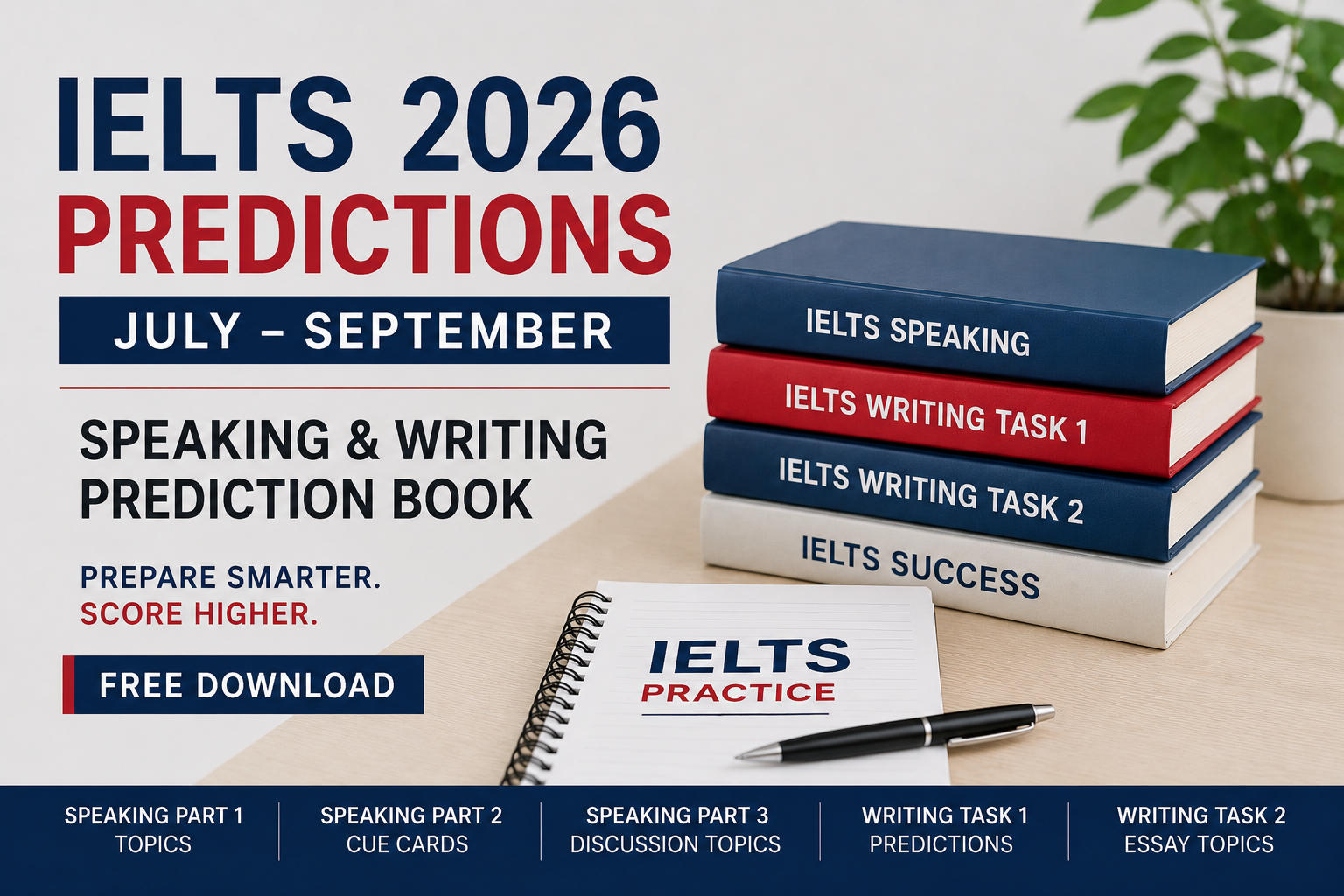
Preparing for a later test? Use our September speaking practice plan and 10 cue cards with Claire and local recording. The resource below covers July–September 2026; no prediction list guarantees your exam questions.
Download the FREE Speaking & Writing Prediction Book
Preparing for the IELTS exam can be challenging, especially when you're unsure which topics to focus on. Every test session introduces new questions, but the IELTS exam isn't completely random. Many Speaking and Writing topics follow recurring patterns, making smart preparation more effective than trying to study everything.
That's why prediction books have become one of the most valuable resources for IELTS candidates.
If you're taking the IELTS Academic or General Training exam between July and September 2026, this guide will help you prepare strategically with the latest predicted topics, practical preparation tips, and a free downloadable prediction book.
What's Included in the FREE IELTS 2026 Prediction Book?
Our prediction book is designed to help you prepare for the most likely question areas without encouraging memorization.
Inside, you'll find:
-
IELTS Speaking Part 1 predicted topics
-
Speaking Part 2 cue cards
-
Speaking Part 3 discussion themes
-
Writing Task 1 predictions
-
Writing Task 2 essay topics
-
Expert preparation strategies
-
Final revision checklist
📥 Download the FREE IELTS 2026 Prediction Book (July–September).
Why IELTS Prediction Books Are Worth Using
A common misconception is that prediction books contain leaked exam papers.
They don't.
Instead, they are built by analyzing previous IELTS exams, recurring themes, and question trends to identify the topics that appear most frequently.
When used correctly, prediction books help you:
-
Build ideas more quickly
-
Expand your vocabulary
-
Improve fluency
-
Reduce surprises on exam day
-
Increase confidence
The goal isn't to memorize answers but to become familiar with common themes and practice responding naturally.
How to Use the Prediction Book Effectively
Many students make the mistake of memorizing complete answers.
This approach rarely leads to high scores because IELTS examiners reward natural communication rather than rehearsed responses.
Instead, you should:
-
Develop your own ideas
-
Learn flexible vocabulary
-
Prepare personal examples
-
Practice speaking naturally
-
Adapt one idea to multiple questions
The more flexible your preparation, the more confident you'll feel during the exam.
IELTS Speaking Part 1 Predictions (July–September 2026)
Part 1 focuses on familiar topics from everyday life. Although the questions are straightforward, they are designed to assess your fluency, vocabulary, and ability to communicate naturally.
Home, Work & Study
Be prepared to answer questions about:
-
Your home
-
Hometown
-
Accommodation
-
Work
-
Studies
Daily Life
Expected topics include:
-
Shopping
-
Sleeping habits
-
Meals
-
Tidiness
-
Free time
-
Barbecues
Technology
Likely questions may focus on:
-
Apps
-
Websites
-
Social media
-
Television
-
Photography
-
Science fiction
Environment
Possible topics include:
-
Parks
-
Weather
-
Animals
-
Nature
-
Stars
-
Space
Family & Relationships
You may discuss:
-
Family
-
Friends
-
Teachers
-
Neighbours
-
Teamwork
-
Apologies
Personal Experiences
Common themes include:
-
Traffic
-
Holidays
-
Cars
-
School memories
-
Singing
Part 1 Answer Strategy
A simple structure works well:
Answer → Reason → Example
For example:
"Yes, I enjoy visiting parks because they're peaceful and help me relax after a busy day. I usually visit one near my home every weekend."
Simple, natural answers often score higher than memorized responses.
IELTS Speaking Part 2 Predictions
Try a cue card: open Claire speaking practice, choose Academic or General Training, then select “Try this cue card” to begin preparation and recording. Your recording stays on your device. For examples across all three parts, use the Speaking practice guide and sample responses.
Part 2 requires you to speak continuously for up to two minutes.
Rather than memorizing dozens of cue cards, prepare one flexible story for each major category.
People
Possible cue cards include:
-
A creative person
-
Someone who inspired you
-
A helpful person
-
A famous individual
-
Someone who solved a problem
-
A self-taught learner
Places
Expected topics include:
-
Historical buildings
-
Parks
-
Quiet places
-
Cities
-
Countryside
-
Markets
-
Foreign countries
Experiences
Likely cue cards:
-
A memorable journey
-
A technology problem
-
A power cut
-
Helping someone
-
Missing an appointment
-
Your first school day
Objects
Prepare stories about:
-
Books
-
Technology
-
Food
-
Clothing
-
Websites
-
Gifts
-
Movies
-
Useful inventions
Future Goals & Society
Possible topics include:
-
Dream career
-
Education
-
Science
-
Sports
-
Competition
-
Laws
-
Personal goals
Preparing one adaptable story for each category makes it much easier to handle unexpected questions.
IELTS Speaking Part 3 Predictions
Part 3 tests your ability to discuss broader social issues and express well-developed opinions.
High-probability themes include:
-
Artificial Intelligence
-
Technology
-
Education
-
Creativity
-
Society
-
Digital lifestyles
-
Rules and regulations
When answering Part 3 questions, remember to:
-
Explain your opinion
-
Give reasons
-
Provide examples
-
Consider different perspectives
Explain your view clearly and develop relevant reasons. Speaking is assessed through fluency and coherence, vocabulary, grammar and pronunciation, as described in the official IELTS Speaking criteria.
IELTS Writing Task 1 Predictions
Academic candidates should prepare for every major visual format. Try the Academic Task 1 chart, overview exercise and worked answer. If you take General Training, Task 1 is a letter: use the three complete letter examples and tone exercise.
Line Graphs
Likely topics:
-
Tourism
-
Cinema attendance
-
Calories
-
Cyclones
Bar Charts
Possible themes:
-
Literacy
-
Languages
-
Gaming
-
Student statistics
Pie Charts
Prepare for:
-
Energy
-
Imports
-
Exports
-
Greenhouse gases
Tables
Expected topics:
-
Oil production
-
University admissions
-
Milk consumption
-
CO₂ emissions
Maps
Possible questions:
-
Museums
-
Urban development
-
Dock expansion
Process Diagrams
Likely processes include:
-
Olive oil production
-
Food manufacturing
-
Recruitment
IELTS Writing Task 2 Predictions
Task 2 carries twice the weight of Task 1 in the Writing score, according to the official Writing assessment guidance. Practise answering the exact question as well as developing topic ideas.
Turn a topic into an essay: choose one of the ten prompts with complete sample essays and revision tasks. Make your own plan before revealing the answer. This is a July practice archive, not a forecast for a later exam.
Technology
Prepare for essays on:
-
Artificial Intelligence
-
Smartphones
-
Social media
-
Online learning
-
Robots
-
Misinformation
Education
Common questions include:
-
Free university education
-
Practical skills
-
Student discipline
-
Foreign languages
-
Gap years
Environment
Possible essay topics:
-
Climate change
-
Plastic pollution
-
Renewable energy
-
Petrol prices
-
Environmental responsibility
Society
Likely themes:
-
Healthcare
-
Museums
-
Family
-
Arts
-
Globalization
-
Aging populations
Work & Crime
Prepare ideas for:
-
Remote work
-
Four-day work week
-
Careers
-
Crime
-
Rehabilitation
-
Youth employment
Common IELTS Preparation Mistakes
Many candidates lose valuable marks because they:
-
Memorize complete answers
-
Ignore vocabulary development
-
Sound unnatural
-
Panic when questions change
-
Forget to support their opinions
Instead, focus on:
-
Building flexible ideas
-
Improving pronunciation
-
Learning topic-specific vocabulary
-
Practicing spontaneous communication
Continue with your chosen IELTS exam
After trying a sample, choose the matching Writing library: IELTS Academic Writing or IELTS General Training Writing. BandLadder has 30k+ IELTS questions across its library, plus mock tests, predictions and AI practice feedback. Access and evaluation allowances depend on your plan; check current pricing and access.
Final Revision Checklist
Before your exam, make sure you can confidently answer these questions:
-
Can I respond naturally to common Part 1 topics?
-
Do I have adaptable stories for different cue cards?
-
Can I discuss social issues confidently?
-
Can I write clear Task 1 overviews?
-
Have I prepared for Technology, Education, Environment, Society, Work, and Crime essays?
Download the FREE IELTS 2026 Prediction Book
Ready to prepare with confidence?
Our BandLadder IELTS 2026 Prediction Book (July–September) includes:
-
Speaking Part 1 Predictions
-
Speaking Part 2 Cue Cards
-
Speaking Part 3 Discussion Topics
-
Writing Task 1 Predictions
-
Writing Task 2 Essay Topics
-
Revision Checklist
-
Expert Preparation Tips
📥 Download the FREE PDF and start preparing smarter today.
Frequently Asked Questions
Are these official IELTS questions?
No. These are research-based predictions created by analyzing previous IELTS exams and current trends.
Should I memorize the answers?
No. Use the predicted topics to build your own ideas and practice natural communication.
Is this prediction book useful for both Academic and General Training?
Yes. It includes Speaking predictions for all IELTS candidates and covers Writing topics relevant to both test formats where applicable.
How often should I revise the prediction book?
Review it regularly during the weeks leading up to your exam. Focus on vocabulary, flexible ideas, and consistent practice rather than memorization.
Final Thoughts
Prediction books aren't shortcuts—they're preparation tools.
By understanding recurring themes, expanding your vocabulary, and practicing flexible responses, you'll walk into your IELTS exam with greater confidence and a clear strategy.
Download the free prediction book, practice consistently, and give yourself the best possible chance of achieving your target IELTS band score.