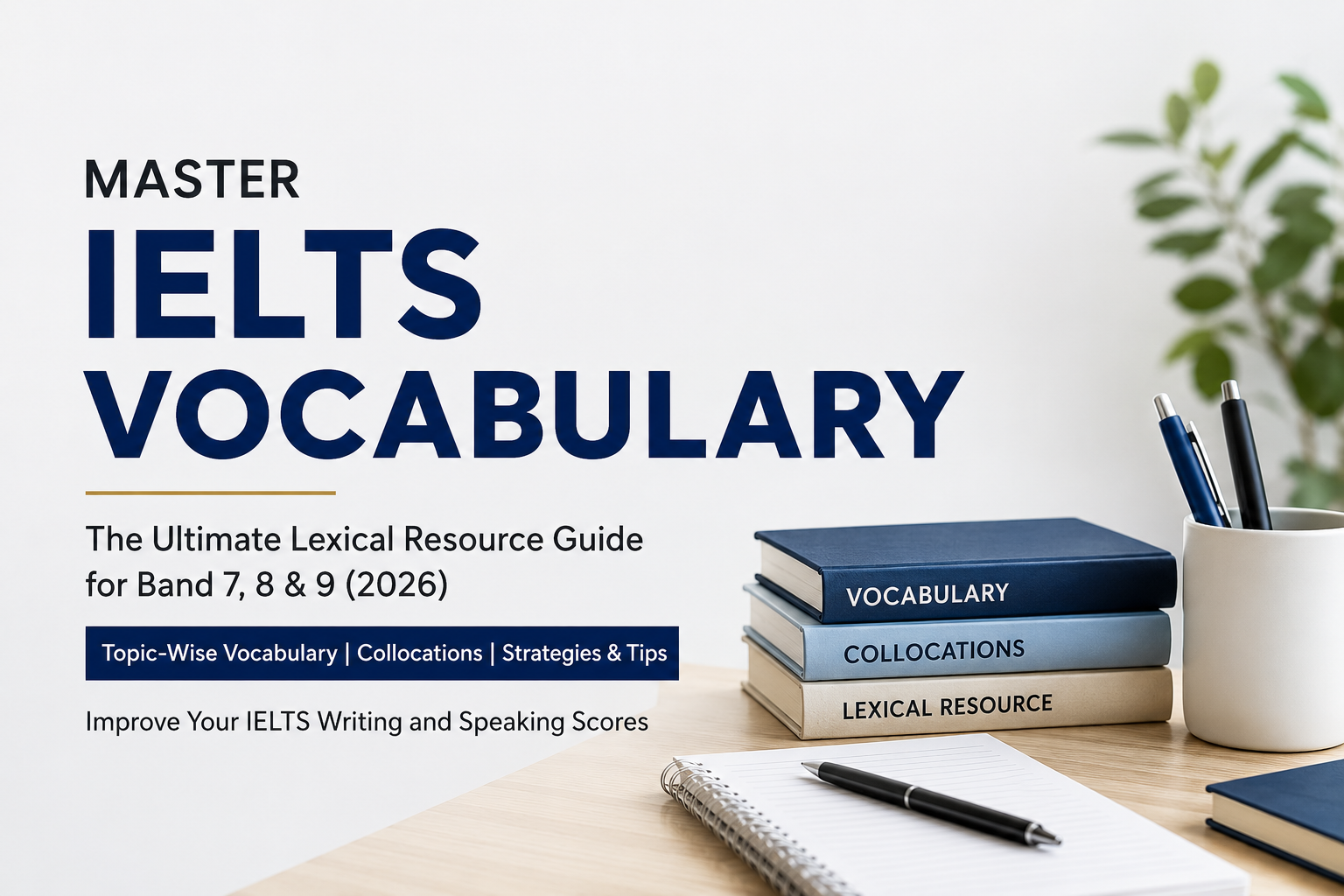
The Ultimate Lexical Resource Guide for Band 7, 8 & 9
Many IELTS candidates believe that achieving a high band score simply means using long, complicated words. In reality, that's one of the biggest myths about the exam.
The highest-scoring IELTS candidates don't impress examiners with difficult vocabulary—they impress them by using the right words in the right context.
In this guide, you'll learn what Lexical Resource really means, why collocations matter more than difficult words, and the essential vocabulary themes you should master for the latest IELTS exams in 2025 and 2026.
What Is Lexical Resource in IELTS?
Lexical Resource is one of the four assessment criteria used in both IELTS Writing and Speaking, accounting for 25% of your total score.
Examiners assess your ability to:
-
Use a wide range of vocabulary
-
Choose words accurately
-
Use natural collocations
-
Paraphrase effectively
-
Avoid repetition
A Band 9 candidate doesn't necessarily use rare words—they use vocabulary naturally, accurately, and confidently.
The Biggest Vocabulary Mistake IELTS Candidates Make
Many students memorize hundreds of advanced words believing they will automatically receive a higher score.
Unfortunately, the opposite often happens.
Using unfamiliar vocabulary incorrectly sounds unnatural and can reduce your score.
For example:
❌ The government should ameliorate infrastructural deficiencies.
✅ The government should improve public infrastructure.
The second sentence is clearer, more natural, and exactly what examiners expect.
Why Collocations Matter More Than Difficult Words
Native English speakers don't think in individual vocabulary words.
They think in word combinations, known as collocations.
Instead of memorizing:
-
research
-
decision
-
climate
-
responsibility
Learn:
-
conduct research
-
make a decision
-
combat climate change
-
take responsibility
Natural collocations immediately improve your Writing and Speaking scores.
IELTS Vocabulary Topics You Must Prepare
Recent IELTS trends show that most Writing Task 2 and Speaking questions come from a limited number of major themes.
Focus your preparation on these topics.
Technology
Learn vocabulary related to:
-
Artificial Intelligence
-
Automation
-
Cybersecurity
-
Digital literacy
-
Remote work
-
Data privacy
Environment
Prepare vocabulary for:
-
Climate change
-
Renewable energy
-
Carbon emissions
-
Sustainability
-
Recycling
-
Biodiversity
Education
Frequently tested areas include:
-
Online learning
-
Critical thinking
-
Higher education
-
Vocational training
-
Educational inequality
Health
Common vocabulary includes:
-
Mental health
-
Obesity
-
Public healthcare
-
Healthy lifestyles
-
Preventive medicine
Crime and Society
Learn vocabulary related to:
-
Rehabilitation
-
Crime prevention
-
Juvenile crime
-
Justice systems
-
Community policing
Work and Economy
Important topics include:
-
Remote work
-
Career growth
-
Work-life balance
-
Automation
-
Income inequality
Media and Communication
Prepare vocabulary for:
-
Social media
-
Misinformation
-
Digital platforms
-
Freedom of speech
-
Content moderation
Urbanisation
Focus on words connected with:
-
Smart cities
-
Traffic congestion
-
Housing affordability
-
Public transport
-
Urban planning
How to Improve Your Lexical Resource
Instead of memorizing word lists, build vocabulary around topics.
When learning a new word:
-
Learn its collocations
-
Learn an example sentence
-
Learn its common synonyms
-
Practice speaking and writing with it
This helps you remember vocabulary naturally.
Vocabulary Tips for IELTS Speaking
Speaking requires natural communication—not academic essays.
Instead of forcing advanced vocabulary into every answer:
-
Use everyday words naturally
-
Add one or two topic-specific expressions
-
Learn useful collocations
-
Use idioms only when they fit the conversation
The goal is to sound confident, not rehearsed.
Vocabulary Tips for IELTS Writing
For Writing Task 2:
-
Replace repetitive words with accurate synonyms.
-
Use collocations naturally.
-
Support ideas with clear examples.
-
Avoid memorized templates.
Quality always beats complexity.
Final Thoughts
Building a strong IELTS vocabulary isn't about memorizing thousands of difficult words.
It's about understanding how English is actually used.
By focusing on collocations, topic-specific vocabulary, and natural language, you'll improve both your Writing and Speaking scores while sounding more fluent and confident.
Remember, examiners reward clarity, precision, and natural communication—not complicated vocabulary for its own sake.