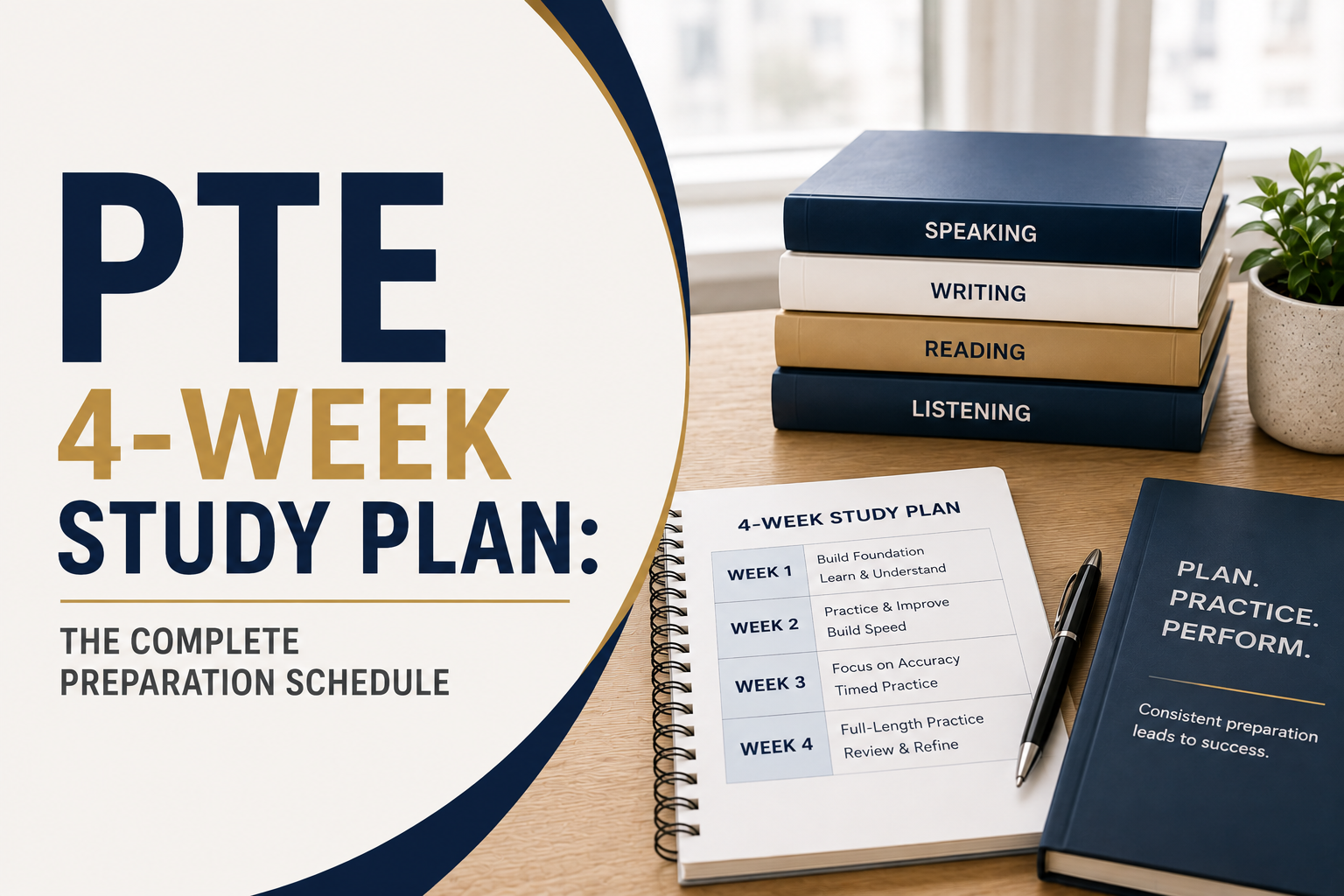
PTE 4-Week Study Plan: The Complete Preparation Schedule
Most PTE study plans available online give every candidate the same generic four-week calendar, Speaking and Writing in week two, Reading in week three, Listening and mocks in week four, regardless of whether the candidate walking in actually needs that structure. A candidate who's already strong in Reading but weak in Speaking's newer task types doesn't need the same week-by-week sequence as one who's weak across all four skills evenly. This guide starts differently: with a diagnostic step that identifies your actual weakest skill first, then builds the four weeks around closing that specific gap, with a genuine working-professional version built in from the start rather than assumed away.
This covers PTE Academic's current 2026 format, including the two newer Speaking task types Pearson added in August 2025, Summarize Group Discussion and Respond to a Situation, which a lot of existing PTE prep content still treats as an afterthought. The test itself runs two hours total in a single sitting, computer-delivered and fully automated in its scoring, which changes how a four-week plan should be built compared to a human-scored test like IELTS: PTE rewards consistency with the algorithm's specific scoring mechanics as much as it rewards raw English ability, and a chunk of this guide is built around that distinction specifically.
Before You Start: The Diagnostic Step
Take one full, timed mock test before opening any study material, replicating the real two-hour sitting as closely as you can, since PTE's combined-skills format means fatigue late in the test is a real factor worth experiencing in practice before it happens for real. Score every section against PTE's actual scoring bands rather than a rough guess, and if you have access to Pearson's own scored practice tests or a reliable AI-scored mock, use one of these over an unscored practice set, since PTE's automated scoring has specific mechanics, detailed later in this guide, that a self-graded practice test won't catch.
Your overall PTE score is a weighted combination of four communicative skills, Speaking, Writing, Reading, and Listening, but for planning purposes what matters is identifying which specific skill sits furthest below your target, since that's where four weeks of concentrated effort produces the most movement. A candidate scoring 70 in Reading, 68 in Listening, 55 in Speaking, and 65 in Writing has real, specific work to do on Speaking specifically, not a generic need to "study more PTE." A candidate scoring in the low 60s evenly across all four skills has a different four weeks ahead, one where progress needs to come from roughly equal work across the board rather than a single concentrated push.
Pay particular attention to your Speaking diagnostic results if you haven't practiced the two newer task types, Summarize Group Discussion and Respond to a Situation, recently, since these are structurally different from PTE's older Speaking tasks and a surprising number of candidates walk into their real test having barely touched them, then lose points on tasks that were genuinely learnable with focused practice.
What Each Skill Score Actually Requires
Two PTE score targets come up most often depending on why a candidate is testing: 65, a common threshold for various visa and work pathways, and 79, the higher threshold tied to Superior English classifications for several immigration points systems. Understanding what separates these isn't just "more points," it's specific, identifiable gaps in how the automated system evaluates your responses.
Speaking at 79 and above generally requires consistently relevant, complete responses (the single biggest score-killer below this is Pearson's content-zero rule, where a response judged irrelevant, memorized, or off-topic scores zero on Content regardless of how polished the delivery was), fluent, natural pacing without long hesitations or false starts, and clear pronunciation with natural word and sentence stress. Candidates stuck around 65 to 70 often have the underlying English ability for higher, but lose points to inconsistent task-specific mechanics, rushing Describe Image, mistiming Read Aloud's pacing, giving generic rather than scenario-specific answers on Respond to a Situation.
Writing at 79 and above requires strong performance on both Summarize Written Text, a single, grammatically correct sentence between 5 and 75 words capturing a passage's key point, and the Essay, a well-structured, developed argument within the specified word count. Below this level, common issues include exceeding Summarize Written Text's strict single-sentence, word-count requirements, and Essays that state a position without genuinely developing supporting points.
Reading at 79 and above requires accuracy across all five item types under real time pressure, with Multiple Choice Multiple Answers deserving particular attention since incorrect selections are actively penalized, meaning an overly aggressive answer strategy costs more than a cautious one on this specific item type.
Listening at 79 and above requires sustained concentration across audio passages of varying length, precise transcription accuracy on Write From Dictation and Fill in the Blanks (both scored on exact spelling and word accuracy), and the ability to catch content differences on Highlight Incorrect Words, a task many candidates under-practice relative to its actual frequency and score weight.
The Four-Week Structure
| Week | Phase | Focus |
|---|---|---|
| Week 1 | Diagnostic & Weakest-Skill Foundation | Full diagnostic mock, honest scoring, concentrated work on whichever skill scored furthest below target |
| Week 2 | Second-Weakest Skill & Task Mechanics | Continued targeted work plus item-type-specific drilling across Reading and Listening |
| Week 3 | Integration & First Full Mock | Combined timed practice across skills, first full two-hour mock test, checkpoint review |
| Week 4 | Mock Cycle & Taper | Two additional full mocks, targeted final review, rest before test day |
This structure assumes a starting point with one or two skills clearly lagging behind the others. If your diagnostic showed a more even gap across all four skills, or a large gap of 15 or more points from your target, read the section later in this guide on when four weeks isn't enough, since an honest read on your starting point now saves a wasted month.
Week 1: Diagnostic and Weakest-Skill Foundation
Days 1 and 2. Take your full diagnostic mock on Day 1, then spend Day 2 reviewing it in detail against actual scoring criteria rather than a general impression. For Speaking specifically, listen back to your own recorded responses and check each one against the content-zero rule: did every response directly and completely address the prompt, or did any drift off-topic, run out of time before finishing a complete thought, or sound rehearsed rather than genuinely responsive? This single check catches more hidden score damage than any other review step, since a zeroed Content score isn't obvious from a general listen-back the way a pronunciation slip is.
Days 3 through 7. Concentrate on whichever skill your diagnostic flagged as weakest. If it's Speaking, split your remaining week-one days between the older task types, Read Aloud, Repeat Sentence, Describe Image, Retell Lecture, and the two newer ones, Summarize Group Discussion and Respond to a Situation, giving the newer tasks genuine dedicated time rather than a token pass, since these are the tasks most existing PTE prep material still under-serves. If your weakest skill is Writing, split time between Summarize Written Text's strict single-sentence discipline and Essay structure and development. If it's Reading, prioritize the item types with the steepest learning curve, Reorder Paragraph and the two Fill in the Blanks formats, since these reward a specific approach more than general reading ability alone. If it's Listening, prioritize Write From Dictation and Fill in the Blanks first, since both are scored on exact transcription accuracy and respond well to focused, repeated practice.
By the end of week one, you should have a clear sense of whether your weakest skill is a mechanics problem, not understanding a specific task's scoring rules or format, or a genuine proficiency gap, which tells you how much further concentrated work that skill will realistically need over the remaining three weeks.
Week 2: Second-Weakest Skill and Task Mechanics
Days 8 through 10. Shift concentrated attention to your second-weakest skill from the diagnostic, using the same task-mechanics-first approach as week one. If Reading and Listening were both flagged as needing work, this is a natural pairing, since both reward similar underlying skills, careful, structured comprehension under time pressure, and drilling them close together reinforces overlapping technique.
Days 11 and 12. Dedicate focused time to Reading's five item types specifically if you haven't already: Multiple Choice Multiple Answers (where incorrect selections are actively penalized, rewarding a more conservative selection strategy than Multiple Choice Single Answer), Reorder Paragraph (which rewards identifying the passage's opening sentence first, then building outward using logical and grammatical connectors), and both Fill in the Blanks formats (which reward reading the full passage once before attempting any blank, so context from later sentences can inform earlier gaps).
Days 13 and 14. Dedicate focused time to Listening's eight item types, particularly Highlight Incorrect Words (which rewards reading along with the transcript actively rather than only listening, since the task is fundamentally a text-audio comparison) and Select Missing Word (which rewards predicting the grammatically and logically likely final word before the beep, based on the sentence's structure, then confirming or adjusting against the available options).
By the end of week two, you should have concentrated practice behind you on your two weakest skills from the diagnostic, plus initial exposure to the specific mechanics of every Reading and Listening item type, setting up week three's shift into integrated, timed practice.
Week 3: Integration and Your First Full Mock
Days 15 through 17. Shift from isolated skill practice to timed, integrated sessions, one full Speaking block, one full Writing block, and one full Reading-and-Listening block, each under real time pressure, rather than the more isolated single-task practice from weeks one and two. This builds the specific skill of sustaining accuracy and pacing across a longer stretch, distinct from performing well on any single task in isolation.
Day 18. Take your first full, timed, two-hour mock test, replicating real exam-day conditions as closely as possible: one sitting, no pausing, no notes beyond what the real test permits. Score it immediately and compare directly against your Day 1 diagnostic.
Days 19 and 21. Review the Day 18 mock in detail using the same error-pattern process from week one, then address whatever it revealed as your current biggest remaining gap specifically, rather than reviewing everything evenly. This is also the point in the plan to apply the adjustment protocol covered later in this guide if your mock results suggest the current plan needs to shift.
Week 4: Mock Cycle and Taper
Days 22 through 24. Targeted final review of whatever skill or task type is still below target after week three's mock, using the same specific, mechanics-focused approach throughout this plan rather than broad, unfocused re-study.
Day 25. Second full mock test, timed, all four skills. Compare against both Day 1 and Day 18 to see your trajectory across the full month.
Day 26. Light, targeted practice on whatever the Day 25 mock flagged as still needing attention, roughly half a day's focused work rather than another full mock.
Day 27. Third full mock if your schedule allows it, or a lighter half-mock, one Speaking set plus one Writing task plus a timed Reading or Listening block, if a full two-hour mock feels like too much this close to test day.
Days 28 through your actual test date. Light review only: a quick pass through your prepared Essay structures and Speaking task strategies, confirming test-day logistics, and prioritizing rest over any last-minute new material. Cramming heavily in the final 48 hours costs more through fatigue than it gains through marginal extra review, a trade candidates consistently misjudge under pre-test pressure.
The Working Professional Variant
Most published PTE study plans, including well-known ones from dedicated PTE prep platforms, assume something close to full-time daily study availability, three to four hours a day, which isn't realistic for most working professionals fitting PTE preparation around a full-time job. Here's how to adapt the same four-week structure without stretching the actual calendar.
Weekday evenings, a realistic 60 to 90 minutes after work, are enough for one focused task-type practice session: one Speaking task set, one timed Reading passage, or one Listening item-type drill, following the same day-by-day content outlined above but compressed into a single focused task per evening rather than the fuller sessions a full-time candidate could manage.
Weekends carry the heavier load, since full two-hour mock tests need an uninterrupted block that a working weekday schedule rarely accommodates. Structure your weekends around this plan's three mock-test days, Day 1's diagnostic, Day 18's first full mock, and Day 25's second, since these need the large uninterrupted block, while shorter task-specific practice fits into weekday evenings around them.
If a full 60 to 90 minutes genuinely isn't available on a given weeknight, protect Speaking and Writing practice over Reading and Listening when you have to choose, since Speaking specifically benefits from consistent, frequent short sessions, even 20 to 25 minutes most days, more than infrequent longer ones, while a single Reading passage or Listening item-type drill compresses more naturally into whatever shorter window remains.
Build in one full rest day per week rather than maintaining seven-day intensity on top of a full-time job for a full month, since burnout partway through a four-week working-professional plan does more damage to your eventual score than one lighter day per week costs you.
Quick Reference: Every PTE Academic Task Type
| Skill | Task Types |
|---|---|
| Speaking | Personal Introduction (unscored); Read Aloud; Repeat Sentence; Describe Image; Retell Lecture; Answer Short Question; Summarize Group Discussion; Respond to a Situation |
| Writing | Summarize Written Text; Essay |
| Reading | Fill in the Blanks (Dropdown); Multiple Choice, Multiple Answers; Reorder Paragraph; Fill in the Blanks (Drag and Drop); Multiple Choice, Single Answer |
| Listening | Summarize Spoken Text; Multiple Choice, Multiple Answers; Fill in the Blanks (Type In); Highlight Correct Summary; Multiple Choice, Single Answer; Select Missing Word; Highlight Incorrect Words; Write From Dictation |
This guide covers each task's core mechanics in the sections above at the depth needed to plan your four weeks around them. For task-by-task deep dives, worked 90-level examples, and item-specific scoring breakdowns, BandLadder's dedicated complete guides for Speaking, Read Aloud, Repeat Sentence, Describe Image, Retell Lecture, Summarize Written Text, Write From Dictation, and the Essay each go considerably deeper than a study-plan overview like this one can.
How to Score Your Own Mock Tests Honestly
Reading and Listening's fixed-answer item types are the easiest to self-score, but even here, apply the real scoring rules exactly, Multiple Choice Multiple Answers penalizes incorrect selections, so score it that way in practice too, not with partial credit you're inventing yourself. Write From Dictation and Fill in the Blanks require exact spelling and word accuracy, so a near-miss answer should be marked wrong in practice, matching how the real automated system would score it.
Speaking and Writing self-scoring is harder, since both involve more overall, judgment-based assessment than a fixed answer key provides. For Speaking specifically, listen back to every response and apply the content-zero check described earlier before anything else, since this single mechanic causes more hidden score damage than pronunciation or fluency issues do for most candidates stuck below their target. If you have access to any AI-scored practice tool trained on real PTE scoring data, use it for at least your Speaking and Writing mock responses, since self-assessment on these two skills tends to run more forgiving than the actual automated system.
The Adjustment Protocol: What to Do If Your Day 18 Mock Shows You're Off Track
Day 18's first full mock exists specifically to catch a plan that isn't working before it's too late to adjust with real time left.
If your overall score has moved meaningfully toward your target since Day 1, continue the plan as structured through the remaining mock cycle and taper. If a specific skill hasn't moved despite a full two weeks of concentrated work, the most common cause is a misdiagnosed error pattern rather than insufficient practice volume: go back to the actual mistakes in the Day 18 mock and check whether they're a different type than what you assumed you were fixing. A candidate who spent two weeks drilling Speaking fluency for a score gap that was actually the content-zero rule quietly zeroing several responses will see limited movement, because the effort targeted the wrong mechanism.
If you're now ten days from your test date and still meaningfully below target on a specific skill, prioritize whichever fix moves the most points fastest rather than trying to address everything remaining. For Speaking, this usually means the content-zero check first, since a handful of previously zeroed responses becoming genuinely scored responses can move your Speaking score more in a short window than incremental pronunciation polish would. For Reading and Listening, this usually means focused practice on whichever specific item type is producing the most errors, rather than broad additional practice across all thirteen combined item types.
If the gap is large, more than 10 to 12 points below target with ten days remaining, be honest about whether your current test date is still the right one. If postponing and adding two to three more weeks is realistically available, it often costs less overall than sitting an underprepared test and needing a full retake later.
Common Mistakes on a Four-Week PTE Plan
Treating all four skills as equally weak by default. Even distribution feels safe, but it under-serves whichever skill your diagnostic actually flagged as the real gap holding your score down.
Ignoring the content-zero rule until it's too late. A candidate can spend weeks polishing pronunciation and fluency while several Speaking responses are being scored zero on Content for being off-topic or rushed, a fixable mechanics issue that pronunciation practice alone never touches.
Under-practicing Summarize Group Discussion and Respond to a Situation specifically. Since these were added to PTE Academic in August 2025, a meaningful share of available third-party prep material still treats them as an afterthought, which means candidates relying on older or generic material walk in under-prepared for two full scored tasks.
Practicing tasks in isolation without ever rehearsing the full two-hour combined test until test day itself. Task-specific practice builds underlying skill, but sustaining accuracy and pacing across a genuine two-hour sitting is a distinct skill only built by full, timed mock tests, which is why this plan schedules them explicitly.
Skipping error review in favor of raw practice volume. Doing many practice items without reviewing why specific ones were wrong repeats the same mistakes at a faster pace rather than fixing them.
Cramming heavily in the final 48 hours. Fatigue on test day costs more than last-minute review typically gains, a trade candidates consistently misjudge under pre-test pressure.
Two Worked Examples
Aisha, a working nurse preparing for a skilled-visa application, scored Speaking 58, Writing 66, Reading 71, Listening 68 on her Day 1 diagnostic, an overall score well short of her 79 target, with Speaking as the clear outlier. Her diagnostic review revealed the actual cause: several of her Speaking responses, particularly on Describe Image and the two newer tasks, ran out of time before completing a full thought, likely triggering partial or zero Content scores rather than reflecting weak English ability. Following the working-professional variant, she spent her weekday evenings almost entirely on Speaking task-completion pacing for the first two weeks, then shifted to integrated practice in week three. Her Day 18 mock showed Speaking up to 71, a large jump directly traceable to fixing the specific completion-timing issue her diagnostic had caught. Her final test came in at Speaking 76, Writing 68, Reading 74, Listening 72, an overall score that cleared her target once combined, with Speaking's dramatic improvement doing most of the work.
Farhan, preparing for university admission with a more moderate overall gap, scored Speaking 64, Writing 62, Reading 65, Listening 63 on Day 1, roughly even across all four skills with a 65 target. Rather than concentrating heavily on one skill, he split his four weeks into roughly equal blocks across all four, using the same task-mechanics-first approach throughout. His Day 18 mock showed even, moderate improvement across the board, Speaking 68, Writing 67, Reading 70, Listening 69, and his remaining ten days went toward light, balanced review rather than concentrating on any single skill, since none was disproportionately dragging the others down. His final result cleared 65 comfortably across all four skills. Farhan's case illustrates that the diagnostic-first approach doesn't always point toward one dominant weak skill, sometimes it correctly reveals that balanced effort is actually the right call, which is itself useful, actionable information rather than a plan defaulting to balance without checking first.
Devansh, applying for a skilled-migration pathway with a 70 target, scored Speaking 61, Writing 68, Reading 66, Listening 64 on Day 1, Speaking again the clear outlier, but his Day 18 mock told a different story than Aisha's. He'd followed the plan's Speaking-first structure for two weeks, yet his Day 18 Speaking score had only moved to 63, a small gain nowhere near enough to close an 8-point gap with ten days left. Rather than continuing the same approach and hoping the remaining time would be enough, he treated the Day 18 result as the trigger it's meant to be and ran the adjustment protocol described earlier in this guide. Reviewing his mock recordings against the item-level feedback showed the problem wasn't completion timing or content relevance, the issues that had explained Aisha's low score, but consistently weak oral fluency on Repeat Sentence and Answer Short Question specifically, a narrower, more mechanical gap than a general Speaking weakness would suggest. He spent his final ten days almost entirely on those two task types rather than broad Speaking review, drilling short-response timing and sentence-repetition accuracy daily. His final test came in at Speaking 69, Writing 69, Reading 68, Listening 67, one point under his Speaking target but comfortably over 70 once averaged with the other three skills. Devansh's case is the one this guide's Day 18 checkpoint exists for: a diagnostic-first plan that isn't also monitored partway through can spend its final two weeks compounding the wrong assumption instead of correcting it.
When Four Weeks Genuinely Isn't Enough
This plan works well for candidates starting within roughly 10 to 12 points of their target, with one or two skills clearly lagging behind stronger ones. It's worth being honest about when four weeks is too tight a window to responsibly promise a specific target score.
If your diagnostic places you 15 or more points below target across most skills, you're generally looking at a longer runway, closer to six to eight weeks of consistent, structured practice, than four weeks reasonably allows for most candidates. Compressing that gap into four weeks usually produces real but partial progress rather than the hoped-for jump to target.
If all four skills are roughly equally weak rather than one or two clearly lagging, the diagnostic-driven, weakest-skill-first efficiency this plan relies on loses some of its advantage, since there's no single skill to concentrate disproportionate time on, similar to Farhan's situation above but at a larger overall gap. This doesn't make four weeks impossible, but it does mean more moderate expectations and, if your schedule allows, seriously considering an extended timeline.
If your available daily study time is under 30 minutes on most days, even the working-professional variant of this plan compresses further than it can meaningfully sustain, since full mock tests and genuine task-completion practice both need larger blocks of time that don't subdivide indefinitely without losing their value. A longer timeline at the same weekly rhythm usually beats a compressed four-week version in this situation.
A Note on PTE Core vs PTE Academic for This Plan
This guide is built around PTE Academic's current task lineup, including the two Speaking tasks added in August 2025, since that's the version most university admissions and several visa pathways require, and it's the version BandLadder's task-specific guides, Read Aloud, Repeat Sentence, Describe Image, and the rest, are built around. PTE Core, the separate, streamlined Pearson product built specifically for Canadian immigration through Express Entry, uses a different task structure entirely and isn't covered by this four-week plan's specific task-by-task content.
If you're preparing for PTE Core specifically for Canada PR purposes, the underlying study-plan philosophy in this guide, diagnostic first, weakest-skill concentration, a genuine mid-point mock checkpoint, a working-professional variant, still applies, but the task types and target-score-to-CLB mapping differ from what's covered here. BandLadder's IELTS vs PTE for Canada PR guide covers the CLB and CRS mechanics specific to PTE Core in detail, worth reading alongside this guide if Express Entry, not university admission or a points-based skilled visa using PTE Academic, is your actual goal.
A Glossary of Terms Used in This Guide
Content-zero rule. Pearson's scoring mechanic where a Speaking response judged irrelevant, memorized, or otherwise non-responsive to the prompt receives no Content points, regardless of pronunciation or fluency quality, which caps the entire item's score.
Communicative skills. Pearson's term for the four headline PTE score categories, Speaking, Writing, Reading, and Listening, that combine to produce your overall score.
Diagnostic mock test. A full, timed practice test taken specifically to establish a starting baseline across all four skills before beginning focused preparation.
Item type. A specific, distinct task format within a PTE section, such as Reorder Paragraph within Reading or Write From Dictation within Listening, each scored according to its own particular mechanics.
Superior English classification. A commonly referenced higher-threshold PTE score band, often associated with a score around 79, tied to several immigration points systems' higher language-proficiency categories.
How This Guide Was Researched
The task-type breakdowns for Reading and Listening in this guide are checked directly against Pearson's own official PTE Academic test-format pages for each section. The Speaking task lineup and the content-zero scoring mechanic reflect Pearson's own published Test Taker Score Guide, consistent with BandLadder's existing dedicated Speaking guides. The two-hour total test duration is checked against Pearson's own public announcement of the November 2021 format change, which remains the current duration as of this guide's research. Where this guide references PTE Core rather than PTE Academic specifically, it says so explicitly rather than treating the two products as interchangeable, since their task structures genuinely differ.
Building a Realistic Daily Schedule Around This Plan
The day-by-day breakdown above describes what to work on, not necessarily how many hours each day needs, since that varies by starting level and how efficiently a given session goes. For a full-time preparation schedule, expect roughly 90 minutes to two hours on most skill-building days in weeks one and two, two to three hours on integration days in week three, and a full two hours plus review time on mock-test days.
Consistency matters more than total weekly hours compressed into fewer, longer sessions, particularly for Speaking, since fluency and comfort with the newer task types specifically benefit from frequent short exposure rather than occasional long sessions. A candidate practicing Speaking for 20 to 25 minutes most days maintains sharper real-time performance than one doing two hours once a week, even at similar total weekly time.
Protect your three scheduled mock-test days specifically on your calendar in advance, since these are the checkpoints the plan's entire adjustment logic depends on. A mock test skipped or rushed because of a scheduling conflict removes the exact data point that tells you whether your remaining time is being spent on the right thing.
Tracking Your Progress: A Simple Daily Log
A plan this specific runs better with a simple daily log than relying on memory across a busy month. Track four things: what you actually practiced each day against what the plan called for, since a gap between intended and actual schedule is useful information about which days are consistently getting skipped or cut short; your specific error patterns from each session, not just a score, but the actual pattern, "Speaking response on Retell Lecture ran long and got cut off before the conclusion," "missed three Fill in the Blanks answers due to spelling, not comprehension"; your three mock-test scores side by side so you can see your actual trajectory across the month rather than only comparing each mock to the one immediately before it; and a brief note on your own confidence and fatigue level at each checkpoint, since a candidate who's increasingly exhausted by week three benefits from catching that pattern early rather than pushing through and having it show up as a worse Day 25 mock score.
This log takes only a few minutes a day to maintain, and its value compounds specifically at the Day 18 checkpoint, where a written record of three weeks of specific error patterns makes the adjustment decision considerably easier than a vague general sense of how the month has gone.
Frequently Asked Questions
1. Can I really move my PTE score meaningfully in just four weeks? For candidates starting within roughly 10 to 12 points of their target with a clear, identifiable weak skill, yes, this is a realistic window given consistent, diagnostic-driven daily effort. For candidates starting further below target or with all four skills evenly weak, four weeks is tighter, covered in the section above on when it genuinely isn't enough.
2. What's the single most important thing to understand about PTE's Speaking scoring before starting this plan? The content-zero rule: a response judged irrelevant, memorized, or non-responsive scores zero on Content regardless of pronunciation or fluency quality, which caps that entire item's score. Many candidates stuck below their target have the underlying English ability for higher and lose points to this specific, fixable mechanic rather than genuine proficiency gaps.
3. How is PTE Core different from PTE Academic, and does this plan apply to both? PTE Core is a separate, streamlined Pearson product built specifically for Canadian immigration through Express Entry, with a different task structure than PTE Academic. This guide's specific task-by-task content is built around PTE Academic; the underlying study-plan philosophy, diagnostic first, weakest-skill concentration, mock checkpoints, still applies to PTE Core preparation, but the tasks themselves differ.
4. Should I take a diagnostic mock test even if I've already taken PTE before? Yes. A previous real test result tells you your overall scores but not necessarily today's specific error patterns, since your preparation and comfort with the two newer Speaking task types may have changed since your last attempt; a fresh diagnostic gives more actionable, current data.
5. How many full mock tests does this plan include, and is that enough? Three: Day 1's diagnostic, Day 18's first full mock, and Day 25's second, plus an optional third around Day 27. This balances getting enough checkpoint data against spending so much time on full mocks that it crowds out the targeted skill-building work those checkpoints are meant to inform.
6. What if I don't have access to an AI-scored practice tool for Speaking and Writing feedback? Self-review against the actual scoring criteria, particularly the content-zero check for Speaking, is still valuable without a scoring tool, though it's harder to fully trust than external or automated feedback. If any AI-scored option is available even occasionally, prioritize using it for Speaking and Writing specifically, since these two skills are hardest to self-assess accurately.
7. Is it worth memorizing template responses for Speaking tasks like Describe Image or Respond to a Situation? This is risky specifically because of the content-zero rule; Pearson's scoring is designed to catch responses that sound memorized or don't genuinely address the specific prompt, and a templated response that doesn't fit the actual image or scenario risks scoring zero on Content entirely. Prepare flexible structures and vocabulary, not fixed scripts.
8. How do I know if my Reading pacing is actually a problem, or if I'm just naturally slower? Track your per-item timing explicitly during timed practice; if you're consistently running short on time across multiple Reading item types rather than occasionally on a specific harder item, that's a pacing issue worth addressing directly through timed drilling rather than assuming it will resolve with general practice alone.
9. What's the biggest difference between preparing for a 65 target and a 79 target? A 65 target mainly requires avoiding major errors, completing tasks fully, avoiding obvious content-zero triggers, reasonable accuracy on fixed-answer items. A 79 target requires closing smaller, more specific gaps, consistent pronunciation and stress patterns, fully developed Essay arguments, precise transcription accuracy, that a 65-focused plan wouldn't necessarily address.
10. Does this plan work the same way for a candidate retaking PTE after a previous attempt? Yes, with an added advantage: reviewing which specific item types or Speaking tasks cost points on your previous attempt lets you target this plan's relevant sections more precisely than a first-time candidate working from a diagnostic alone.
11. How long is the actual PTE Academic test, and does this affect how I should practice? Two hours total, in a single sitting, since Pearson shortened it from three hours in November 2021. This matters for practice because sustaining accuracy and pacing across a genuine two-hour block is a distinct skill from performing well on any single task in isolation, which is why this plan schedules full-length mock tests rather than relying only on shorter task-specific practice.
12. What are Summarize Group Discussion and Respond to a Situation, and why does this guide emphasize them? These are the two Speaking task types Pearson added to PTE Academic in August 2025. A meaningful share of existing third-party PTE prep material still under-serves them since they're newer, which means candidates relying on older or generic material risk walking into two full scored tasks under-prepared.
13. Is it better to do a little of everything every day, or focus intensely on one skill per day? This plan is built around focused single-skill or paired-skill days rather than a little of everything daily, since concentrated attention lets you work through error patterns in depth. Full mock-test days are the deliberate exception, where all four skills are practiced together to build integrated exam-day stamina.
14. How strict is PTE's scoring on Write From Dictation and Fill in the Blanks? Very strict; both are scored on exact spelling and word accuracy, so a near-correct answer with a spelling error should be treated as wrong during your own practice review, matching how the actual automated system would score it.
15. Should I prepare differently if I'm aiming for PTE for a university application versus a skilled visa? The underlying task types and scoring mechanics are identical regardless of purpose, since PTE Academic itself doesn't differ based on why you're taking it. What differs is your specific target score, and this guide's 65 versus 79 comparison covers the practical difference in what each level actually requires.
16. What's the risk of skipping the diagnostic mock and just starting week one's generic skill-building? You risk spending real time on a skill that wasn't actually your biggest gap, while the skill genuinely holding your score down gets comparatively less attention. The diagnostic is what turns this from a generic four-week calendar into a plan responsive to your actual starting point.
17. How do I handle Reorder Paragraph if I genuinely can't tell which sentence comes first? Look for a sentence that introduces a general concept or makes a broad claim without referring back to something not yet mentioned, since this is usually the passage's opening; sentences containing pronouns like "this" or "it," or transition words like "however" or "therefore," usually can't be first, since they reference something established earlier.
18. Does PTE penalize a strong accent the way it might seem to? No, Pronunciation scoring assesses clarity, whether vowels and consonants are articulated clearly and stress falls naturally, not accent itself; candidates with strong regional or non-native accents can score well provided their pronunciation is clear and intelligible.
19. What's a reasonable per-passage time budget for Reading, given the item mix and overall section timing? Reading runs roughly 22 to 30 minutes total across all five item types combined on the current format; rather than a fixed per-item target, practice tracking your overall Reading section pace across full mock tests, adjusting if you're consistently running long on any single item type relative to the others.
20. How do I avoid running out of time on the Essay specifically? Practice with a strict timer and track exactly where your time goes, planning, writing, reviewing, since candidates who run out of time are often spending too long on planning or the introduction relative to developing body paragraphs; a rough allocation weighted toward drafting over planning, with a short review buffer at the end, is a reasonable starting target to practice toward.
21. What's the most common reason candidates lose points on Summarize Written Text specifically? Exceeding the strict single-sentence, word-count format, since this task requires the entire summary to be one grammatically correct sentence within a specified word range; a summary that runs across two sentences or outside the word limit is penalized regardless of how well it captures the passage's content.
22. How do I improve at Highlight Incorrect Words if I keep missing the differences? Practice reading along with the provided transcript actively while listening, rather than only listening, since this task is fundamentally a text-audio comparison exercise; treating it as a pure listening task without engaging with the transcript text misses the core skill it's actually testing.
23. Should I answer every question in Reading and Listening even if I'm unsure, or skip uncertain ones? Answer everything; for fixed-answer item types without an active penalty for blank answers, leaving a question unanswered guarantees zero credit, while even an uncertain guess retains some chance of being correct. The one specific exception is Multiple Choice Multiple Answers, where incorrect selections are actively penalized, so a more conservative selection strategy is warranted there specifically.
24. What if I finish a mock test early? Should I stop or review? Always use remaining time to review, particularly items you were genuinely uncertain about and any Fill in the Blanks or Write From Dictation answers where spelling accuracy matters, rather than stopping simply because you've technically completed every item.
25. How do I practice Speaking if I don't have another person to practice with? Recording yourself and reviewing critically against the content-zero check and general fluency and pronunciation criteria is a workable substitute; since PTE Speaking is entirely machine-scored rather than human-scored, this self-practice approach maps more directly onto real test conditions than it would for a human-scored test like IELTS.
26. Is British or American English acceptable in PTE Writing? Both are generally accepted by PTE's automated scoring, provided you're reasonably consistent, though PTE's spelling checking tends to be less strict about this specific consistency requirement than some human-scored tests; the more important factor is correct spelling within whichever convention you use.
27. What's the difference between PTE's Multiple Choice Single Answer and Multiple Choice Multiple Answers in terms of strategy? Single Answer has no penalty for wrong selections since you're choosing exactly one option, so answer confidently based on your best read. Multiple Answers actively penalizes incorrect selections, so a more conservative approach, selecting only options you're reasonably confident about rather than guessing broadly, protects your score better on this specific item type.
28. How do I know if I'm ready to book my actual PTE test date, or need more preparation time? A reasonable readiness signal is your final one or two mock tests landing at or above your target score with reasonably consistent error patterns rather than wide swings between attempts. If your mock scores are still well below target or swinging widely, extending preparation before locking in a test date, if your schedule allows it, is worth considering.
29. Does sleep and rest actually affect PTE performance given it's only a two-hour test? Yes, genuinely; two hours of sustained, high-concentration performance across four different skill types with minimal breaks is more demanding than the shorter duration alone suggests, which is part of why this plan's taper phase explicitly deprioritizes last-minute cramming in favor of rest before test day.
30. What's the value of a working-professional variant if I can technically clear my calendar for a month? If you genuinely can dedicate full-time hours to preparation, the full-time version of this plan is the more efficient choice; the working-professional variant exists specifically for candidates who can't realistically clear that time, not as a universally recommended lighter-effort default.
31. How do I stop rambling or running out of things to say on Retell Lecture? Use the short preparation window to jot a few keywords covering the lecture's main points, not full sentences, then structure your 40-second response around those keywords in order, since a structured, complete summary of the main points scores better than a longer response that includes tangential detail but misses the core content.
32. What's the risk of speaking too fast to fit more content into a Speaking response? Rushed, unnaturally fast speech tends to cost fluency and pronunciation points, since natural stress and pause patterns get compressed or lost, and content crammed in without natural pacing doesn't necessarily score better than a slightly shorter, more naturally paced response that covers the essential points clearly.
33. Do I need to use advanced vocabulary in the Essay to score well? Not specifically; PTE's automated scoring rewards accurate, natural language use and well-developed argument structure over vocabulary complexity for its own sake. Vocabulary used inaccurately or unnaturally can cost more than it gains.
34. How important is typing speed for the Writing and Listening sections? Genuinely important, since Summarize Written Text, the Essay, Fill in the Blanks (Type In), and Write From Dictation all require typed input under time pressure; if typing speed is a bottleneck, dedicated typing practice, not just PTE content practice, can directly help.
35. What if my Speaking response gets cut off by the recording time limit before I finish my point? This is a real risk on time-limited tasks like Describe Image and Respond to a Situation, and it's part of why pacing practice matters as much as content quality; practicing with the actual time limits repeatedly builds the instinct for how much content fits naturally within each task's specific window.
36. Is there a specific order I should study the four skills in when using this guide? No fixed order is required beyond starting with whichever skill your diagnostic flags as weakest; a reasonable approach after that is working through your second-weakest skill next, then integrating all four together in week three as this plan's structure outlines.
37. How do I build vocabulary specifically useful for the Essay's common topic areas? Reading accessible news or opinion pieces across common Essay topic categories, education, technology, environment, work, and society, builds naturally relevant vocabulary and awareness of current arguments more effectively than memorizing isolated topic-specific word lists.
38. What's the biggest mechanical difference between PTE Speaking and a human-scored Speaking test like IELTS? PTE Speaking is entirely machine-scored, which means it rewards specific, learnable mechanics, the content-zero rule, precise timing, natural pacing recognized by the algorithm, in ways that a human examiner might weigh differently; understanding these mechanics specifically, not just general spoken English ability, is what separates strong PTE Speaking scores from strong general English speakers who haven't studied the format.
39. Should I practice with noise-canceling headphones or in a quiet room specifically? Practicing in conditions similar to your actual test center's environment is useful, though most test centers provide a controlled, relatively quiet environment with a headset; the more valuable practice habit is getting comfortable speaking clearly into a microphone with a headset on, if that's unfamiliar to you, rather than optimizing your home practice environment beyond what's realistic to replicate.
40. What's the honest answer to whether a four-week plan guarantees hitting my target score? No study plan can guarantee a specific outcome, since actual results depend on your starting point, consistency, how accurately you diagnose and address your specific gaps, and some normal test-day variance. This plan offers a structured, diagnostic-driven approach that gives you the best realistic shot within four weeks for a starting point in the range this guide is built around, not a guarantee independent of those factors.
41. How do I handle a Describe Image that shows a chart type I've never seen before? Focus on identifying the overall trend or key comparison the chart shows, rather than needing to name the specific chart type correctly; PTE's scoring rewards accurately describing what the image conveys, main trends, notable high or low points, general comparisons, over technical chart-type vocabulary alone.
42. What if I make a factual error about the image content in Describe Image, even though my English was fluent? This affects your Content score specifically, since Content assesses whether your response accurately reflects what's actually shown; fluent, well-pronounced speech describing something inaccurate about the image still loses Content points, which is part of why using the full preparation window to study the image carefully matters as much as planning your delivery.
43. Is it worth taking notes during Retell Lecture and Summarize Spoken Text, or should I just listen? Brief note-taking during the audio, key terms, numbers, main points, generally helps more than pure listening for these two tasks specifically, since both require producing an accurate summary afterward and working memory alone often isn't reliable enough across the audio length involved.
44. How do PTE's four communicative skill scores combine into my overall score? The four skills, Speaking, Writing, Reading, Listening, are weighted and combined according to Pearson's own scoring formula to produce your overall score; several Speaking tasks, like Answer Short Question, also contribute to your Listening score, meaning strong Speaking performance has broader reach in the overall structure than it might first appear.
45. What's a realistic number of Speaking mock sessions to do across the four weeks, given eight distinct task types? Aim for at least two to three full run-throughs of each of the seven scored task types across the month, more for whichever specific tasks your diagnostic flagged as weakest, rather than treating all eight tasks as needing equal repetition regardless of your starting performance on each.
46. Does PTE's automated system ever misjudge a genuinely correct response? Automated scoring systems, including PTE's, aren't perfect, and occasional edge cases exist, though Pearson's system is built on a large validated dataset and generally performs reliably; this guide's advice is built around understanding the system's documented mechanics, the content-zero rule especially, rather than assuming the system is either flawless or unreliable.
47. How much does prior familiarity with computer-based, typed test formats matter for PTE specifically? It matters more for PTE than for a paper-based or hybrid test, since every section, including spoken Speaking responses, happens through a computer interface with a headset and keyboard; candidates unfamiliar with this format benefit from at least one full practice session focused purely on interface comfort before layering on content practice.
48. What if my Writing self-assessment feels confident but an AI scoring tool consistently rates me lower? Trust the tool's assessment over your own confidence for calibration purposes, since self-assessment bias on Writing is well-documented and tends to run more generous than actual scoring; use the specific feedback the tool provides to identify what it's flagging rather than dismissing a consistently lower score as the tool being wrong.
49. Is there a risk in over-preparing for the newer Speaking tasks at the expense of the more established ones? Yes, if it comes at the direct expense of neglecting Read Aloud, Repeat Sentence, Describe Image, or Retell Lecture, which still make up a meaningful share of your Speaking score; this guide emphasizes giving the newer tasks genuine attention specifically because they're commonly under-practiced, not because they should replace attention to the established tasks entirely.
50. How do I stay motivated across a full four weeks without losing momentum partway through? Visible progress data helps more than willpower alone, which is part of why this guide's daily log and three mock-test checkpoints matter beyond their diagnostic value; seeing concrete movement between Day 1 and Day 18 is genuinely motivating in a way vague daily effort without measurement often isn't.
51. Can I use this plan if my test date is only two or three weeks away instead of four? Yes, compress the phase proportions rather than trying to fit the full four weeks of content into a shorter window; prioritize the diagnostic on Day 1, shorten the weakest-skill concentration phase, and preserve at least two full mock tests before test day, since the mock-and-checkpoint structure matters more than hitting an exact day count.
52. What's the single highest-impact change I can make if I only have a few days left before my test? Reviewing your prepared Speaking task strategies and running through the content-zero check on a couple of recent recorded responses tends to protect score more reliably this close to test day than trying to learn new vocabulary or grammar structures, since structural and mechanical fixes are easier to solidify quickly than genuinely new language ability.
53. Does taking PTE multiple times and getting a worse score on a later attempt hurt future applications? Generally you choose which valid result to submit for whatever purpose you're using the score for, so this guide's four-week plan focuses on preparing well for your next attempt rather than worrying about how previous attempts compare; specific policies about which score counts vary by the receiving institution or immigration program, not by PTE itself.
54. How do I know if a Fill in the Blanks error was a spelling mistake or a comprehension mistake? Check whether the word you wrote was contextually and grammatically appropriate but misspelled, a spelling issue, versus a genuinely different, contextually wrong word, a comprehension issue; these require different fixes, spelling drilling for the former, deeper context-reading practice for the latter, so distinguishing between them in your error log matters.
55. What if English isn't widely spoken where I live and I lack Speaking practice partners? Since PTE Speaking is machine-scored rather than requiring a live conversation partner, recorded self-practice reviewed against the actual scoring mechanics, particularly the content-zero check, is a genuinely close substitute for live practice, more so than it would be for a human-scored test like IELTS where a listener's real-time reaction matters more.
56. Should I prepare differently for PTE if I'm naturally a fast talker versus naturally a slower, more deliberate speaker? Fast talkers should specifically practice pacing and complete-thought delivery within each task's time limit without rushing content past the point of clear pronunciation; slower, more deliberate speakers should specifically practice completing responses fully within the time limit, since running out of time before finishing a thought risks a lower or zero Content score.
57. How do I avoid losing points on Highlight Correct Summary by picking a summary that sounds right but misses details? Compare each candidate summary against the actual audio's main point and structure, not just whether it sounds plausible or well-written; distractor summaries on this task type are often grammatically fine and topically related but subtly misrepresent the audio's actual emphasis or conclusion.
58. What's the value of studying old PTE score reports or feedback from a previous attempt? Genuinely useful if you have this from a prior attempt; reviewing which specific item types or Speaking tasks scored lower gives you real, individual data to target your four weeks around, more precise than starting purely from a fresh diagnostic alone.
59. Is it common for candidates to plateau partway through a four-week PTE plan? Yes, and this is exactly what the Day 18 checkpoint is designed to diagnose, whether a plateau reflects a genuinely difficult remaining gap needing a different approach, or normal variance between individual practice sessions that resolves with continued consistent work; reviewing specific error patterns rather than just the overall score is how to tell the difference.
60. How do I handle nerves or anxiety specifically for a computer-based, machine-scored test like PTE? Repeated exposure to realistic timed mock tests under the actual headset-and-keyboard format genuinely reduces anxiety for most candidates by making test-day mechanics feel familiar rather than novel; anxiety specific to speaking into a microphone with no human listener present, rather than the test content itself, often responds well to simply logging more practice hours in that exact format.
61. What's the best way to review a completed practice Listening section? Go back to exactly where in the audio each wrong answer came from and understand specifically why, a distractor that sounded plausible, a detail you missed while focused elsewhere, time pressure that caused a rushed answer; this produces more improvement per hour than simply redoing more practice questions without this review step.
62. Does the order of tasks within the real PTE test affect how I should plan my practice? The real test moves through Speaking and Writing together first, then Reading, then Listening, in a single continuous two-hour sitting; practicing in this same order during your integration and mock-test sessions in weeks three and four helps build the specific stamina and mental-shift pattern the real test requires, more so than practicing sections in a different order.
63. What if I consistently score well on isolated practice items but worse on full mock tests? This gap usually points to a stamina or integration issue rather than a knowledge gap, sustaining accuracy across a full two-hour combined test is a distinct skill from performing well on shorter, isolated practice; increasing the proportion of full or partial integrated practice sessions relative to isolated single-item drilling addresses this directly.
64. How important is it to practice using the exact same headset type I'll use on test day? Not critical, but general comfort speaking clearly into any standard headset microphone, rather than a phone or laptop's built-in microphone, is worth building if that's unfamiliar, since the physical act of speaking into a boom microphone differs slightly from casual phone use.
65. Should I be worried about background noise affecting my Speaking scores during the actual test? Test centers are generally designed to minimize background noise and provide a controlled recording environment; this guide's plan doesn't cover test-center-specific technical troubleshooting, since that's outside preparation strategy, but choosing a well-reviewed test center is a reasonable precaution.
66. What's the difference between how Reading and Listening's Multiple Choice Multiple Answers items are scored? Both use the same penalized-selection scoring logic, incorrect selections cost points, which rewards a more conservative selection approach on both, rather than selecting broadly and hoping for partial credit the way some other multiple-answer formats work.
67. How do I decide how much of my four weeks to spend on Writing versus Speaking if both were flagged as weak? Split time based on the size of each gap specifically from your diagnostic, not evenly by default; if Speaking is 12 points below target and Writing is 5 points below target, Speaking likely deserves proportionally more of your concentrated time in weeks one and two.
68. Is there a risk in practicing too narrowly on just the item types I find easiest? Yes, this is a common trap, since practicing comfortable item types feels productive but doesn't move your score as much as targeting the genuinely weak ones your diagnostic identified; deliberately allocating more time to uncomfortable, weaker item types produces more score movement even though it feels less immediately rewarding.
69. What's a reasonable target accuracy rate to aim for on fixed-answer item types like Fill in the Blanks before test day? There's no single official threshold, but consistently landing in a similar accuracy range across your final week's practice sessions as your overall target score would suggest is a reasonable readiness signal; wide, inconsistent swings in accuracy on the same item type across different practice sessions suggests more practice is still needed.
70. How do I know if a specific PTE prep resource or mock test is actually calibrated close to the real test's difficulty? Official Pearson-produced or Pearson-licensed practice materials are the most reliable calibration benchmark; third-party materials vary in quality, so if your scores on a specific third-party resource consistently diverge significantly from official practice materials, weight the official source more heavily when assessing your actual readiness.
71. What if I'm strong in spoken English generally but specifically weak at the newer PTE Speaking tasks? This is a common and specific pattern, since Summarize Group Discussion and Respond to a Situation reward structured, scenario-specific responses rather than general conversational fluency; dedicated practice on these two task formats specifically, not broader spoken English practice, is the more efficient fix.
72. How does this four-week plan differ from a generic "PTE tips" article? A generic tips article typically lists advice without a structure for applying it against your specific starting point; this plan is built around a diagnostic that identifies your actual weakest skill, a phased four-week structure responsive to that diagnostic, mock-test checkpoints with a specific adjustment protocol, and an explicit working-professional variant, rather than one-size-fits-all advice.
73. Should Writing practice happen before or after Speaking practice in a single study session, if I'm covering both the same day? No strict rule applies, though some candidates find starting with Speaking, while mental energy is freshest, produces stronger results, since sustained spoken fluency arguably demands more real-time cognitive effort than Writing's more deliberate, revisable pace; test this for yourself during weeks one and two and adjust based on which order produces better practice results for you specifically.
74. What's the honest value of "tips and tricks" content for PTE specifically, given it's machine-scored? Genuinely higher than for many human-scored tests, since PTE's automated scoring follows documented, learnable mechanics, the content-zero rule, exact-match transcription scoring, specific timing windows, that a candidate can study and adapt to directly, distinct from trying to guess at variable human examiner preferences.
75. How do I handle a Respond to a Situation prompt describing a scenario I've genuinely never encountered in real life? Focus on producing a reasonable, contextually appropriate response using the details given in the prompt itself, rather than needing genuine personal experience with that exact scenario; the task is assessing your ability to respond appropriately in English to a described situation, not your real-world experience with that specific circumstance.
76. Is it worth studying PTE score conversion charts to other tests like IELTS while using this plan? If you're deciding between tests or need to understand how your PTE target relates to another test's equivalent score, yes, this is covered in BandLadder's dedicated IELTS to PTE score conversion guide; for this specific four-week plan's purposes, focus stays on PTE's own scoring mechanics rather than cross-test conversion.
77. What if my Day 1 diagnostic and Day 18 mock show conflicting weak points? Trust the more recent, more specific data, the Day 18 mock reflects two additional weeks of practice and may reveal a genuinely different current gap than Day 1's baseline; use the Day 18 result to guide your remaining ten days rather than continuing to chase the Day 1 diagnostic's original weak point if it's no longer accurate.
78. How many total item types does PTE Academic have across all four skills? Twenty-three counted individually: eight Speaking tasks including the unscored Personal Introduction, two Writing tasks, five Reading item types, and eight Listening item types, several of which, like Answer Short Question, contribute to more than one skill's score simultaneously.
79. Does this plan assume I'm using PTE Academic's online-proctored option or an in-person test center? The underlying task types, scoring mechanics, and study approach are identical between the two delivery options; this guide doesn't cover delivery-option-specific logistics, like at-home technical setup requirements for online-proctored testing, since that's an administrative rather than preparation-strategy question.
80. What's the best way to build confidence heading into test day after following this plan? Trust the mock-test data you've gathered across the month rather than a subjective feeling of readiness; if your final mock tests consistently landed at or above target with reasonably stable error patterns, that's a more reliable readiness signal than how confident you happen to feel on any single given day.
81. Can I combine this plan with a formal PTE coaching class I'm already enrolled in? Yes, this plan's diagnostic, phased structure, and progress-tracking log work well alongside formal coaching rather than as a replacement, providing a structured self-study framework around whatever direct instruction and feedback a class already provides.
82. What if two of my four skills are tied for weakest after the diagnostic? Address both within the concentrated weeks rather than picking one arbitrarily, either running them concurrently if your schedule allows, or splitting the days originally allocated to a single weak skill roughly in half between the two. The Day 18 checkpoint will show whether this split allocation is working for both.
83. Does a higher score than my actual target help in any way, or is there no benefit beyond the threshold? Depends entirely on the specific program or institution you're submitting the score to; some have hard minimum thresholds where anything above adds no additional benefit, while others may weigh a higher score favorably in a broader competitive process. Check your specific target's requirements rather than assuming either universally.
84. How do I handle test-day nerves specifically affecting my typing accuracy on Writing tasks? Practicing Writing tasks under timed, simulated pressure, not just untimed drafting, builds resilience against nerves affecting typing accuracy specifically; if typos under pressure are a recurring issue in your mock tests, building in a consistent, quick review habit at the end of each Writing task catches most pressure-induced errors before submission.
85. What's the relationship between this four-week plan and BandLadder's existing PTE 79 plan for working professionals? That guide focuses specifically on the 79 target score for working professionals; this guide provides a broader diagnostic-driven four-week framework applicable to any target score, with its own working-professional variant built in, and can be used as a general structural framework whether your specific target is 65, 79, or another score entirely.
86. Is it worth studying example high-scoring Essay responses, or does that risk sounding memorized? Studying example responses for structure, argument development, and natural vocabulary use is valuable and low-risk, since Writing doesn't carry the same live "does this sound rehearsed" scrutiny that Speaking's content-zero rule effectively applies; the risk in Writing is closer to plagiarism or off-topic content than to sounding memorized in the way Speaking responses can.
87. How do I handle a Reading passage on a subject I find genuinely difficult to understand? Focus on the mechanical comprehension task the item type actually requires, locating specific information, identifying structure, matching claims to evidence, rather than needing full subject mastery; PTE Reading items are generally answerable from information within the passage itself without requiring outside expert knowledge.
88. What if I'm naturally introverted and find speaking aloud into a microphone uncomfortable, even in practice? This discomfort is common initially and tends to fade with repetition; starting practice sessions with lower-stakes, more comfortable topics before moving into full PTE task practice can ease the transition, and the discomfort of hearing your own recorded voice specifically tends to lessen noticeably after the first several sessions.
89. Does PTE's Essay task require a specific number of paragraphs? No fixed paragraph count is officially mandated, though a clear introduction, developed body content, and a conclusion within the required word count is the generally expected structure; what matters more than exact paragraph count is genuine development of your argument within the space available.
90. How do I stop second-guessing correct answers and changing them to incorrect ones during Reading review time? Trust your first, careful answer unless you find specific, concrete evidence in the passage that clearly contradicts it; changing an answer based on vague unease rather than a specific textual reason more often introduces an error than corrects one.
91. What's the biggest difference between preparing for Read Aloud and preparing for Repeat Sentence? Read Aloud gives you a visible passage and preparation time to plan pacing and pronunciation in advance; Repeat Sentence gives you no visible text and only one listen before responding, which rewards a different skill, working memory for exact sentence structure and content, more than pronunciation planning.
92. How do I improve my working memory specifically for Repeat Sentence? Practice with progressively longer sentences, focusing on capturing the sentence's overall meaning and structure rather than trying to memorize it word-for-word, since natural paraphrase-free repetition of the general structure tends to hold up better under pressure than attempting exact verbatim recall of every single word.
93. Should I worry about my Writing vocabulary sounding too simple compared to native-level writing? Clear, accurate, naturally used vocabulary at a moderate level of complexity generally scores better than forced advanced vocabulary used incorrectly or unnaturally; simplicity used precisely isn't itself a scoring weakness the way inaccurate complexity is.
94. What if I have a documented disability or accessibility need? Does this plan account for that? Pearson publishes accessibility and accommodation policies for candidates with documented needs; this guide doesn't cover the specific accommodation request process, since that's a test-administration matter rather than a study-plan question, though the underlying diagnostic-driven, phased approach in this guide still applies alongside whatever accommodations you've arranged.
95. How do I know if my Speaking pronunciation issues are about specific sounds or about overall stress and rhythm? Record yourself and compare against a native or highly proficient reference recording of the same content, listening specifically for which individual sounds differ versus whether your overall sentence rhythm and word stress placement differs; these require different practice approaches, sound-specific drilling for the former, rhythm and stress-pattern practice for the latter.
96. Is it risky to use idioms or casual expressions in PTE Speaking or Writing? Generally not risky the way it might be in a strictly formal human-scored context, provided the expression is used accurately and appropriately for the task; PTE's automated scoring focuses more on content relevance, fluency, and grammatical accuracy than on formal register policing, though genuinely formal tasks like the Essay still benefit from a more measured tone overall.
97. What if I consistently perform better on practice tests taken in the morning versus the evening, or vice versa? If you notice a consistent pattern across several practice sessions, schedule your actual test appointment, if you have flexibility in choosing a time slot, to match whichever time of day your practice data shows you performing best, rather than defaulting to whatever slot happens to be available.
98. How do I handle a Summarize Group Discussion where multiple speakers disagree with each other? Focus on accurately representing the range of views expressed and the discussion's overall direction or conclusion if one emerges, rather than only capturing one speaker's position; this task specifically tests your ability to synthesize multiple viewpoints, not just recall a single speaker's statement.
99. Does this guide's four-week structure change if I'm preparing for PTE alongside another major commitment, like final university exams? The working-professional variant's underlying principle, protecting full mock-test days on your calendar while compressing daily skill practice into whatever shorter windows remain, applies to any competing major commitment, not just employment specifically; adapt the daily time estimates to whatever realistic windows your other commitment leaves available.
100. What's the final, single most important takeaway from this entire guide? Diagnose before you plan: identify your actual weakest skill and its specific error pattern before committing four weeks of effort, then use the Day 18 checkpoint to confirm the plan is working or adjust it if it isn't, rather than following a fixed generic calendar regardless of what your own data shows along the way.
101. How do I avoid running out of time across the combined Speaking and Writing section during the real test? Speaking and Writing run together as one combined section on the real test with a shared or sequential time allowance depending on the current format, so practicing both together under realistic combined timing during weeks three and four, not just separately, builds the specific pacing skill the real test structure requires.
102. What if I score well on a mock test but feel like I got lucky rather than genuinely prepared? Review the specific items you got right and assess honestly whether you applied a deliberate strategy or guessed correctly; if a pattern of genuine guessing shows up across multiple items, treat the mock score as less reliable than it looks and prioritize deeper practice on those specific item types before your next checkpoint.
103. How do I prepare for the possibility that PTE updates its format again during my preparation window? Format changes are relatively rare and, when they happen, are typically announced by Pearson well in advance rather than appearing without notice; checking Pearson's own official test-format pages once at the start of your four weeks, as this guide's sources do, is a reasonable way to confirm you're preparing for the current format.
104. Is there a risk in relying too heavily on this guide's task-type overview instead of BandLadder's deeper individual guides? This guide's task-type coverage is intentionally a planning-level overview rather than a full replacement for the deeper individual guides; using this guide to structure your four weeks while turning to the dedicated Speaking, Writing, and task-specific guides for genuine skill-building depth is the intended combination, not a substitute relationship.
105. What if my diagnostic mock and my actual memory of past PTE performance disagree? Trust the fresh diagnostic over memory or past results if there's been any meaningful gap in active practice since your last real attempt, since skills, particularly Speaking fluency and Writing structure, can shift over even a few months without consistent practice; the diagnostic reflects your current actual state more reliably than recollection of a past score.
106. How much does general English fluency, outside of PTE-specific practice, still matter for this plan to work? Considerably; this guide's mechanics-focused approach assumes a reasonable underlying English proficiency and is most effective at converting that proficiency into a higher PTE score efficiently, not at building English ability from a genuinely low starting point, which would need broader language development time beyond what a four-week test-specific plan can provide.
107. What's the best way to simulate real test-day pressure during my Day 18 and Day 25 mock tests specifically? Take them at the same time of day you expect your actual test appointment, in a quiet room with a headset, without pausing or taking breaks beyond what the real test structure allows, and resist the urge to look up answers or strategies mid-test, since building genuine familiarity with sustained, uninterrupted pressure is the specific value these mock tests add beyond shorter practice sessions.
108. Does switching between different PTE prep platforms or resources during the four weeks cause any problems? Not inherently, though consistency in your mock-test source specifically, using the same or similarly calibrated official or high-quality practice tests for your three checkpoint mocks, produces more comparable, trustworthy progress data than switching mock sources between checkpoints, which can introduce difficulty-calibration noise into your progress tracking.
109. How do I handle feeling like I've plateaued even after following the adjustment protocol at Day 18? If a second adjustment attempt after Day 25's mock still shows minimal movement on a specific persistent gap, consider whether that specific gap reflects a deeper proficiency issue, not just a mechanics issue, that genuinely needs more than the remaining days in this four-week window; extending your timeline at that point is a more honest response than continuing to apply short-term mechanical fixes to a longer-term gap.
110. What should I do in the final 24 hours before my actual PTE test appointment? Light review only, a quick pass through your prepared Essay structures and Speaking task strategies, confirming test-day logistics and required identification, and prioritizing rest over any new studying; trust the month of structured preparation behind you rather than trying to cram additional content this close to test day.
111. Can I use this same plan structure if I'm preparing for a second attempt after narrowly missing my target? Yes, and a narrow miss is often the clearest case for this plan's diagnostic-first approach, since a small remaining gap usually traces to one or two specific, fixable issues rather than a broad proficiency shortfall; a fresh diagnostic focused specifically on whichever skill was closest to target but still short often reveals a precise, addressable cause.
112. How do I balance practicing PTE-specific mechanics against just generally improving my English? For most candidates within four weeks of a test date, PTE-specific mechanics practice produces faster score movement than general English study, since the mechanics, the content-zero rule, exact transcription scoring, task timing, are specific and learnable in a way that general fluency improvement is slower to build. General English study is the better long-term investment if your test date is genuinely flexible and several months away instead.
113. What's the risk of practicing exclusively with one specific PTE prep platform's mock tests? Some risk of over-familiarity with that specific platform's question style and difficulty calibration, which may not perfectly match the real test; mixing in official Pearson practice materials at least for your three scheduled checkpoint mocks helps keep your progress data grounded in realistic difficulty.
114. Does handwriting versus typing matter for PTE the way it might for a paper-based test? PTE is entirely computer-delivered, so handwriting isn't a factor at all; typing speed and accuracy under pressure, covered earlier in this guide, is the relevant skill instead, and it's worth building deliberately if it's not already a strength.
115. What's the honest difference between this guide and a generic AI-generated PTE study plan someone might find elsewhere? The specific value here is grounding: every task-type description and scoring mechanic is checked against Pearson's own official test-format pages rather than generic assumed knowledge, the content-zero rule is explained with its actual practical implications rather than mentioned in passing, and the plan structure responds to your own diagnostic rather than applying identically regardless of your starting point.
116. How do I handle a Speaking task where I genuinely mispronounce a word I don't know how to say? A single mispronounced word, particularly an uncommon one, generally costs less than hesitating, stopping, or restarting your response entirely; continuing smoothly through the rest of your response after a mispronunciation protects your Fluency score even when a specific Pronunciation point is lost on that one word.
117. Does this plan's advice change if my native language uses a completely different writing system than English? The underlying diagnostic-and-phased approach applies regardless of native writing system; typing speed and spelling accuracy specifically, covered earlier in this guide, may need more dedicated practice time if switching between writing systems isn't already a well-practiced skill for you, since PTE's Writing and dictation-based Listening items require fast, accurate English typing under pressure.
118. What if I've been preparing casually for months but only have four structured weeks before my actual test? This is a common and favorable starting position; your months of casual exposure likely built underlying proficiency that a purely cold four-week starter wouldn't have, so this plan's diagnostic will likely reveal more specific, narrower gaps to close rather than broad foundational work, letting you move through the phases more efficiently than someone starting from scratch.
119. Is it worth setting a specific target score that's higher than what I technically need, as a buffer? Some candidates find preparing toward a target a few points above their actual required threshold provides useful buffer against test-day variance; this isn't necessary for the plan to work, but if your schedule and diagnostic suggest realistic room to aim higher, it's a reasonable adjustment to make once you've confirmed you're on track at the Day 18 checkpoint.
120. What's the best way to use this guide if I'm supporting someone else's PTE preparation, like a spouse or sibling, rather than preparing myself? The diagnostic-first structure works well as a coaching framework: help the person you're supporting take an honest diagnostic mock, review the results together against this guide's skill-specific breakdown, and use the same checkpoint-and-adjustment logic to guide how their remaining weeks get allocated, rather than assuming a generic plan without first identifying their actual weak points.
121. How do I avoid over-preparing certain Speaking tasks at the cost of neglecting Writing entirely, given Speaking has more distinct task types? Weight your time by diagnostic gap, not by number of task types; Speaking having eight task types against Writing's two doesn't mean Speaking automatically deserves four times the practice time, since your actual score gap on each skill, not the task count, should drive the allocation this plan is built around.
122. What if my score genuinely doesn't move much even after doing everything this guide recommends? If you've followed the diagnostic, applied the adjustment protocol at the Day 18 checkpoint, and still see minimal movement by Day 25, this is a stronger signal than a single flat result and suggests either an inaccurate initial diagnostic or a genuine proficiency gap needing more time than four weeks provides; seeking a qualified outside assessment at this point is worth the investment over continuing to self-diagnose.
123. Does listening to English-language podcasts or watching English media count as useful PTE preparation? It supports general listening comprehension and vocabulary exposure over time, but it's a slower, less targeted lever than direct, timed practice on PTE's specific eight Listening item types; useful as a supplementary habit alongside this plan, not as a substitute for the structured practice the plan calls for.
124. What if I realize partway through week two that my original diagnostic missed something important? Trust new information over the original diagnostic if your ongoing practice reveals a pattern the initial mock didn't catch; a single diagnostic mock is a strong starting signal but not infallible, and adjusting your remaining weeks based on accumulating evidence from daily practice is consistent with this guide's overall philosophy of following the data rather than a fixed script.
125. Is there a meaningful difference in how this plan should run for PTE Academic versus PTE Academic UKVI? PTE Academic UKVI uses the same underlying task types and scoring mechanics as standard PTE Academic, with the distinction being its acceptance for specific UK visa purposes rather than any difference in test content; this guide's task-by-task content and four-week structure apply equally to both.
126. How do I keep track of which item types I've actually mastered versus which still need work across four weeks? The daily log covered earlier in this guide, tracking accuracy or self-assessed quality per item type after each practice session, gives a clearer, more specific picture than general impressions of how prepared you feel, and directly informs which sections of this guide deserve another pass before your next mock checkpoint.
127. What's a reasonable way to simulate real PTE test anxiety during practice beyond just timing myself? Practicing your full mock tests at a real test center's typical noise and activity level, if you have access to a library or shared study space rather than only a private quiet room, more closely replicates the mild ambient distraction of a real test center than fully isolated home practice, building comfort with that specific condition.
128. Does this guide's advice hold up if PTE introduces further Speaking task changes after August 2025's update? The specific task descriptions in this guide reflect the format as of this guide's research; the underlying diagnostic-first, phased preparation philosophy applies regardless of specific format details, so if further changes occur, apply the same structure to whatever the current official task lineup is at the time you're preparing, checking Pearson's own pages for the latest confirmed format.
129. What's the most efficient way to use this guide if I'm reading it with less than a week before my test date? Skip straight to the content-zero check for Speaking, the exact-transcription reminders for Listening's Write From Dictation and Fill in the Blanks, and the Multiple Choice Multiple Answers penalty-selection strategy for Reading, since these three mechanics produce the fastest, most reliable score protection in a short window, rather than attempting the full four-week structure compressed into a few days.
130. Where should I go after this guide if I want deeper, task-specific practice for one particular skill? BandLadder's dedicated complete guides for PTE Speaking, Read Aloud, Repeat Sentence, Describe Image, Retell Lecture, Write From Dictation, Summarize Written Text, and the Essay, linked throughout this guide and in the Continue Your Prep section below, go considerably deeper into each individual task than this four-week planning overview does, and pair directly with whichever skill your diagnostic flags as needing the most attention.
131. How do I decide between this four-week plan and a longer, more gradual PTE preparation approach if my test date is flexible? If your schedule genuinely allows more than four weeks, a longer timeline generally produces more durable improvement, particularly for candidates with a larger starting gap or less recent English practice, since language skill development benefits from sustained exposure over time in a way a compressed sprint can't fully replicate; use this guide's phase structure and stretch each phase proportionally if you choose the longer path.
132. Does taking breaks between practice sessions during the day hurt consistency, or is spaced practice actually better? Spaced practice, shorter focused sessions with breaks between them, generally produces better retention than one long uninterrupted block for skill-building days, though full mock tests specifically need to be done in one continuous sitting to accurately simulate real test conditions and build genuine two-hour stamina.
133. What if I'm bilingual or multilingual already, does that change how I should approach this plan? Existing multilingual experience often supports faster adaptation to new language mechanics generally, but PTE's specific automated scoring rules, particularly the content-zero rule and exact-transcription requirements, still need dedicated, format-specific practice regardless of how many languages you already speak fluently, since these are testing mechanics unique to this particular exam, not general language aptitude.
134. Is it worth reviewing this guide again partway through if I've already started following it? Yes, treat it as a working reference rather than a one-time read; the task-specific tips and mechanics land more effectively when revisited immediately before or after practicing that exact task, and the adjustment protocol section specifically is designed to be re-read right around your Day 18 checkpoint, not just once at the very start.
135. What's the realistic ceiling on how much a guide like this can improve my score on its own? This guide's genuine contribution is diagnostic-driven structure and PTE-specific scoring mechanics, both of which measurably help convert existing English ability into a higher score efficiently; it can't substitute for underlying proficiency built through sustained practice, so treat it as a meaningful accelerant to focused, consistent effort across the full four weeks, not a replacement for that effort.
136. How do I avoid confusing PTE's Fill in the Blanks Dropdown format with the Drag and Drop format during practice? Dropdown presents a menu of options for each individual blank, testing precise word choice within a longer passage of up to 300 words; Drag and Drop offers a shared pool of words for all blanks in a shorter passage of up to 80 words, testing whether you can correctly distribute a limited set of options across multiple gaps. Practicing both explicitly, rather than treating them as interchangeable, avoids applying the wrong strategy to either.
137. What's the single best habit to build in week one that pays off across the entire four weeks? Honest, specific error logging, writing down not just that an answer was wrong but exactly why, a spelling slip, a content-zero trigger, a timing issue, a genuine comprehension gap, since this habit is what makes the Day 18 and Day 25 checkpoints genuinely useful rather than just additional practice tests with no clearer diagnostic value than the ones before them.
138. Does this guide assume I already know how to use PTE's specific test interface, or does it cover that too? This guide focuses on preparation strategy and task mechanics rather than interface tutorials; Pearson's own official practice materials include interface familiarization, and at least one full practice session focused purely on interface comfort, covered earlier in this guide, is worth doing early in week one if the format is entirely new to you.
139. How do I handle feeling overwhelmed by the sheer number of item types, twenty-three across four skills, this early in my preparation? Focus only on the Quick Reference table and your specific diagnostic results in week one, rather than trying to absorb every item type's full strategy at once; this plan is deliberately sequenced so you encounter each item type's detailed tips at the point you're actually practicing it, not all at once in a single overwhelming pass.
140. What's the most important difference between how this guide defines success and how a generic "pass PTE" mindset might? This guide defines success as closing your specific, diagnosed gap efficiently within four weeks, not as a vague sense of having "studied a lot." A candidate who worked hard but never targeted their actual weakest, most fixable issues can finish four weeks with less score movement than one who worked less overall but applied the diagnostic-and-checkpoint approach this guide is built around.
141. If I only take away one specific action item from this entire guide, what should it be? Take a genuine, timed, full diagnostic mock test before doing anything else, score it honestly against real PTE scoring criteria, and specifically check every Speaking response against the content-zero rule; this single step, done properly, tells you more about where your four weeks should actually go than any other single piece of advice in this guide.
142. Does BandLadder update this study plan's specific details over time as PTE's format evolves? Task-type breakdowns and scoring mechanics reflect the current confirmed PTE Academic format as of this guide's research, checked against Pearson's own official pages; if you're reading this well after a subsequent format change, cross-check the current task lineup against Pearson's live test-format pages before relying on any format-specific detail here.
A four-week PTE plan works when it's built around what your actual diagnostic shows, not around a generic assumption that every candidate needs the same amount of time on Speaking as Writing as Reading as Listening. The Day 1 diagnostic and the Day 18 checkpoint are the two moments in this plan that matter most, since they're what turn a fixed calendar into a plan that actually responds to your real starting point and your real progress across the month.
If you're about to start, take the diagnostic mock seriously before anything else, and pay particular attention to the content-zero check on your Speaking responses, since this single mechanic quietly caps more scores than any other single factor covered in this guide. Build your first two weeks around whichever skill the diagnostic actually flags as weakest, not around whichever skill feels most comfortable to practice.
The working-professional variant exists because most published PTE study plans assume full-time availability that doesn't match most candidates' actual lives, and a plan that ignores your real schedule constraints, however well-designed on paper, doesn't get followed consistently enough to work. Match the plan to your actual available time from the start rather than an idealized version of your schedule.
BandLadder's free PTE practice tools, alongside AI-based Speaking and Writing feedback, make it straightforward to run this exact diagnostic-and-checkpoint structure without needing to piece together practice materials from multiple sources, and BandLadder's dedicated task-specific guides go considerably deeper into each individual skill once you've identified where your four weeks should concentrate.
None of this replaces the actual work of practicing under real conditions. A diagnostic result on paper doesn't move your score until it's translated into deliberate, targeted practice against the specific gap it revealed, and the gap between the two is closed by consistent effort across the full four weeks, not by reading this guide once and assuming the plan will execute itself. Start with an honest diagnostic, be specific about what it shows, and build the weeks that follow around that specific evidence rather than a generic assumption about what PTE preparation is supposed to look like.
Whichever skill your diagnostic points to first, remember that PTE's automated scoring rewards specific, learnable mechanics more directly than most human-scored tests do. That's genuinely good news for a four-week timeline: the content-zero rule, exact-transcription requirements, and task-specific timing windows are things you can study and adapt to deliberately, not vague qualities you have to hope improve with general practice. Four weeks is enough time to close a real, specific gap when the plan is built around what that gap actually is.
Sources
PTE Academic Reading test format — Pearson's official Reading section item-type breakdown, source for the five Reading item types referenced throughout this guide.
PTE Academic Listening test format — Pearson's official Listening section item-type breakdown, source for the eight Listening item types referenced throughout this guide.
PTE Academic Speaking and Writing test format — Pearson's official Speaking and Writing section format page, source for the Speaking task lineup and structure referenced throughout this guide.
Pearson shortens PTE Academic test — Pearson's official announcement of the November 2021 test-duration change, source for the current two-hour total test duration cited in this guide.
Continue Your Prep
- How to Score 90 in PTE Speaking: The Complete 2026 Blueprint
- PTE Describe Image: The Complete Guide
- PTE Retell Lecture: The Complete Guide
- PTE Essay Writing: The Complete Template Guide
- Best PTE Study Material 2026
- PTE Write Essay: What's Actually Being Reported for August 2026
- PTE Repeat Sentence: Complete Guide, Tips & 50 Practice Sets