Reading passage
Studying Rainfall in a Laboratory Column
Skip to the questions ↓Rain falling on a field does not necessarily travel straight down through it. Some water remains near the surface, some moves deeper, and some may flow away over the ground. The balance depends on the rainfall and on the condition of the land before the storm. This makes comparisons outdoors difficult: two apparently similar patches can have different histories of wetting, disturbance and plant growth. A small laboratory column offers a more limited but manageable question. If the incoming water and the material inside the column are controlled, how does changing one feature affect the water collected beneath it? The apparatus described here is a hypothetical teaching design, rather than a report of a particular research project.
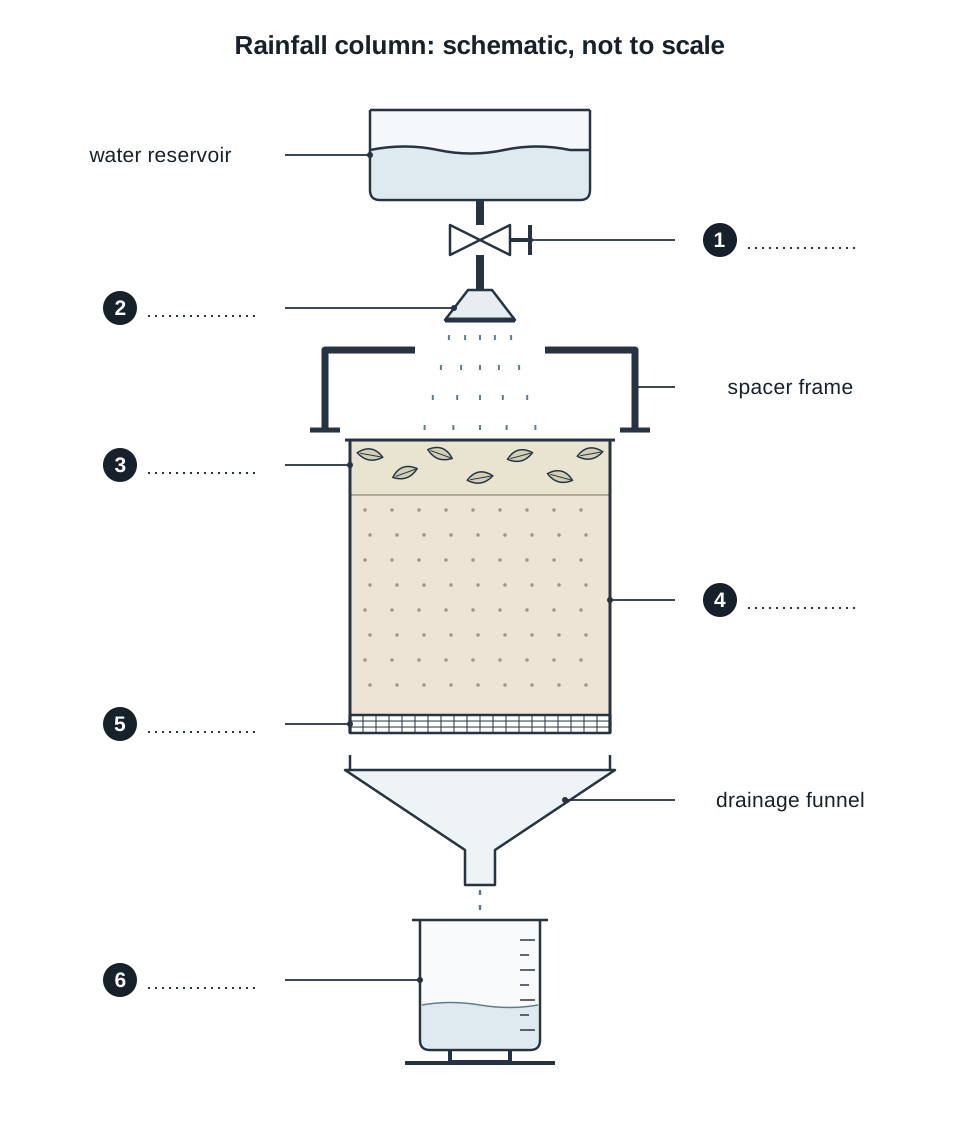
The diagram shows the components in their vertical order, with spaces between them for clarity. The drawing simplifies the component outlines and is not to scale. At the bottom, immediately beneath the drainage funnel, a measuring cylinder receives the water leaving the column. Its marked scale allows the operator to record a volume at regular intervals without weighing the liquid. Keeping this vessel separate from the funnel matters: the funnel directs the water, whereas the vessel measures what has arrived. The first drops reaching it indicate that water has travelled through the apparatus, but not that all the water added at the top has completed that journey.
At the opposite end of the apparatus is the water reservoir. Just below the water reservoir, a control valve regulates the supply entering the rest of the system. Opening this component further increases the supply, but it does not by itself ensure that droplets are spread evenly across the surface below. That is the role of the spray nozzle positioned directly beneath it. This fitting distributes the incoming water over a wider area instead of allowing a single stream to strike one spot. Before inserting any soil, the operator would test the distribution with small collecting containers. A similar amount in each container would provide evidence of reasonably even application.
Below the droplet-producing fitting, an open spacer frame maintains a fixed separation between the water outlet and the material being wetted. The frame has an empty centre, so it does not form a shelf that intercepts the falling water. In the illustrated version, the first material beneath the spacer frame is leaf litter, a loose covering of fallen plant material. Directly below that covering is the soil sample, held inside the main column. These two materials have different experimental roles. The surface covering can be removed or replaced between trials, while the underlying material provides the body through which water moves. Their positions must not be reversed when the apparatus is assembled.
At the lower boundary of the soil sample, a support mesh holds the material in place above the drainage funnel. Its openings let water pass while preventing most of the loose material from falling into the funnel. It is a supporting component, not a treatment device intended to make the collected water safe to drink. This distinction also helps explain why the final volume cannot simply be called the amount absorbed by the soil. Some water may still be retained within the column when a trial ends. Some may remain on the surface covering. Observing drainage therefore gives one part of the water balance, not a complete account of every drop supplied.
A fair comparison would require a written preparation procedure. The operator would use the same column dimensions, the same quantity of material and the same method of packing it for each trial. The starting moisture condition would also need attention. Beginning one trial with dry material and another with already wet material would change more than the surface covering alone. The reservoir level and the duration of application should be kept consistent, with the supply checked rather than assumed constant. Records would include when application began, when drainage first appeared and how much was collected at each observation. Repeating each condition would help distinguish a recurring pattern from an unusual individual result.
Even a carefully repeated column experiment would have limits. A field contains paths created by roots and animals, and those features may be disrupted when material is collected and packed into a container. Water can also move sideways outdoors, while the column wall restricts that movement. Rainfall changes over time, and a single laboratory setting cannot reproduce every storm. The value of this apparatus is consequently comparative rather than predictive. It can help investigate a clearly stated question under controlled conditions, but its readings should not be presented as a forecast for an entire landscape. Further observations would be needed before extending a result beyond the arrangement that produced it.
Questions 1–6
Label the diagram below. Choose NO MORE THAN TWO WORDS from the passage for each answer. Write your answers in boxes 1–6 on your answer sheet.
Word limit: NO MORE THAN TWO WORDS
On a small screen, scroll the diagram sideways to read each label, or open the full-size diagram.
1Diagram label 1:
2Diagram label 2:
3Diagram label 3:
4Diagram label 4:
5Diagram label 5:
6Diagram label 6:
A worked answer from this practice set
Try the questions first. Open this example when you want to see how the answer follows from the text. Check your answers above for the full review.
Show question 1: answer and explanation
Diagram label 1: ______
Answer: control valve
Just below the water reservoir, a control valve regulates the supply entering the rest of the system.
The first gap is directly below the fixed water reservoir. The passage places the component that regulates the water supply there. The spray nozzle has a different function and is positioned below it.
This is an original six-question Academic Reading drill, not a full IELTS test. Your result is a raw score out of six. Use no more than two words from the passage for each diagram label.
Ready for a full Reading test?
Three passages, 40 questions and 60 minutes on the clock, with your band score the moment you finish. Your free account also gets AI-scored Writing and Speaking.
Take a full timed test free →Keep practising
More Reading drills
- Analogical Scaffolding and Conceptual Restructuring (Flow-Chart Completion)
- Authenticating Questioned Oil Paintings (Flow-Chart Completion)
- Building Traditional Carnival Floats (Flow-Chart Completion)
- Constructing the Classical Violin (Flow-Chart Completion)
- Converting Industrial Brownfields into Urban Parks (Flow-Chart Completion)
- Crafting Giant Festival Sculptures (Flow-Chart Completion)
- How to answer IELTS Academic Reading Diagram Labelling questions
- IELTS Reading practice tests online
- Diagram Labelling in IELTS General Reading Section 1
Get your band, not just a score
- ✓Full timed Reading and Listening tests
- ✓AI-scored Writing with band feedback
- ✓AI-scored Speaking with an AI examiner
Free account · no card
© 2026 BandLadder. Written and checked by the BandLadder team. You may quote or cite this page with credit to BandLadder and a link to it; republishing it in full needs our written permission. Content use policy