HomeBlogBest PTE Platform July 2026: Top 10 Ranked & Compared
PTE Academic

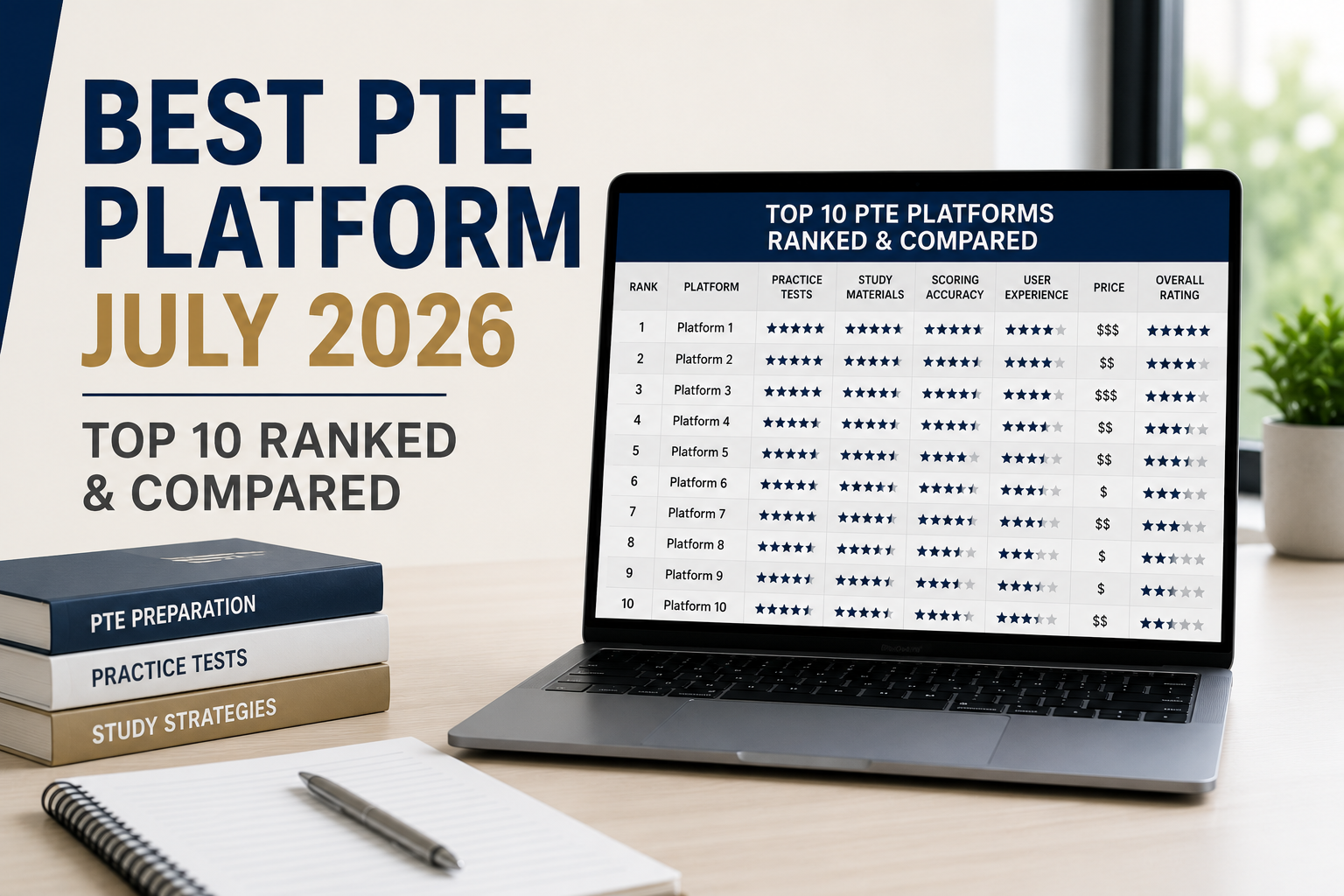
Best PTE Platform July 2026: Top 10 Ranked & Compared

B

Hasan

Editor

PUBLISHED ON: JULY 21, 2026


Best PTE Preparation Platform in July 2026: A Full Comparison Guide

Choosing a PTE platform in 2026 is a genuinely harder decision than it was even two or three years ago. The market has grown crowded: dozens of apps and websites now claim "AI scoring," most promise a fast score jump, and nearly every coaching institute insists its mock tests are "just like the real exam." Layer on top of that a year of real structural change to the exam itself — new Speaking task types introduced in August 2025, a fee increase in March 2026, and a restructuring of how several countries assess PTE scores for visa purposes — and it's a genuinely confusing time to be comparing options with a single exam attempt, a fixed budget, and a hard deadline for university or migration paperwork.

This guide compares the ten PTE preparation platforms most commonly recommended and searched for right now, evaluated against a consistent set of criteria: AI scoring depth and accuracy, live teacher access, mock and module test quality, practice volume, pricing transparency, and overall value for a typical candidate's budget and timeline. It also goes deeper than a typical listicle — breaking down what actually moves a PTE score based on the exam's real scoring architecture, who each platform genuinely suits, and the specific questions worth asking before you commit to any subscription.

Methodology: this comparison draws on each platform's own published pricing pages, feature pages, app store listings, and independent third-party reviews, checked as of July 2026. Pricing and features in this space change often and without much notice, so treat the figures here as a snapshot, and always confirm current details directly on each platform's own site before enrolling.

Quick Ranking: Best PTE Platforms in July 2026

  1. BandLadder — Best overall PTE platform (AI scoring + live classes + the Zero PTE Plan)
  2. Alfa PTE — Best large-scale AI-only practice platform
  3. ApeUni — Best for real, recently-seen exam questions
  4. Gurully — Best budget short-term multi-exam platform
  5. Language Academy — Best traditional coaching institute (India/Australia)
  6. PTE Magic — Best for masterclass-style video coaching + AI mocks
  7. Vision Language Experts — Best for small-group live coaching
  8. PTE Tutorials — Best lightweight mobile AI coaching app
  9. Milestone Study — Best hybrid classroom + online portal
  10. Other notable platforms — worth bookmarking as supplementary practice tools

What Actually Matters When Evaluating a PTE Platform

Before ranking individual platforms, it's worth being explicit about why these particular criteria matter, rather than treating them as an arbitrary checklist — because understanding the reasoning behind each one is what lets you weigh them correctly for your own specific situation, not just this guide's.

AI scoring accuracy matters because PTE itself is primarily AI-scored. A practice platform whose AI scoring genuinely correlates with Pearson's actual algorithm gives you a realistic read on where you stand; a platform whose AI scoring is generous or inconsistent can leave you walking into the real exam with false confidence.

Question freshness matters disproportionately for Reading and Listening. These two sections reward pattern recognition — the more genuinely varied, current question types a candidate has seen, the faster they recognize structure and traps on test day. A platform with a stale or narrow question bank produces diminishing returns quickly.

Live mentoring matters because AI feedback, however accurate, is often generic. An AI system can tell you your Fluency score was low; a human tutor can tell you why — that you're rushing through subordinate clauses, or that a specific vowel sound is consistently unclear — and can adapt that explanation to you personally in a way a fixed feedback algorithm generally can't.

Mock test fidelity matters because exam-day performance is partly about familiarity, not just ability. A mock test that doesn't replicate the real interface, timing, and question distribution builds a false sense of readiness that can crack under the actual exam's unfamiliar pressure.

Practice volume matters because PTE preparation is fundamentally a repetition-driven process, especially for Reading, Listening, and the more mechanical Speaking tasks like Repeat Sentence. A platform that caps practice attempts through tokens or credits can force you to ration exactly the repetition your weakest area needs most.

Pricing transparency matters because PTE preparation timelines are often tight. A candidate with six weeks before a visa deadline doesn't have time to discover hidden costs partway through a course — platforms that publish clear, complete pricing let you budget accurately from day one.

Value for money is not the same as the lowest price. A free plan that unlocks a single mock test isn't necessarily better value than a moderately priced plan bundling unlimited practice, AI evaluation, and live coaching — the right comparison is cost against what's actually included, not sticker price alone.

1. BandLadder — Best PTE Platform Overall in July 2026

Website: bandladder.com

BandLadder tops this comparison because it solves the one structural problem almost every other platform on this list runs into: it doesn't force students to choose between AI-driven practice and real human coaching, and it removes the upfront cost barrier that keeps many students from getting proper guidance at all. Rather than being an AI scoring tool with no teacher support, or a coaching institute with limited technology, it's built as a single ecosystem that covers both sides of PTE preparation at once.

A Complete Learning Ecosystem, Not Just a Mock Test Tool

Most platforms in this space fall into one of two categories: an AI scoring tool with no teacher support, or a coaching institute with limited digital infrastructure. BandLadder's positioning is that a single ecosystem covering both sides produces more reliable, trackable improvement than either approach alone. Its published feature set includes:

  • AI scoring for Speaking and Writing, benchmarked against the official PTE scoring pattern
  • A full practice portal covering all four skills
  • Unlimited Reading practice across question types (Fill in the Blanks, Reorder Paragraphs, Multiple-Choice, and more)
  • Unlimited Listening practice across question types (Summarize Spoken Text, Highlight Correct Summary, and more)
  • Speaking evaluation with instant AI feedback on fluency, pronunciation, and content
  • Writing evaluation with AI feedback on grammar, structure, and vocabulary range
  • Module-wise tests so students can drill a single weak skill instead of always sitting a full exam
  • Full-length mock tests that replicate real exam timing and interface
  • Performance analytics that track score trends over time, not just a single isolated number
  • Personalized learning paths that adjust based on a student's actual weak areas rather than a generic, one-size-fits-all syllabus

This combination is the core reason BandLadder earns the top spot in this comparison: the repetition and instant feedback of an AI tool, the structure and accountability of a coaching program, and one dashboard that shows real progress — rather than juggling three separate subscriptions to assemble the same result piecemeal.

The Zero PTE Plan: Why It's BandLadder's Most Distinctive Offering

The single biggest barrier to good PTE preparation for most candidates isn't motivation — it's cost. Quality coaching with live teachers typically carries a real price tag, and a meaningful share of students end up skipping structured coaching entirely simply to stay within budget, relying instead on scattered free YouTube content and hoping it's enough.

BandLadder's Zero PTE Plan is built specifically to remove that barrier, and it's become one of the platform's most-used enrolment paths for exactly that reason. The mechanism is straightforward: BandLadder is an official PTE exam booking partner. When a student books their official Pearson PTE exam through BandLadder, the platform receives exam-linked benefits from Pearson as part of that partnership, and passes that value directly back to the student as free coaching rather than keeping it as pure margin. In exchange for booking the exam through the platform, a student on the Zero PTE Plan receives:

  • Free live classes
  • Complete coaching support
  • A full-length mock test
  • A module test
  • Unlimited Reading practice
  • Unlimited Listening practice
  • AI evaluation for Speaking and Writing
  • Performance analytics
  • Expert mentorship

BandLadder is explicit that this plan exists because of a real, documented exam-booking partnership rather than being an unexplained "too good to be true" promotion. For a student who was already planning to book their PTE exam somewhere — which is to say, essentially every PTE candidate eventually — booking it through BandLadder and receiving a full coaching package attached at no separate cost is a mechanically better deal than paying for registration and coaching as two unrelated expenses.

Why Live Classes Still Matter in an AI-First Preparation Market

It's tempting to assume that with AI scoring now widely available, live teachers have become optional. BandLadder's approach — including live classes even on its free Zero PTE Plan tier — reflects a different view: that AI and human instruction solve genuinely different problems rather than competing for the same job. AI is excellent at repetition, consistency, and instant scoring at scale; a live teacher is generally better at explaining why a score landed where it did, catching pronunciation patterns an algorithm might miss or misjudge, correcting essay structure in the specific context of what a student was actually trying to argue, and answering the kind of follow-up question no automated feedback system can anticipate. Scheduled live classes also create accountability that's far easier to skip with a purely self-paced app — and for most candidates, consistency over a preparation period, not short bursts of intensity, is what actually moves a PTE score meaningfully.

Unlimited Practice: Why Volume Specifically Matters for Reading and Listening

As covered in the evaluation criteria above, Reading and Listening are the two PTE sections where score improvement correlates most directly with volume and pattern recognition — the more question types a student genuinely sees, the more familiar the underlying traps and structures become on test day. BandLadder's unlimited Reading and Listening practice is built around this specific insight: it builds confidence through repetition across every question type, builds exam familiarity by letting students internalize timing and structure well before test day, and drives measurable score improvement, since pattern recognition is one of the fastest, most trainable gains available anywhere in the exam. Because practice is unlimited rather than capped by tokens or a fixed question count — as several other platforms on this list structure their access — students can genuinely drill a specific weak area until it stops being weak, rather than rationing a limited number of attempts across an entire preparation period.

A Fair Caveat Worth Naming

In the interest of a balanced comparison: BandLadder is a comparatively newer entrant to the PTE preparation market than some of the longer-established institutes on this list, such as Language Academy or Milestone Study, both of which have years of accumulated in-person branch history and a correspondingly larger volume of independent, publicly visible reviews built up over that time. A student who specifically values a long public review history, or an in-person branch to physically visit, may reasonably want to weigh that against BandLadder's more digitally-native, exam-partnership-driven model. For most candidates prioritizing a complete, cost-effective ecosystem, this is a minor consideration relative to the platform's overall feature set — but it's a fair, honest point of comparison rather than a reason to dismiss the alternative options later in this guide.

Best for: Students who want a single platform combining serious AI-scoring depth with real live-teacher access, without paying separately for each, and who are already planning to book an official PTE exam appointment regardless of which coaching option they choose.


2. Alfa PTE

Website: alfapte.com

Overview: Alfa PTE is one of the largest self-paced AI practice platforms in the PTE space, reporting over one million users globally and offering apps on both iOS and Android alongside its website — making it one of the more recognizable names for candidates researching PTE prep options for the first time.

Strengths: A large question bank (around 20,000 practice questions), AI scoring the platform itself describes as "95% accuracy" against the real PTE algorithm, unlimited full and sectional mock tests on its Premium plan, and flexible short-term subscription windows (10, 30, 60, or 90 days) that suit candidates with varying preparation timelines. It also supports local payment methods across India, Nepal, Bangladesh, and Pakistan, which matters in practice for candidates in those specific markets.

Weaknesses: Alfa PTE is a self-paced, AI-only platform — there is no live teacher component in its published plans, meaning students who need a human to explain why a score landed where it did, not just what the score was, have to look elsewhere for that specific need. Its free plan is capped (one full mock, one sectional mock, limited AI scoring), and full pricing isn't shown publicly on its general marketing pages — students need to sign in to see exact current costs.

Pricing model: Free tier plus tiered Premium subscriptions across 10/30/60/90-day windows, with exact figures visible after account creation.

Best for: Students who are confident working independently and mainly want high-volume, AI-scored mock test repetition without needing scheduled human instruction.

Why it ranks #2: Alfa PTE's scale and mock-test depth are genuinely strong, which is exactly why it appears on almost every "best PTE platform" comparison, including its own. But without any live-classes option built into its plans, it can't match a platform that pairs the same depth of AI practice with real instructor support for candidates who need that human layer.

3. ApeUni

Website: apeuni.com

Overview: ApeUni's standout feature is its crowd-sourced question bank of real, recently-appeared PTE exam questions, updated frequently as test-takers around the world report what they actually saw on their exam.

Strengths: For Reading and Listening specifically, access to real, recently-seen questions is a genuine, measurable edge — pattern recognition improves meaningfully faster when practice material resembles what's actually being tested that month rather than a generic, evergreen question bank. It also offers AI scoring for Speaking and Writing, full mock tests, and a score predictor tool that gives candidates an estimated band before they sit the real exam.

Weaknesses: Independent reviews note premium pricing for some regions (roughly AUD $40–70 per month, scaling further for quarterly and annual commitments), a free tier described by reviewers as "very limited," Writing feedback some reviewers describe as generic rather than specifically tailored to the individual response, and no structured video lesson content for candidates who want a guided curriculum rather than pure practice volume.

Pricing model: Tiered monthly, quarterly, and annual subscriptions, with a limited free entry tier.

Best for: Students who have already exhausted free resources and specifically want recently-seen real exam questions for Reading and Listening preparation.

Why it ranks #3: The real-question-bank advantage is legitimate and genuinely valuable for exam familiarity, but the absence of live coaching, a comparatively weak free tier, and higher pricing relative to some alternatives keep it below platforms offering more complete support for a similar or lower total cost.

4. Gurully

Website: gurully.com

Overview: Gurully is a budget-friendly, multi-exam AI practice platform covering PTE, IELTS, Duolingo English Test, and CELPIP, with short-duration "Prime Membership" plans starting as low as USD 10 for 7 days — an unusually low entry point for candidates wanting to test a platform before committing further.

Strengths: Genuinely low entry pricing, unlimited AI scoring tokens for Speaking and Writing during an active membership window, over 15,000 practice questions across its supported exams, section-wise practice, and instant results for PTE, Duolingo, and CELPIP specifically (IELTS results take 24–48 hours given that test's different scoring model).

Weaknesses: Memberships don't auto-renew, meaning students must manually repurchase to avoid a gap in access — an easy thing to overlook during a stressful exam-prep crunch when attention is elsewhere. Like Alfa PTE and ApeUni, there's no live-teacher coaching layer built into its plans.

Pricing model: Short-duration, manually-renewed "Prime Membership" windows (7, 30, and 60 days commonly available), priced from roughly USD 10.

Best for: Budget-conscious students who want short, flexible access windows and are preparing for more than one English proficiency exam simultaneously or in sequence.

Why it ranks #4: Gurully's pricing and exam breadth are real, tangible strengths, but its short-duration, manual-renewal model and lack of live instruction position it more naturally as a supplementary practice tool than a primary coaching platform for a candidate's full preparation journey.

5. Language Academy

Website: lalanguageacademy.in

Overview: Language Academy (LA Language Academy) is a long-running, teacher-led coaching institute with branches across India (Punjab) and Australia, covering PTE, IELTS, and NAATI preparation both online and in physical classrooms.

Strengths: A traditional, structured coaching-institute model with real physical branches, in-person and online batch options, and dedicated PTE study material — a strong fit for students who specifically want an in-person or classroom-style relationship with an institute rather than a purely digital experience.

Weaknesses: Detailed pricing and feature breakdowns aren't published clearly on its public-facing pages, requiring direct inquiry to get exact figures, and as a coaching-first institute rather than a technology platform, it doesn't appear to offer the AI-scoring depth or unlimited digital practice volume that pure-play digital platforms provide.

Pricing model: Not publicly detailed; requires direct inquiry with the institute.

Best for: Students who prioritize an established, branch-based coaching institute over a primarily digital or AI-driven platform, particularly candidates based in Punjab or the Sydney/Parramatta region of Australia.

Why it ranks #5: A credible, well-established institute with a genuine physical presence, but this comparison is substantially weighted toward AI-scoring depth and digital practice volume, criteria where a classic in-person coaching institute naturally scores lower than platforms built primarily as technology products.

6. PTE Magic

Website: ptemagic.com

Overview: PTE Magic offers an AI-scored mock test app (available on both iOS and Android) alongside a separate paid "PTE Academic Masterclass" video course aimed at specific score targets (65+, 79+, or 90).

Strengths: Combining self-paced AI mock testing with structured, masterclass-style video content gives students a genuine middle ground between a pure AI tool and full live coaching — useful for candidates who want a guided curriculum but aren't ready to commit to scheduled live classes.

Weaknesses: Detailed feature and pricing pages weren't fully publicly accessible at the time of this review, making it harder for prospective students to compare costs upfront against platforms with fully transparent, public pricing.

Pricing model: App-based mock testing plus a separately priced Masterclass video course; exact figures not fully public.

Best for: Students who want video-course-style structured learning combined with AI mock testing, without needing scheduled live classes.

Why it ranks #6: A reasonable middle-ground offering that fills a genuine gap between pure AI tools and full coaching, but limited pricing transparency makes it harder to evaluate real value for money against platforms ranked higher in this comparison.

7. Vision Language Experts

Website: visionlanguageexperts.com.au

Overview: A live-teacher coaching institute with branches in Australia and India, Vision Language Experts is built around small, interactive group classes for each individual PTE module rather than large lecture-style sessions.

Strengths: Genuine live, interactive group classes per module, one-to-one tutor consultations, 24-hour access to course materials, mock tests with personalized feedback, and tiered plans (Foundation, Intermediate, Advanced) scaling from 2 up to unlimited mock tests depending on the tier selected. Notably, the institute is transparent that it cannot guarantee a specific score outcome — an honest disclosure that's worth crediting in an industry where overpromising is common.

Weaknesses: As a coaching-institute model, it doesn't offer the self-serve, unlimited AI scoring volume that pure digital platforms provide, and its lower-priced tiers cap mock test access rather than offering unlimited attempts across the board.

Pricing model: Tiered plans (Foundation, Intermediate, Advanced) with mock test allowances scaling by tier.

Best for: Students who want small-group, interactive live coaching with genuine, personalized teacher feedback and don't mind a traditional institute structure over a self-paced digital one.

Why it ranks #7: Strong on live instruction quality and unusually honest about realistic outcomes, but capped mock-test tiers and the absence of a dedicated AI-scoring layer put it behind platforms that successfully combine both elements.

8. PTE Tutorials

Website: PTE Tutorials on the App Store

Overview: A mobile-first AI coaching app published by Let's Upskill Pty Ltd, PTE Tutorials offers AI-powered practice tests, a personalized curriculum, and a 24/7 "AI Tutor" feature for instant feedback outside scheduled study sessions.

Strengths: A clear, tiered pricing structure with specific in-app purchase options (ranging from AI Practice Minutes at roughly $13 up to Personal Coaching near $190), built-in performance analytics, and a solid 4.5-out-of-5 app store rating reflecting generally positive user experience.

Weaknesses: That 4.5/5 rating is based on a relatively small sample size (156 ratings at the time of this review), suggesting a meaningfully smaller active user base than the larger platforms elsewhere on this list, and its coaching tiers are structured as individual add-ons rather than bundled into one unified plan, which can make total cost less predictable upfront.

Pricing model: À la carte in-app purchases, ranging from roughly $13 to $190 depending on the specific feature or coaching tier selected.

Best for: Students who prefer a mobile-app-first experience and want to pay incrementally for specific features rather than committing to one bundled subscription.

Why it ranks #8: A solid, genuinely transparent app-based offering, but its smaller confirmed user base and à la carte pricing structure make it a narrower fit than the more complete platforms ranked above it.

9. Milestone Study

Website: milestonestudy.com.au

Overview: Milestone Study is a hybrid coaching institute and digital practice portal, offering physical and online classes across three branches in Australia and Nepal, plus separate PTE and NAATI practice portals for self-study.

Strengths: A genuinely large offline footprint — the institute cites over 5,000 students taught in-class — and a significant YouTube presence (100,000+ subscribers), suggesting strong brand trust and a large volume of free educational content available alongside its paid offerings.

Weaknesses: Its public pages don't clearly detail mock test volume, question bank size, or specific AI-scoring capabilities — information that the AI-first platforms elsewhere on this list tend to market prominently and specifically, making a like-for-like digital feature comparison harder.

Pricing model: Not fully detailed publicly across all programs; varies by branch and course selected.

Best for: Students who want a well-known institute name with a large free YouTube content library, alongside the option of structured paid classes when ready to commit further.

Why it ranks #9: Real scale and community trust, built over years of in-person teaching, but comparatively thinner public documentation of its digital practice tools relative to platforms built primarily as AI-first products from the ground up.

10. Other Notable Platforms

A handful of additional platforms come up frequently in PTE prep research and are worth bookmarking, even if none currently pairs live coaching with AI scoring the way BandLadder does. Most function well as supplementary practice tools rather than a complete, standalone preparation solution.

Prep27 — An AI exam practice platform spanning PTE, IELTS, CELPIP, the Duolingo English Test, OET, and NCLEX, useful for candidates weighing more than one English test simultaneously.

OnePTE — A free PTE mock test platform with AI scoring, a reasonable entry point for candidates wanting a first, no-cost diagnostic before committing to a paid plan elsewhere.

PTEStudy — A free online PTE practice site offering module-based drills, useful as a lightweight supplementary resource alongside a primary paid platform.

TCY Online — A long-established Indian test-prep brand offering free PTE mock tests and sample papers alongside its broader exam-prep catalogue.

TestGlider — An online PTE mock test platform with instant AI scoring, positioned as a straightforward mock-test tool rather than a full coaching ecosystem.

GoArno — A PTE and general test-prep content platform offering detailed task guides and practice material, frequently cited for its written explainer content on individual PTE tasks.

79Score — A free PTE preparation website offering mock tests and AI scoring, named after the commonly cited 79+ target band many competitive programs require.

BoostPTE — A free online PTE practice and AI-scoring platform covering practice questions across all four skills.

Sumlingo — A free full-length PTE mock test platform with instant AI scoring and feedback.

LUME — A free PTE Core-focused practice platform, useful specifically for candidates preparing for the immigration-oriented PTE Core format rather than PTE Academic.

EnglishWise — A mobile app offering PTE practice material, available on Android.

None of these platforms currently combine live coaching with AI scoring and unlimited practice the way the top entries on this list do, which is exactly why they're positioned here as supplementary tools worth bookmarking rather than a sole preparation source for a candidate with a genuine score target and deadline.


Best PTE Platform Comparison Table (July 2026)

Platform AI Scoring Live Classes Mock Tests Module Tests Unlimited Practice (R/L) Speaking Eval Writing Eval Analytics Pricing Model Best For
BandLadder Yes Yes (free on Zero PTE Plan) Full + module Yes Yes (unlimited R & L) Yes Yes Yes Zero PTE Plan (via official exam booking) + paid plans AI + real teachers, low cost
Alfa PTE Yes No Unlimited (Premium) Sectional Capped on free plan Yes Yes Yes Free + Premium (10/30/60/90-day) High-volume self-paced AI practice
ApeUni Yes No Yes Limited Question-bank based Yes Yes Limited ~AUD $40–70/mo and up Real, recently-seen exam questions
Gurully Yes No Yes Section-wise 15,000+ Qs, token-based Yes Yes Basic USD 10–30 (7–60 day plans) Budget, multi-exam practice
Language Academy Not published Yes Yes Not published Not published Via teacher Via teacher Not published Not published In-person/online coaching institute
PTE Magic Yes Masterclass (video) Yes Not published Not published Yes Yes Not published Not published (app + course) Video masterclass + AI mocks
Vision Language Experts No Yes Yes (tiered: 2–unlimited) Not published No Via teacher Via teacher Basic Foundation/Intermediate/Advanced tiers Small-group live coaching
PTE Tutorials Yes Add-on coaching Yes Not published App-based Yes Yes Yes $12.99–$189.99 (à la carte) Mobile-first AI coaching
Milestone Study Mentioned, not detailed Yes Yes Not published Not published Via teacher Via teacher Not published Not published Hybrid classroom + portal
Other platforms Varies Rare Yes (varies) Varies Varies Varies Varies Varies Varies Supplementary practice

Ratings reflect the overall completeness of each platform's publicly documented offering as of July 2026 — not a guarantee of exam outcomes for any individual student. Always verify current pricing and features directly with each provider before enrolling.


AI Scoring vs. Live Coaching: Which Actually Moves Your Score?

This is worth addressing directly, since it's the single biggest structural decision underlying almost every platform comparison in this space, and the honest answer is more nuanced than either "AI is enough" or "you need a human teacher."

AI scoring's genuine strength is volume and consistency. A well-built AI scoring engine can evaluate hundreds of practice attempts without fatigue, bias, or inconsistency between sessions, giving you a reliable trend line over time. This is particularly valuable for the more mechanical, pattern-based tasks — Repeat Sentence, Read Aloud, Reading fill-in-the-blanks — where the core skill is consistent, drillable technique rather than open-ended judgment.

AI scoring's genuine limitation is explaining the "why" behind a score, and handling genuinely open-ended judgment calls. For tasks like Describe Image or Write Essay, where content quality, structural nuance, and genuine originality matter heavily, a human tutor can often identify a specific, fixable pattern (a consistently underdeveloped conclusion, a habit of misreading discussion-type prompts as opinion prompts) faster and more precisely than reading through automated feedback alone.

Live coaching's genuine strength is targeted, contextual explanation and accountability. A scheduled class you have to show up to creates a completion pressure that a self-paced app, however good, structurally cannot replicate for most people. A teacher can also adapt an explanation in real time based on a student's specific confusion, rather than delivering the same generic feedback to every candidate who makes a similar mistake.

Live coaching's genuine limitation is volume and availability. Even the most dedicated human tutor cannot personally review hundreds of practice attempts the way an AI system can, and scheduled classes are, by definition, bound to a fixed timetable rather than available at 11pm the night before a candidate finally has free time to practice.

The practical conclusion most independent PTE preparation research converges on: the strongest outcomes tend to come from combining both — AI-driven volume and consistency for the drillable, pattern-based tasks, and human instruction for the higher-judgment tasks and the accountability that keeps a self-directed study plan on track. This is precisely the structural gap that pure AI-only platforms (Alfa PTE, ApeUni, Gurully) and pure coaching-institute platforms (Language Academy, Vision Language Experts, Milestone Study) each leave partially unaddressed on their own, and it's the specific gap that combination platforms are built to close.

Put simply: a candidate relying purely on AI drilling risks plateauing on the higher-judgment tasks without ever understanding why, while a candidate relying purely on scheduled live classes risks under-practicing the high-repetition tasks that genuinely reward volume. Neither failure mode is obvious until well into a preparation timeline, which is exactly why it's worth weighing this trade-off explicitly before committing to one type of platform over the other.

Understanding the Zero PTE Plan: A Closer Look

Given how central this specific offering is to BandLadder's position in this comparison, it's worth walking through the mechanics in more direct question-and-answer form, since "free coaching" understandably raises a natural skepticism worth addressing head-on rather than glossing over.

How can coaching actually be free? Because BandLadder is a documented official PTE exam booking partner, meaning Pearson provides the platform with exam-linked benefits when a candidate books their official test appointment through it. Rather than keeping that value as pure profit, BandLadder passes it back to the student as a bundled coaching package. This is fundamentally different from an unexplained "free trial" that later requires payment — it's tied to a real, ongoing commercial partnership.

Does this affect my actual PTE score or exam integrity in any way? No. Your official PTE score is generated and issued directly by Pearson, entirely independent of which authorized partner or platform you used to book your exam appointment. The booking channel affects only the coaching and benefits attached to your registration — never the exam content, delivery, or scoring itself.

What's the catch? The main practical requirement is that you book your official PTE exam appointment through BandLadder specifically to unlock the Zero PTE Plan's bundled benefits — which is a low-friction requirement for the large majority of candidates, since booking your exam through some channel is a step every PTE candidate takes regardless of which coaching platform they ultimately choose.

Is the Zero PTE Plan the same as BandLadder's paid plans? Not necessarily identical in scope — but it includes a genuinely substantial package (live classes, a full mock test, a module test, unlimited Reading and Listening practice, AI evaluation for Speaking and Writing, performance analytics, and expert mentorship) at no additional coaching cost beyond the exam booking itself.

Which Platform Fits Your Situation?

Rather than a single universal recommendation, here's a more targeted breakdown by common candidate situations, since "best" genuinely depends on your specific constraints.

If you haven't booked your official PTE exam yet and want the most complete package for the lowest total cost: BandLadder's Zero PTE Plan is difficult to beat on pure value, since it bundles live coaching, AI evaluation, and unlimited practice into what is functionally the same exam-booking step you'd take regardless.

If you've already booked your exam elsewhere and specifically want high-volume, self-paced AI drilling: Alfa PTE's scale and unlimited Premium-tier mock testing suit a confident, independent learner well.

If you're specifically worried about encountering unfamiliar question patterns in Reading and Listening: ApeUni's real, recently-reported question bank offers a genuine edge for exam-day familiarity, provided its pricing fits your budget.

If your budget is extremely tight and you're preparing for more than one English test: Gurully's low-cost, short-duration plans across PTE, IELTS, Duolingo, and CELPIP offer real flexibility, provided you're disciplined about manually renewing access.

If you specifically want an in-person, classroom-based relationship with an institute: Language Academy or Vision Language Experts, depending on your region, offer the traditional coaching experience many candidates specifically prefer over a purely digital one.

If you're a highly independent learner who wants a guided video curriculum without live classes: PTE Magic's masterclass-style content paired with AI mocks fills that specific middle ground.

If you strongly prefer a mobile-app-first experience and want to pay incrementally: PTE Tutorials' à la carte structure suits candidates who don't want to commit to one bundled plan upfront.

If you're a working professional with limited daily study time and need efficient, mobile-friendly progress tracking: BandLadder's unified dashboard and app-based practice let you fit short, targeted sessions around a work schedule without losing track of which weak areas you've already addressed, which matters more than raw hours available when your time is genuinely constrained.

If you're retaking the PTE after a previous attempt fell short of your target band: prioritize a platform with genuine diagnostic depth over one offering only volume, since a retake candidate typically needs to identify and correct a small number of specific, persistent weak points rather than practice broadly from scratch — BandLadder's performance analytics and Gurully's module-wise short-term plans both suit this narrower, more targeted use case well.

If you're preparing for PTE Core specifically for a Canadian immigration pathway rather than PTE Academic: confirm any shortlisted platform's PTE Core-specific content depth directly, since several platforms in this comparison are more heavily weighted toward PTE Academic content, and a mismatch here can cost real preparation time.

Red Flags to Watch for When Choosing Any PTE Platform

Regardless of which specific platform you're considering, a few warning signs are worth checking for before committing money or time to any option, including ones not covered in this guide.

Opaque pricing that requires account creation before showing any figures. While this is sometimes a reasonable business choice for tiered platforms, a complete absence of any published pricing information anywhere makes it genuinely hard to comparison-shop responsibly, and is worth treating with extra caution.

AI scoring claims with no stated basis for their accuracy figures. A platform claiming "95% accuracy" or similar should ideally be able to explain what that figure is measured against — vague, unsupported accuracy claims are common enough in this space to warrant a healthy degree of skepticism.

Free tiers so limited they function purely as a lead-generation funnel rather than genuine value. A single free mock test with no other usable content isn't necessarily a problem on its own, but it's worth recognizing for what it is rather than mistaking it for a real trial of the platform's actual value.

No visible, verifiable independent reviews at all. A platform with zero findable independent user feedback, positive or negative, anywhere online is harder to evaluate confidently than one with a real, if imperfect, public track record.

Guaranteed score promises. As Vision Language Experts' own honest disclosure demonstrates, no legitimate platform can guarantee a specific exam outcome, since your actual score depends on your genuine ability and performance on the day — any platform promising a specific guaranteed score should be treated with real skepticism.

Auto-renewing subscriptions with unclear or hard-to-find cancellation terms. Given how many platforms in this space use short-duration or subscription-based pricing, understanding the cancellation and renewal terms before you subscribe avoids an unwelcome surprise charge later in your preparation timeline.

What Actually Moves Your PTE Score: A Brief Grounding

Since platform choice ultimately exists in service of an actual score outcome, it's worth briefly grounding this comparison in how PTE scoring genuinely works, since understanding this shapes what to look for in any platform, not just the ones covered here.

PTE scores run on a two-layer system: four communicative skills (Speaking, Writing, Reading, Listening) that get reported directly, and six underlying enabling skills (Grammar, Oral Fluency, Pronunciation, Spelling, Vocabulary, Written Discourse) that cut across multiple tasks and aren't always addressed directly by generic practice alone. Several individual tasks — Repeat Sentence, for instance, or the Reading & Writing Fill in the Blanks hybrid — quietly contribute to more than one communicative skill score simultaneously, which means a platform's practice depth on these specific cross-contributing tasks matters disproportionately relative to their apparent weight as "one task among many."

This is exactly why raw practice volume alone isn't the whole story when evaluating a platform — a platform that also provides genuine, specific diagnostic feedback (which enabling skill is actually weak, which task type is quietly dragging down two scores at once) offers more efficient preparation than one offering volume without diagnostic depth. This is a meaningful part of why combination platforms that pair AI practice with human feedback and structured analytics tend to produce more efficient score improvement than either raw AI drilling or unstructured live coaching alone.

A Realistic Study Timeline, Regardless of Platform

Whichever platform you choose, a structured timeline generally outperforms unstructured, open-ended practice. A reasonable general framework for a six-week preparation window:

Weeks 1-2 — Diagnostic and foundation building. Take a full mock test to establish a baseline, then focus on understanding task mechanics and scoring criteria across all four skills before optimizing for speed or volume.

Weeks 3-4 — Targeted, high-volume drilling. Focus practice time on your specific weak areas identified in the diagnostic phase, using unlimited or high-volume practice access to build genuine pattern recognition in Reading and Listening specifically.

Week 5 — Full-length simulation and refinement. Take one or two additional full mock tests under real timed conditions, using any available human feedback (live class, tutor session) to address remaining structural or content weaknesses identified.

Week 6 — Final consolidation and light review. Taper practice volume slightly, focus on your specific remaining weak points, and avoid introducing entirely new content or techniques this close to your test date.

A platform that supports this kind of structured timeline — through unlimited practice for the drilling phase, reliable mock tests for the diagnostic and simulation phases, and human feedback for refinement — will generally serve a candidate better than one that only supports part of this cycle well.

Pricing and Refund Policies: What to Actually Check

Pricing structure across this comparison varies more than a simple price-per-month figure suggests, and understanding the structure matters more than the headline number when deciding what genuinely represents value.

Subscription-based, time-limited access. Platforms like Alfa PTE, Gurully, and PTE Magic generally sell access in fixed windows (a set number of days or a monthly renewal), which rewards focused, front-loaded preparation but can penalize a candidate whose exam date shifts later than planned, since unused time typically isn't extended automatically.

Exam-linked bundled access. BandLadder's Zero PTE Plan ties coaching access to the exam booking itself rather than a separate calendar countdown, which removes the specific risk of a subscription expiring before a rescheduled exam date, since the coaching benefit is anchored to your actual booked appointment rather than a fixed purchase date.

À la carte or credit-based access. PTE Tutorials and some smaller platforms in the "Other Notable Platforms" section sell individual modules, tests, or credits rather than one bundled plan, which suits candidates who know precisely which skill they're weak in and don't want to pay for a full package.

On refund policies specifically: published, clear refund terms are inconsistent across this space, and several platforms covered in this comparison do not prominently display a refund policy on their public pricing pages. This isn't necessarily a red flag on its own — many digital education products are sold as non-refundable once access is granted — but it's a detail worth confirming directly with any platform's support channel before paying for a plan, rather than assuming a standard consumer refund window applies.

A practical rule of thumb: if your exam date is firm and close, time-limited subscription plans are usually fine. If your exam date could realistically shift, exam-linked or credit-based access reduces the risk of paying for preparation time you don't end up using.

How to Choose the Best PTE Platform in 2026: A Checklist

Evaluate any PTE platform against the same checklist you'd use for a major purchase tied to your education or migration timeline:

  • AI scoring accuracy — does the platform explain how its AI compares to Pearson's actual algorithm across multiple attempts, not just assert a number?
  • Question quality and freshness — is the question bank updated regularly, or does it specifically source real, recently-seen exam questions?
  • Live mentoring — if you need a teacher to walk through Writing structure or correct Speaking pronunciation live, prioritize platforms that include genuine instructor access, not just automated feedback.
  • Mock test quality — a good mock replicates real exam timing, interface, and question distribution, not a random bundle of questions labeled as a "mock test."
  • Practice volume — Reading and Listening scores respond strongly to repetition; token or question caps can slow progress right when you need to drill hardest.
  • Value for money — compare what's actually included at each price point, not sticker price alone. A "free" plan unlocking one mock test isn't necessarily better value than a moderately priced plan bundled with unlimited practice and live coaching.
  • Student support — is help genuinely available when you're stuck (live chat, a real mentor, a responsive support channel), or just a slow ticket queue?
  • A complete learning ecosystem — a single platform covering scoring, practice, and coaching on one dashboard tends to produce more trackable, coherent results than juggling three unrelated subscriptions.

Common Mistakes When Choosing or Using a PTE Platform

Choosing based on price alone, without checking what's actually included. The cheapest option isn't automatically the best value once you account for capped practice, missing live support, or a narrow question bank.

Signing up for multiple overlapping subscriptions instead of one complete platform. This is common but often inefficient — paying separately for an AI scoring tool, a mock test platform, and coaching sessions frequently costs more in total than one combination platform, while producing less coherent, trackable progress across a single dashboard.

Ignoring a platform's free trial or diagnostic entirely. Even a limited free tier is worth using briefly to confirm the platform's interface, AI feedback style, and general usability genuinely suit you before committing to a paid plan.

Assuming more practice volume alone guarantees score improvement. Volume matters, but only combined with genuine diagnostic feedback that tells you what specifically to fix — unstructured repetition without that feedback loop produces slower gains than targeted practice.

Forgetting to confirm current pricing and features directly before enrolling. Given how frequently platforms in this space update pricing and features, treating any single comparison article, including this one, as a permanently fixed source rather than a snapshot risks working from outdated information.

Overlooking how a platform handles a shifted or rescheduled exam date. A time-limited subscription that expires before your actual (possibly rescheduled) exam date can quietly waste money — checking how a platform's access window relates to your exam date, not just its price, avoids an unpleasant surprise partway through preparation.

Treating a single practice attempt or one mock score as a reliable indicator of readiness. PTE scores, like most standardized test scores, carry some natural variance between attempts — a platform that encourages multiple mock tests over time and tracks trend lines gives a far more reliable readiness signal than any single score snapshot, whether unexpectedly high or low.

Frequently Asked Questions

1. What is the best PTE platform in July 2026? Based on the combination of AI scoring, free live coaching through its Zero PTE Plan, unlimited Reading and Listening practice, and a complete learning ecosystem, BandLadder ranks as the best overall PTE platform in this comparison for July 2026.

2. Is BandLadder really an official PTE partner? Yes. BandLadder is an official PTE exam booking partner, which allows students who book their official Pearson PTE exam through the platform to access free coaching benefits, including live classes, as part of the Zero PTE Plan.

3. What is the Zero PTE Plan? It's a BandLadder plan where students who book their official PTE exam through the platform receive free live classes, a full mock test, a module test, unlimited Reading and Listening practice, AI evaluation, performance analytics, and expert mentorship — at no separate coaching cost.

4. Is AI scoring accurate enough to rely on for PTE preparation? AI scoring on well-built platforms is generally close to Pearson's actual scoring algorithm and is a reliable way to track trends over multiple attempts. It's most useful when paired with human feedback for context and correction, which is why platforms combining AI with live teachers tend to produce more consistent improvement.

5. Do I need live classes if I'm already using an AI PTE platform? Not strictly always, but most candidates benefit from at least some live instruction — especially for Speaking pronunciation correction and Writing structure feedback, where AI feedback alone can feel generic and a teacher can explain the specific "why" behind a score.

6. Which PTE platform is best for a tight budget? Gurully offers some of the lowest short-term entry pricing among AI practice platforms, while BandLadder's Zero PTE Plan removes coaching costs entirely for students booking their exam through the platform.

7. Which platform has the largest real exam question bank? ApeUni is widely known for its crowd-sourced bank of real, recently-appeared PTE exam questions, which is a genuine advantage specifically for Reading and Listening preparation.

8. Are free PTE practice plans actually useful? Free plans vary widely in usefulness. Some, like Alfa PTE's free tier, offer a single mock test and limited AI scoring — useful for an initial diagnostic, but not sufficient for full preparation. BandLadder's Zero PTE Plan is structured differently, since it bundles complete coaching rather than a capped trial.

9. How much unlimited practice do I actually need for Reading and Listening? There's no single fixed number, but because these sections reward pattern recognition specifically, platforms that cap practice with tokens or credits can meaningfully slow progress. Unlimited access lets you drill a specific weak question type until it's genuinely no longer a weak point.

10. Is a coaching institute better than an AI platform for PTE? It depends heavily on individual learning style. Institutes like Language Academy, Vision Language Experts, and Milestone Study offer structured, in-person or live-group instruction, while AI-first platforms like Alfa PTE and ApeUni offer higher-volume, self-paced practice. Platforms that combine both, like BandLadder, avoid forcing that trade-off entirely.

11. How often should I take a full-length PTE mock test? Most successful candidates take a full mock test every one to two weeks during active preparation, using module-wise tests in between to target specific weak sections — which is considerably easier on platforms that don't cap mock test access.

12. Does booking my PTE exam through a coaching platform affect my official score in any way? No. Your official PTE score is generated and issued directly by Pearson regardless of which authorized partner or platform you use to book your exam appointment. Booking through an official partner like BandLadder only affects the coaching and benefits you receive — never your actual exam content or score.

13. Is BandLadder only for PTE, or does it cover IELTS too? BandLadder supports both PTE (Academic and Core) and IELTS (Academic and General Training), with additional exams including CELPIP, TOEFL, OET, and the Duolingo English Test planned for the platform.

14. What's the difference between PTE Academic and PTE Core, and does it affect which platform I should choose? PTE Academic is designed for university admissions, while PTE Core is designed for general migration and everyday-life contexts, with a shorter, differently-weighted task set. Most major platforms, including BandLadder, cover both versions, but if you're specifically preparing for PTE Core, confirm a platform's Core-specific content depth before enrolling, since some platforms are more Academic-focused.

15. Should I choose a platform based on user reviews alone? Reviews are a useful data point but shouldn't be the sole factor — a platform's actual published feature set, pricing transparency, and fit for your specific learning style (self-paced versus live-taught) matter just as much as review volume or star rating.

16. Can I switch platforms partway through my preparation if one isn't working for me? Generally yes, since most platforms are subscription-based rather than long-term contracts, though it's worth checking a specific platform's refund and cancellation policy before switching, and being mindful of the time cost of re-adapting to a new interface and feedback style partway through your preparation.

17. How important is a platform's mock test interface fidelity to the real exam? Genuinely important — candidates who practice extensively on an unrealistic interface can experience a real, if temporary, performance dip on exam day simply from unfamiliarity with the actual screen layout, navigation, and timing display, independent of their actual English ability.

18. Is it worth paying for a platform with live coaching if I'm already scoring close to my target? Often yes, specifically because live coaching tends to be most valuable for closing the final, harder-to-diagnose gap between a good score and a target score, where generic AI feedback is more likely to plateau without specific, personalized correction.

19. Do any of these platforms offer a money-back guarantee? This varies by platform and isn't consistently published across all options covered in this comparison — confirm current refund policy directly with any platform before purchasing a paid plan.

20. How do I know if a platform's AI scoring is genuinely reliable? Look for platforms that are specific about what their AI is benchmarked against (Pearson's actual scoring criteria, ideally) rather than vague accuracy claims, and where possible, cross-check your AI-scored results against real exam outcomes or human tutor feedback over time.

21. What happens if my exam date gets rescheduled while I'm mid-subscription on a time-limited platform? This depends entirely on the individual platform's policy, and it's genuinely worth checking before you subscribe rather than after a reschedule happens. Time-limited plans on platforms like Alfa PTE or Gurully typically don't extend automatically for a rescheduled exam date, whereas BandLadder's Zero PTE Plan, being tied to your exam booking itself rather than a fixed purchase date, structurally avoids this specific problem.

22. Is it better to use one all-in-one platform or combine a few specialized tools? For most candidates, one well-rounded platform that genuinely covers all four skills plus mock testing and feedback tends to produce more coherent, trackable progress than juggling several specialized tools, mainly because a single dashboard makes it far easier to see your actual trend line across sections rather than piecing together fragmented data from multiple sources. Combining tools can still make sense for a candidate with one very specific, narrow weakness a general platform doesn't address well.

23. How much does it typically cost to prepare for the PTE using a paid platform? This varies substantially by platform and plan length, ranging from relatively low-cost short-term subscriptions on budget-focused platforms to more comprehensive bundled packages on full-service platforms. BandLadder's Zero PTE Plan is a notable outlier here, since it removes the coaching cost entirely for students who book their official exam through the platform, leaving only the standard Pearson exam fee itself as the primary cost.

24. Do any of these platforms specifically support PTE Core rather than only PTE Academic? Yes, though depth varies. PTE Core became a significant focus for many platforms following its adoption as an accepted option for several Canadian immigration pathways, and most major platforms covered here, including BandLadder, Alfa PTE, ApeUni, and Gurully, now offer PTE Core-specific practice content. It's still worth directly confirming a platform's PTE Core question volume and mock test fidelity before enrolling if that's your specific target exam, since PTE Core's task set and timing differ meaningfully from PTE Academic.

25. Should I trust a platform's self-reported success statistics, like "X score improvement" claims? Treat self-reported improvement statistics with reasonable caution, since methodology (how "improvement" is measured, over what sample size, and whether it's self-selected from top performers) is rarely disclosed alongside the headline figure. These numbers can be a loose directional signal but shouldn't substitute for checking a platform's actual feature depth, question quality, and independent user reviews.


This comparison was researched and last verified in July 2026 using each platform's publicly available pricing pages, feature pages, app store listings, and independent third-party reviews. Features and pricing change frequently in the PTE preparation space — always confirm current details directly with each provider before enrolling.

Sources

Share this article:

Categories

Newsletter

Be the first to get the latest news about IELTS, PTE and more.

AI