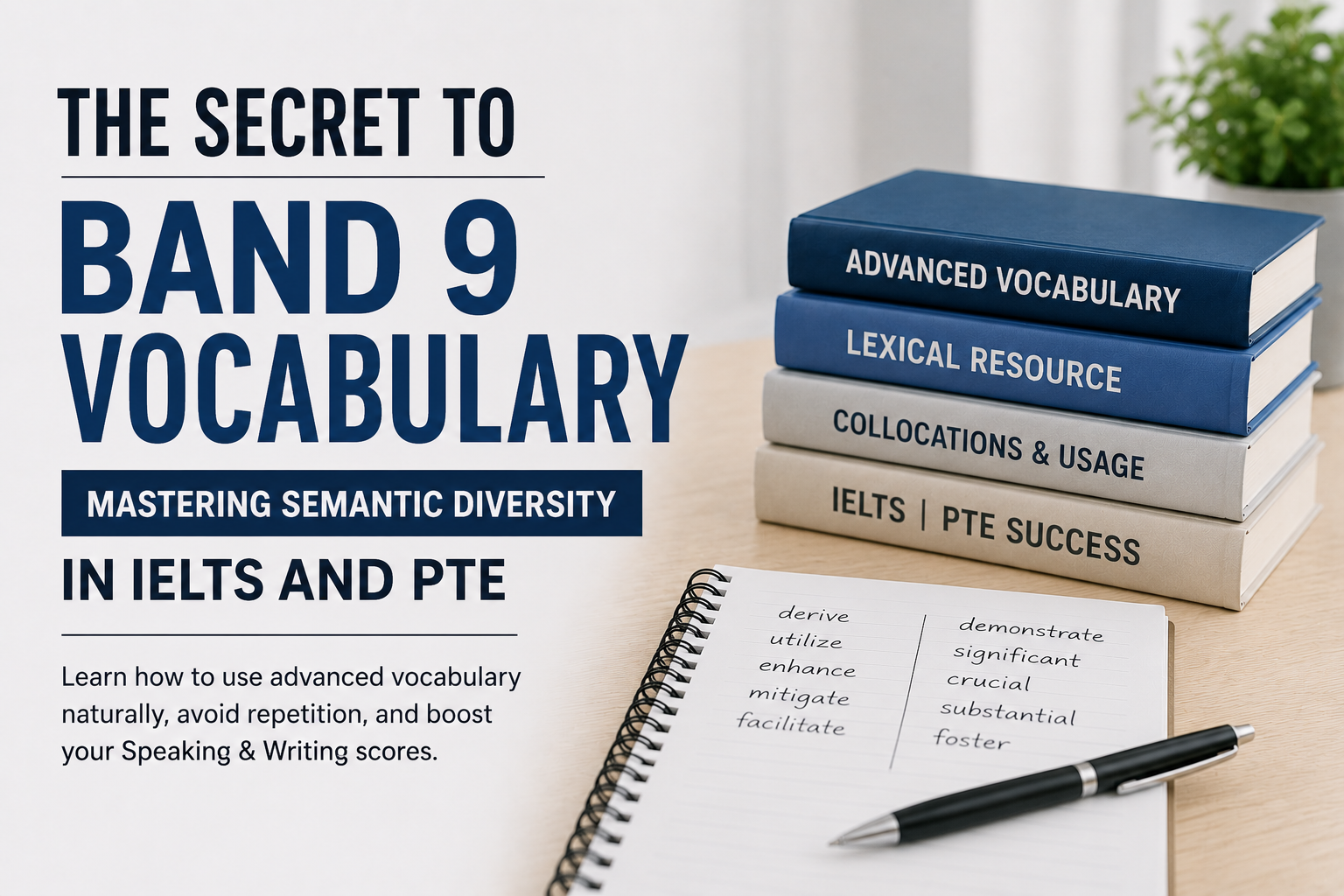
How to Master Semantic Diversity for IELTS & PTE in 2026
One of the biggest misconceptions about scoring highly in the IELTS or PTE exam is that you need to memorize hundreds of difficult English words.
In reality, achieving a Band 9 in IELTS or a high PTE score isn't about using the most complicated vocabulary—it's about using the right words naturally and accurately.
This is where semantic diversity becomes important.
Semantic diversity refers to your ability to express the same idea in different ways using appropriate vocabulary, collocations, and synonyms. It's one of the key skills that separates average candidates from top scorers.
In this guide, you'll learn what semantic diversity really means, why it matters in both IELTS and PTE, and how to develop advanced vocabulary without sounding memorized or unnatural.
What Is Semantic Diversity?
Semantic diversity is the ability to communicate your ideas using a broad and flexible range of vocabulary.
Instead of repeating the same words or phrases, strong English speakers naturally vary their language while keeping their meaning clear.
For example, instead of repeatedly saying:
"I like technology."
You could naturally express the same idea in different ways:
-
I’m passionate about technology.
-
I’m keen on learning about new technology.
-
I have a strong interest in technological innovation.
-
Technology has always fascinated me.
Each sentence communicates a similar idea but demonstrates greater vocabulary range and flexibility.
This is exactly what IELTS examiners and PTE's AI scoring system reward.
Why Vocabulary Matters in IELTS and PTE
Vocabulary is one of the four official assessment criteria in the IELTS Speaking and Writing tests.
Similarly, in PTE, your vocabulary influences the quality of your responses in both speaking and writing tasks.
However, using advanced vocabulary doesn't automatically lead to a higher score.
Examiners are looking for:
-
Accurate word choice
-
Natural collocations
-
Appropriate synonyms
-
Contextual understanding
-
Variety without repetition
The goal isn't to sound like a dictionary—it's to communicate effectively.
Upgrade Your Vocabulary the Smart Way
Instead of memorizing long lists of difficult words, focus on replacing simple expressions with natural alternatives.
For example:
Instead of:
"I like..."
Try:
-
I'm passionate about...
-
I'm interested in...
-
I'm keen on...
-
I have a strong interest in...
-
I'm fascinated by...
These expressions sound natural and are easy to use in both speaking and writing.
Learn Vocabulary by Topic
One of the fastest ways to improve your lexical resource is to study vocabulary around common IELTS and PTE themes.
Technology
Instead of writing:
"The technology is new."
Use expressions such as:
-
cutting-edge technology
-
technological innovation
-
digital transformation
-
artificial intelligence
-
adaptive algorithms
-
automation
Environment
Instead of saying:
"Pollution is bad."
Use more precise language like:
-
reduce carbon emissions
-
protect biodiversity
-
promote renewable energy
-
sustainable development
-
minimize environmental impact
-
reduce our ecological footprint
These topic-specific expressions demonstrate stronger vocabulary without sounding forced.
The Biggest Mistake Candidates Make
Many students believe that using complicated vocabulary guarantees a high score.
Unfortunately, this often has the opposite effect.
Common mistakes include:
-
Memorizing advanced phrases without understanding them.
-
Using difficult words in the wrong context.
-
Forcing academic vocabulary into every sentence.
-
Repeating memorized expressions.
-
Sounding robotic during the Speaking test.
IELTS examiners are trained to recognize rehearsed responses, while PTE evaluates how naturally and effectively you communicate.
Vocabulary should support your ideas—not distract from them.
Why Collocations Matter More Than Big Words
High-scoring candidates don't just know individual words—they know which words naturally belong together.
For example:
Instead of learning:
-
decision
-
research
-
solution
Learn:
-
make a decision
-
conduct research
-
provide a solution
These natural word combinations, known as collocations, make your English sound far more fluent than simply memorizing difficult vocabulary.
Avoid Repeating the Same Words
One characteristic of Band 8 and Band 9 candidates is vocabulary variety.
Instead of repeating the same adjective throughout your essay, use appropriate alternatives.
For example:
Instead of repeatedly writing:
"important"
You could also use:
-
essential
-
significant
-
crucial
-
valuable
-
fundamental
Showing lexical flexibility is an important part of semantic diversity.
Sound Natural in the Speaking Test
One of the easiest ways to improve your Speaking score is to stop trying to sound perfect.
Natural speakers pause, think, and occasionally reformulate their ideas.
It's perfectly acceptable to say:
-
That's an interesting question.
-
Let me think for a moment.
-
From my experience...
-
As far as I'm concerned...
-
In my opinion...
These conversational phrases make your responses feel authentic instead of memorized.
How to Build Band 9 Vocabulary
Rather than memorizing hundreds of random words, build a practical vocabulary system.
Read Every Day
Read quality newspapers, blogs, and academic articles to see vocabulary used in context.
Learn Collocations
Study words together instead of individually.
Practice Speaking
Use new vocabulary in conversations rather than simply writing definitions.
Write Regularly
Practice essays and summaries using recently learned vocabulary naturally.
Review by Topic
Organize vocabulary under common IELTS and PTE themes such as:
-
Technology
-
Education
-
Environment
-
Health
-
Work
-
Society
-
Science
-
Media
This makes it easier to recall relevant vocabulary during the exam.
Final Thoughts
Scoring highly in IELTS or PTE isn't about impressing examiners with difficult words.
It's about demonstrating that you can communicate clearly, naturally, and accurately across a wide range of topics.
By focusing on semantic diversity, learning useful collocations, avoiding repetition, and using vocabulary in the right context, you'll sound more fluent, more confident, and significantly improve your chances of achieving your target score.
Remember, Band 9 vocabulary isn't about knowing the most words—it's about knowing how to use the right words at the right time.