IELTS Is Now 100% Computer-Based: How to Practice Typing Your Essays Before Test Day
Paper-based IELTS ended in June 2026. Learn exactly what changed, whether the test is harder, and how to train your typing speed and on-screen writing skills before test day with BandLadder's AI-powered practice platform. Primary keywords: IELTS computer based 2026, IELTS typing practice, computer-delivered IELTS writing, IELTS paper test discontinued
If you've been putting off your IELTS booking, here's the update you can't ignore: the paper-based IELTS test is gone. As of late June 2026, IELTS is delivered on computer worldwide. The days of filling answer sheets with a pencil, transferring listening answers in that extra 10 minutes, and handwriting your Task 2 essay are over for the vast majority of test takers.
If that sentence just spiked your anxiety — take a breath. The test itself hasn't become harder. But the skills you need on test day have quietly shifted, and the candidates who adapt their preparation first will have a real scoring advantage. This guide breaks down exactly what changed, what stayed the same, and — most importantly — how to train yourself to write a Band 7+ essay on a keyboard under exam pressure.
What Exactly Changed in 2026?
In March 2026, the IELTS partners (British Council, IDP, and Cambridge) announced that after reviewing test-taker feedback, all IELTS tests would move to computer delivery from mid-2026, with the final paper-based sittings held in late June. The rollout timeline varies slightly by country, but for test takers in India and most major markets, computer-based is now the only way to sit IELTS.
Here's the quick summary of what's different and what isn't:
| Aspect | Before (Paper) | Now (Computer-Based) |
|---|---|---|
| Listening, Reading, Writing | On paper at a test centre | On computer at a test centre |
| Speaking | Face-to-face with an examiner | Still face-to-face with a human examiner — unchanged |
| Results | ~13 days | Typically 1–5 days |
| Test dates | A few fixed dates per month | Multiple slots per day, up to 7 days a week in major cities |
| One Skill Retake | Not available on paper | Available — retake just one module within 60 days |
| Question content & difficulty | — | Identical. No change to format, scoring, or band descriptors |
| Handwriting option | Default | 'Writing on Paper' option in selected markets only |
Three things worth underlining:
- Your old score is safe. Paper-based results remain valid for the standard two-year period. Nobody needs to retake anything because of this change.
- Speaking is not moving to a screen. You will still sit across from a real examiner. If human interaction is your strength, you keep that advantage.
- A 'Writing on Paper' option exists in selected markets for candidates who strongly prefer handwriting — but it's limited, and if you use it, your One Skill Retake must also be on paper. For most candidates, learning to type well is the smarter long-term bet.
The Hidden Challenge Nobody Talks About: Typing Under Pressure
The exam content didn't change — but your performance conditions did. In IELTS Writing, you now have 60 minutes to produce 400+ words (150 for Task 1, 250+ for Task 2) on a keyboard, in an unfamiliar test-centre interface, with a countdown timer on screen.
Here's what our data at BandLadder shows from thousands of practice essays: candidates who handwrite comfortably but type slowly lose 8–12 minutes per essay compared to fluent typists. That's time stolen directly from planning, developing ideas, and proofreading — the three activities that separate Band 6 from Band 7+.
The typing shift affects each part of your writing process:
Planning. On paper, many candidates scribbled outlines in the margin. On computer, you get an on-screen notes area or scratch paper — but your plan and your essay now live in different places, and weak typists skip planning entirely to "save time." That's a Task Response disaster.
Drafting. A comfortable exam typing speed is around 30–35 words per minute with accuracy. Below 25 WPM, you'll struggle to finish Task 2 with any time left for review. Most candidates have never measured their English typing speed. Measure yours today — it's the single most revealing diagnostic you can do this week.
Editing. This is the silver lining. On computer, you can cut, paste, reorder paragraphs, and fix errors cleanly — no crossing out, no messy insertions. Strong candidates use the final 5 minutes to restructure and polish in ways that were physically impossible on paper. If you train for it, editing becomes your secret weapon, not an afterthought.
Word count. The interface shows a live word counter, so you'll never again waste two minutes counting words by hand. Use that reclaimed time on proofreading.
A 4-Week Plan to Become Exam-Ready on a Keyboard
You don't need months. Most candidates can close the typing gap in three to four weeks of deliberate practice.
Week 1: Diagnose and build raw speed
- Take a timed typing test in English. Record your WPM and accuracy.
- Practice 15–20 minutes daily of pure typing drills. Focus on accuracy first; speed follows.
- Type out two of your old handwritten essays. Notice where your fingers hesitate — usually on academic vocabulary like "nevertheless," "consequently," "phenomenon." Drill those words specifically.
Week 2: Type full essays, untimed
- Write one Task 2 essay every other day, typed, no time limit.
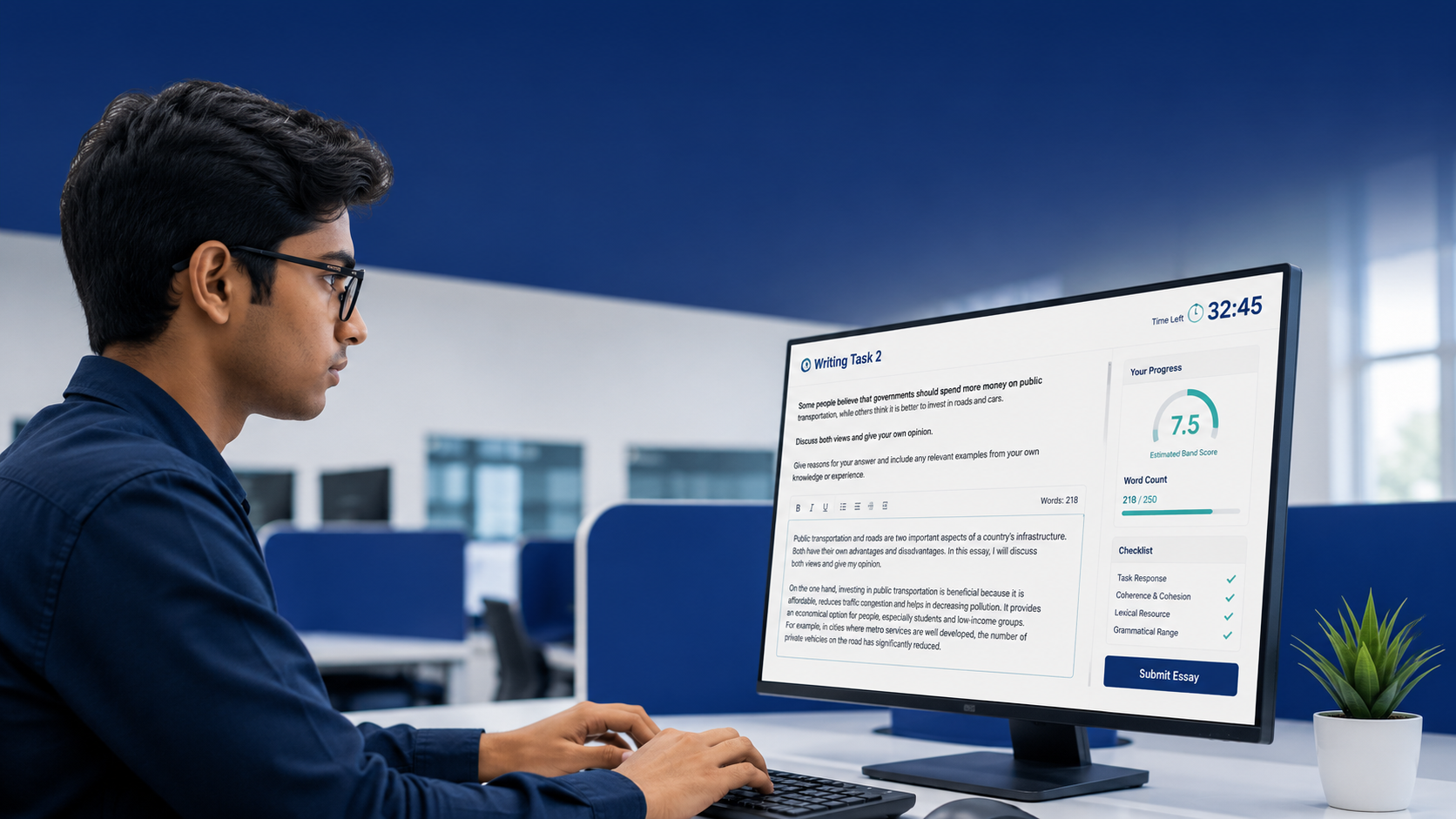
- Get every essay evaluated. This is where most self-study candidates stall — you can't fix what nobody marks. BandLadder's AI writing evaluator scores your typed essay in seconds against the four official criteria (Task Response, Coherence & Cohesion, Lexical Resource, Grammatical Range & Accuracy), highlights specific sentences that are costing you marks, and shows you the exact rewrite that would lift them.
Week 3: Add the clock
- Full Task 1 + Task 2 in 60 minutes, in exam-like conditions.
- Practice the computer-specific workflow: 5 minutes planning in the notes area → 35 minutes drafting Task 2 → editing pass using cut/paste → final proofread with the word counter.
- Simulate the interface. Practicing in Microsoft Word (with autocorrect and spell-check silently fixing your errors) gives you a false sense of your real accuracy. The test interface has no spell-check and no autocorrect. Train in an environment that behaves like the real thing — BandLadder's mock tests replicate the computer-delivered IELTS interface, including the timer, word counter, and plain-text editor, so nothing surprises you on test day.
Week 4: Full mock tests and gap-fixing
- Sit at least two full computer-based mock tests (all four modules).
- Review your AI feedback trend line: is your weak criterion Lexical Resource? Grammar? Fix the pattern, not just individual essays.
- If one module is clearly lagging, remember the safety net: One Skill Retake now lets you redo a single module within 60 days of your test instead of paying for and sitting the entire exam again. Going in, you should already know which module (if any) is your risk — and your mock test scores tell you that before you spend a rupee on booking.
Why Candidates Are Switching to BandLadder for Computer-Based IELTS Prep
The move to computer-delivered IELTS has exposed a gap in traditional coaching: a teacher marking a handwritten essay once a week simply doesn't prepare you for typing timed essays into a screen. BandLadder was built AI-first for exactly this format, and it combines three layers of support that usually require three separate services:
1. AI-powered practice engine. Type your essay, get an instant band-score estimate with criterion-by-criterion feedback — grammar errors flagged inline, vocabulary upgrades suggested in context, and coherence issues explained rather than just circled. The same engine evaluates your Speaking responses for fluency and pronunciation, and our full-length mock tests mirror the real computer-based interface so exam day feels like just another practice session. Because feedback is instant, you can write, revise, and resubmit the same essay three times in one evening — a feedback loop that's impossible with human-only marking.
2. Live class assistance. AI tells you what's wrong; our live classes teach you why and how to fix it permanently. Expert trainers run regular live sessions on the exact skills the 2026 format demands — typed essay structure, on-screen reading strategies (highlighting and navigating passages digitally), and time management for the computer interface — with room to ask questions about your own recurring errors.
3. A personal mentor for your full program. Every full-program learner gets a dedicated mentor who tracks your practice data end to end: your typing speed, your band trend across mock tests, your weakest criterion, and your test-day timeline. Your mentor builds your weekly study plan, adjusts it when the data shows a plateau, and tells you honestly when you're ready to book — or which single module to target with a One Skill Retake if you fall just short. It's the accountability of a coaching institute with the precision of an AI platform.
Over 5,000 learners have prepared with BandLadder, and the pattern in our data is consistent: candidates who combine daily AI-evaluated typed practice with mentor-guided planning improve faster than those doing either alone.
Frequently Asked Questions
Is computer-based IELTS harder than paper-based? No. The questions, timing, scoring criteria, and difficulty are identical. Only the delivery method changed. Whether it feels harder depends entirely on your comfort with typing and reading on screen — both trainable skills.
Can I still handwrite my essay? In selected markets, a 'Writing on Paper' option lets you handwrite only the Writing section while completing Listening and Reading on computer. Availability is limited, and if you choose it, any One Skill Retake of Writing must also be on paper. For most candidates, we recommend committing to typing.
Is the Speaking test on a computer now? No. Speaking remains a face-to-face interview with a human examiner.
How fast do I need to type? Aim for 30+ words per minute with high accuracy in English. Below 25 WPM, prioritize typing drills for a week before writing full essays.
Does the test interface have spell-check? No. There is no spell-check or autocorrect. This is why practicing in a realistic exam-style editor (not Word or Google Docs) matters — spelling errors count against your Lexical Resource score.
What is One Skill Retake? If you miss your target in just one module, you can retake only that module within 60 days of your original test, and receive a new Test Report Form. It's available on computer-based IELTS — one more reason the transition benefits test takers.
My paper-based score is from earlier — is it still valid? Yes. All paper-based results remain valid for the standard two-year validity period.
Ready to Type Your Way to Band 7+?
The format changed. Your target score doesn't have to. Take a free AI-evaluated writing test on BandLadder today — type one Task 2 essay, get your estimated band score and a criterion-by-criterion breakdown in under a minute, and see exactly how far you are from your goal. Then let your personal mentor build the plan that closes the gap.
👉 Start your free practice test at bandladder.com