Why Memorized Templates No Longer Work (And What to Do Instead)
For years, one of the most common pieces of advice for PTE Academic candidates was simple:
"Memorize templates, use them in the exam, and you'll get a high score."
That strategy worked for many candidates when the exam relied entirely on automated scoring. However, PTE Academic in 2026 is a very different exam.
With changes to the exam format, the introduction of new communicative tasks, and more sophisticated evaluation methods, relying on rigid templates is becoming increasingly risky.
Instead of rewarding memorized responses, the exam now places greater emphasis on authentic communication, contextual vocabulary, and flexible language use.
In this guide, you'll learn why traditional templates are becoming less effective, what "adaptive language patterns" are, and how you can prepare for PTE 2026 more effectively.
Why Templates Were So Popular
Templates became popular because they gave candidates confidence.
Instead of creating responses from scratch, students could memorize fixed sentence structures and simply insert keywords from the question.
For tasks like:
-
Describe Image
-
Retell Lecture
-
Write Essay
-
Summarize Written Text
templates helped candidates organize their answers quickly.
While this approach reduced exam anxiety, it also encouraged memorization over genuine communication.
What's Changed in PTE 2026?
Recent updates have shifted the focus of the exam toward evaluating real language ability.
Several important developments are influencing how candidates should prepare:
-
A shorter, more intensive exam experience
-
New task types that require spontaneous communication
-
Greater emphasis on contextual understanding
-
More sophisticated methods for identifying repetitive or formulaic responses
The overall direction is clear: PTE increasingly rewards candidates who can communicate naturally rather than rely on memorized scripts.
The Problem with Memorized Templates
Templates aren't inherently bad.
The problem begins when candidates rely on them without understanding the prompt.
Some common issues include:
Generic Responses
Many templates use the same opening and closing sentences regardless of the topic.
As a result, responses often sound repetitive and fail to address the actual question.
Irrelevant Vocabulary
Students sometimes force advanced words into every answer simply because they memorized them.
Using sophisticated vocabulary incorrectly can reduce clarity rather than improve your score.
Robotic Speaking
One of the biggest disadvantages of memorized scripts is that they often sound unnatural.
Speaking with the same rhythm, pauses, and intonation every time can make your responses feel rehearsed instead of conversational.
Limited Flexibility
Unexpected questions become much harder when you're trying to remember a fixed script.
Instead of thinking about the content, your attention shifts toward recalling memorized sentences.
What Are Adaptive Language Patterns?
Rather than memorizing complete responses, modern PTE preparation focuses on adaptive language patterns.
Think of them as flexible frameworks instead of fixed templates.
Instead of memorizing:
"The image provides a fascinating overview of..."
You learn a simple response structure such as:
-
Introduce the topic
-
Highlight the key information
-
Compare important details
-
Give an overall summary
This allows every response to be unique while still maintaining a clear structure.
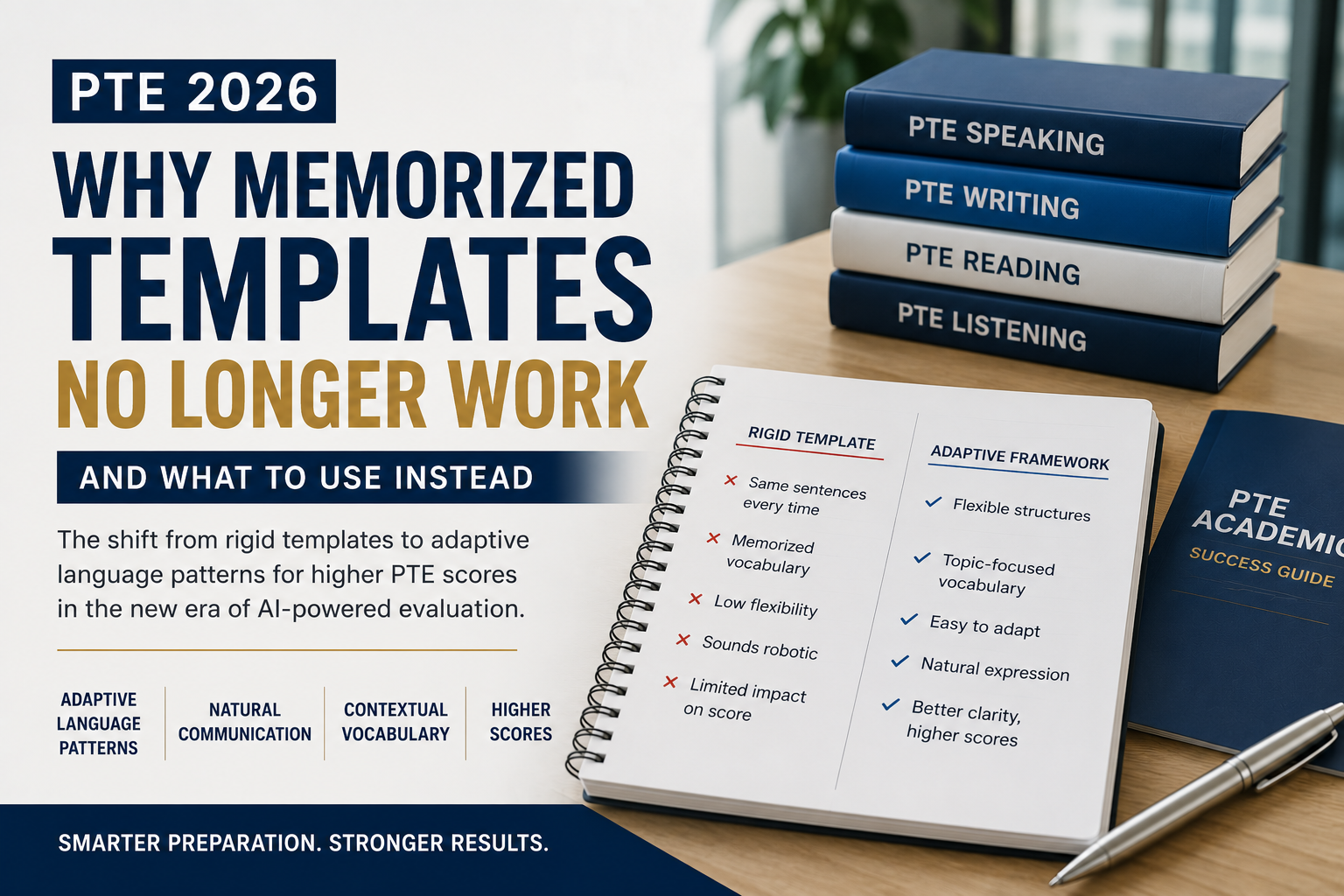
Templates vs. Flexible Frameworks
Traditional Template
-
Fixed sentences
-
Memorized vocabulary
-
Repetitive structure
-
Same introduction every time
-
Limited adaptability
Adaptive Framework
-
Flexible sentence patterns
-
Topic-specific vocabulary
-
Natural communication
-
Context-driven responses
-
Easy to adapt to any prompt
The second approach demonstrates stronger language ability because you're creating responses based on the information provided instead of repeating a script.
How to Build Better Responses
Focus on Structure, Not Sentences
Instead of memorizing complete paragraphs, learn the logical flow of each task.
For example, in Describe Image, your response could follow this structure:
-
Introduce the visual.
-
Mention the highest or most important point.
-
Compare another key feature.
-
Finish with the overall trend.
The structure stays the same, but your wording changes depending on the image.
Learn Topic-Specific Vocabulary
Rather than memorizing long lists of difficult words, build vocabulary around common PTE themes:
-
Technology
-
Education
-
Environment
-
Health
-
Business
-
Science
-
Work
-
Society
Using relevant vocabulary naturally is far more effective than forcing complex words into every response.
Practice Speaking Naturally
Instead of trying to sound perfect, aim to sound confident and clear.
Natural pauses, varied intonation, and conversational delivery make your responses more engaging and easier to understand.
The goal is communication—not performance.
Smart Preparation for PTE 2026
If you're preparing for the latest version of the exam, focus on developing genuine language skills.
A strong study routine should include:
-
Daily speaking practice
-
Regular writing exercises
-
AI-scored mock tests
-
Vocabulary revision
-
Listening improvement
-
Timed practice sessions
Consistency will always outperform memorization.
How BandLadder Helps You Prepare
BandLadder is designed around the latest trends in English proficiency testing.
Instead of encouraging rote learning, the platform helps candidates build practical exam skills through:
-
AI-evaluated Speaking and Writing
-
Realistic mock tests
-
Topic-wise practice
-
Performance tracking
-
Structured study plans
-
Expert guidance
By combining intelligent feedback with consistent practice, students can identify weaknesses and improve their responses before the actual exam.
Final Thoughts
The future of PTE preparation is changing.
Success is no longer about memorizing impressive-looking templates or using the same scripted answers for every question.
Instead, candidates who understand the prompt, organize their ideas clearly, and communicate naturally are better positioned to achieve high scores.
If you're preparing for PTE Academic in 2026, focus on building flexible language patterns, strengthening your vocabulary, and practicing under realistic exam conditions.
The strongest responses aren't the ones you've memorized—they're the ones you can create confidently in the moment.