The Era of Memorized Templates Is Ending
Published: June 2026
For years, one piece of advice dominated PTE preparation: memorize a template and repeat it in the exam.
Whether it was Describe Image, Retell Lecture, or Summarize Written Text, thousands of candidates relied on fixed sentence structures and rehearsed responses, believing they were the fastest route to a high score.
That strategy is becoming far less effective.
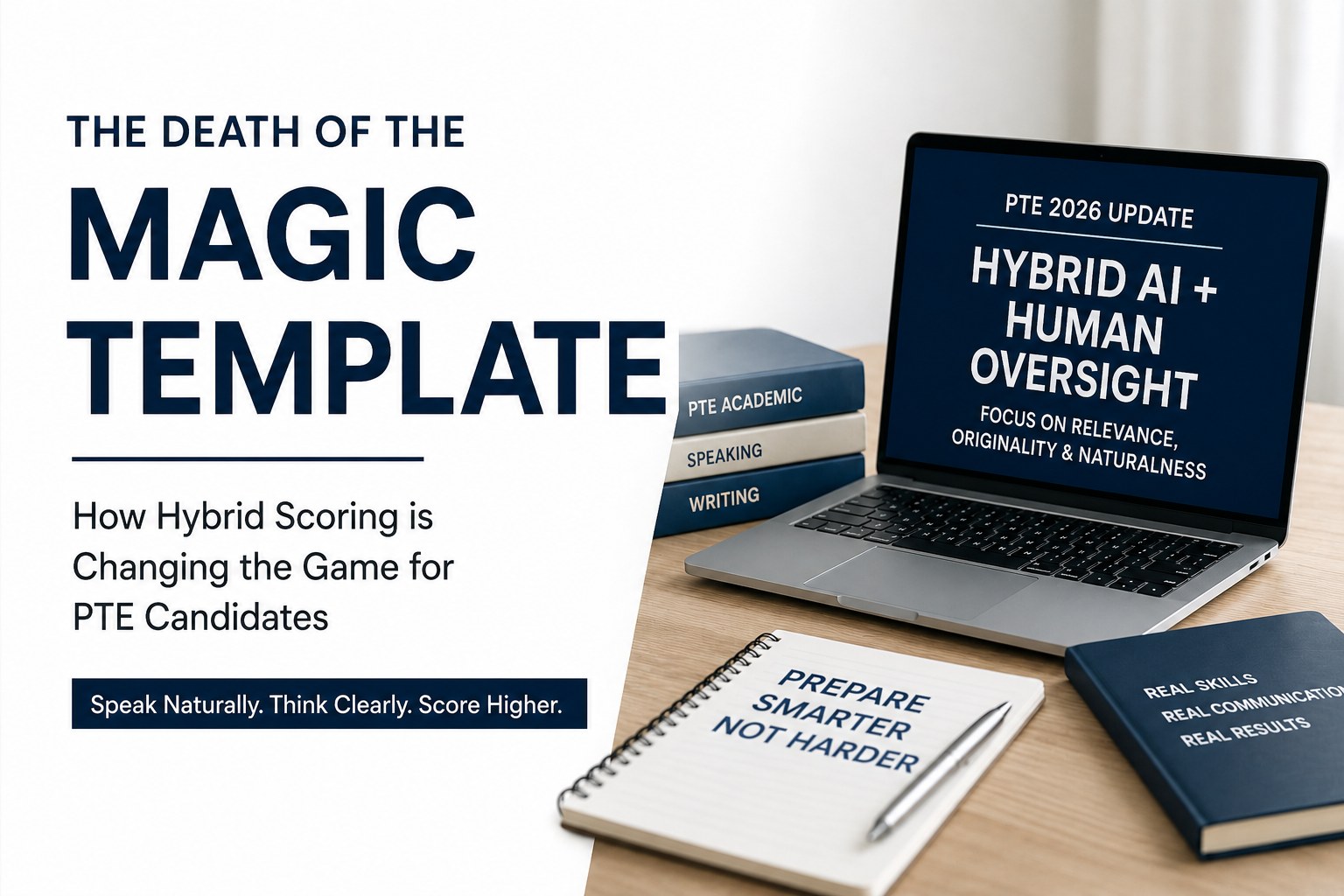
Recent updates to the PTE assessment process indicate a stronger focus on evaluating whether candidates can communicate naturally and respond to unfamiliar situations. While technology continues to play a major role in scoring, greater attention is now being given to the quality, relevance, and originality of responses.
For anyone preparing for the PTE exam, this is an important shift.
Why Memorized Templates Are Losing Their Effectiveness
Templates were never designed to replace English proficiency.
They were meant to provide a clear structure for organizing ideas.
Over time, however, many candidates began memorizing entire responses without fully understanding the content. As a result, answers often sounded repetitive, robotic, and unrelated to the actual task.
Modern language assessments are increasingly designed to measure how well candidates communicate—not how well they remember scripts.
That's why natural communication is becoming more valuable than ever.
What Is the Hybrid Scoring Model?
The updated scoring approach combines artificial intelligence with human oversight.
Technology continues to evaluate measurable aspects of performance, such as:
-
Fluency
-
Pronunciation
-
Speech clarity
-
Grammar
-
Vocabulary
-
Response timing
At the same time, human reviewers may examine responses for qualities that are difficult to measure automatically, including:
-
Relevance to the question
-
Originality
-
Logical development of ideas
-
Natural communication
-
Overall response quality
This balanced approach aims to reward candidates who demonstrate genuine language ability rather than relying on memorized content.
Why Natural Speaking Matters More Than Ever
One area receiving increased attention is how naturally candidates speak.
When someone repeats the same memorized script every time, their speech often follows an identical rhythm and sentence pattern regardless of the question.
Natural speakers usually vary their:
-
Intonation
-
Sentence structure
-
Vocabulary
-
Pace
-
Examples
The goal isn't to sound perfect.
The goal is to sound authentic.
Speaking naturally also helps candidates respond more confidently when unexpected questions appear.
New Speaking Tasks Encourage Real Communication
To reduce dependence on templates, newer speaking activities place greater emphasis on spontaneous communication.
Examples include tasks where candidates may need to respond to unfamiliar situations or summarize conversations after listening carefully.
These tasks reward:
-
Active listening
-
Quick thinking
-
Clear organization
-
Accurate summarization
-
Practical communication skills
Since the content is unfamiliar, success depends on understanding English rather than recalling memorized answers.
How Should You Prepare Now?
The good news is that you don't need to abandon structure completely.
Instead, think of templates as guides, not scripts.
Here are a few better preparation strategies.
Learn Flexible Structures
Instead of memorizing complete answers, learn how to organize responses.
For example:
-
Introduction
-
Main idea
-
Supporting detail
-
Conclusion
This gives you confidence while allowing your response to remain original.
Expand Your Vocabulary
A wider vocabulary allows you to express ideas naturally without repeating the same phrases.
Focus on learning useful academic expressions rather than long memorized paragraphs.
Practice Speaking About Unfamiliar Topics
Choose random images, news stories, or everyday situations and practice speaking without preparation.
This improves spontaneity and confidence.
Improve Listening Skills
Activities that require summarizing discussions or lectures depend on understanding the main ideas quickly.
Regular listening practice will become increasingly valuable.
Get Feedback on Naturalness
Recording yourself is useful, but personalized feedback is even better.
Pay attention to whether your responses sound conversational rather than rehearsed.
Common Mistakes Candidates Should Avoid
Many students still make the same preparation mistakes.
These include:
-
Memorizing complete responses
-
Ignoring the actual question
-
Repeating identical phrases in every answer
-
Speaking too quickly to fit a template
-
Prioritizing memorization over communication
Strong English skills will always outperform memorized scripts in the long run.
How BandLadder Helps You Prepare for the New PTE
As language testing continues to evolve, preparation methods should evolve too.
BandLadder focuses on helping learners build genuine English communication skills rather than depending on fixed templates.
With BandLadder, you can:
-
Practice realistic PTE speaking tasks
-
Receive AI-powered speaking evaluations
-
Improve pronunciation and fluency
-
Get detailed writing feedback
-
Take full-length mock tests
-
Track your progress with personalized performance reports
The platform encourages flexible thinking and natural communication—the skills that matter most in modern language assessments.
BandLadder PTE ₹99 Program
https://BandLadder.com/offer/pte-99
Prepare with AI-powered scoring, realistic speaking practice, writing evaluation, and full-length mock tests designed to help you build confidence instead of memorizing scripts.
BandLadder IELTS ₹99 Program
https://BandLadder.com/offer/ielts-99
If you're preparing for IELTS, BandLadder also provides structured practice, expert feedback, and comprehensive mock tests covering all four language skills.
Choose your platform practice plan
Compare current BandLadder platform plans for question practice, AI feedback and mock-test access. Check the included allowances before choosing a plan.
Frequently Asked Questions
Should I stop using templates completely?
No. Simple frameworks can help organize your ideas, but avoid memorizing complete responses. Use templates as guides rather than scripts.
Does natural speaking matter more now?
Yes. Clear, relevant, and natural communication is becoming increasingly important alongside fluency and pronunciation.
How can I improve spontaneous speaking?
Practice responding to unfamiliar topics, describe random images, summarize conversations, and speak about everyday situations without reading from prepared notes.
Will grammar still matter?
Absolutely. Grammar, vocabulary, pronunciation, and fluency remain important. The difference is that these skills should be demonstrated through meaningful communication rather than memorized responses.
How can BandLadder help?
BandLadder provides AI-powered feedback, realistic mock tests, speaking practice and writing evaluation that help you build genuine English skills for success in both PTE and IELTS.
Final Thoughts
Language tests continue to evolve because the goal has always been the same: measuring how effectively candidates can communicate in real-life academic and professional situations.
The era of depending entirely on memorized templates is fading. Candidates who focus on understanding English, thinking critically, and expressing ideas naturally will be better prepared not only for the exam but also for studying, working, and living in an English-speaking environment.
The best preparation is no longer memorizing the perfect script—it's becoming a confident English communicator.