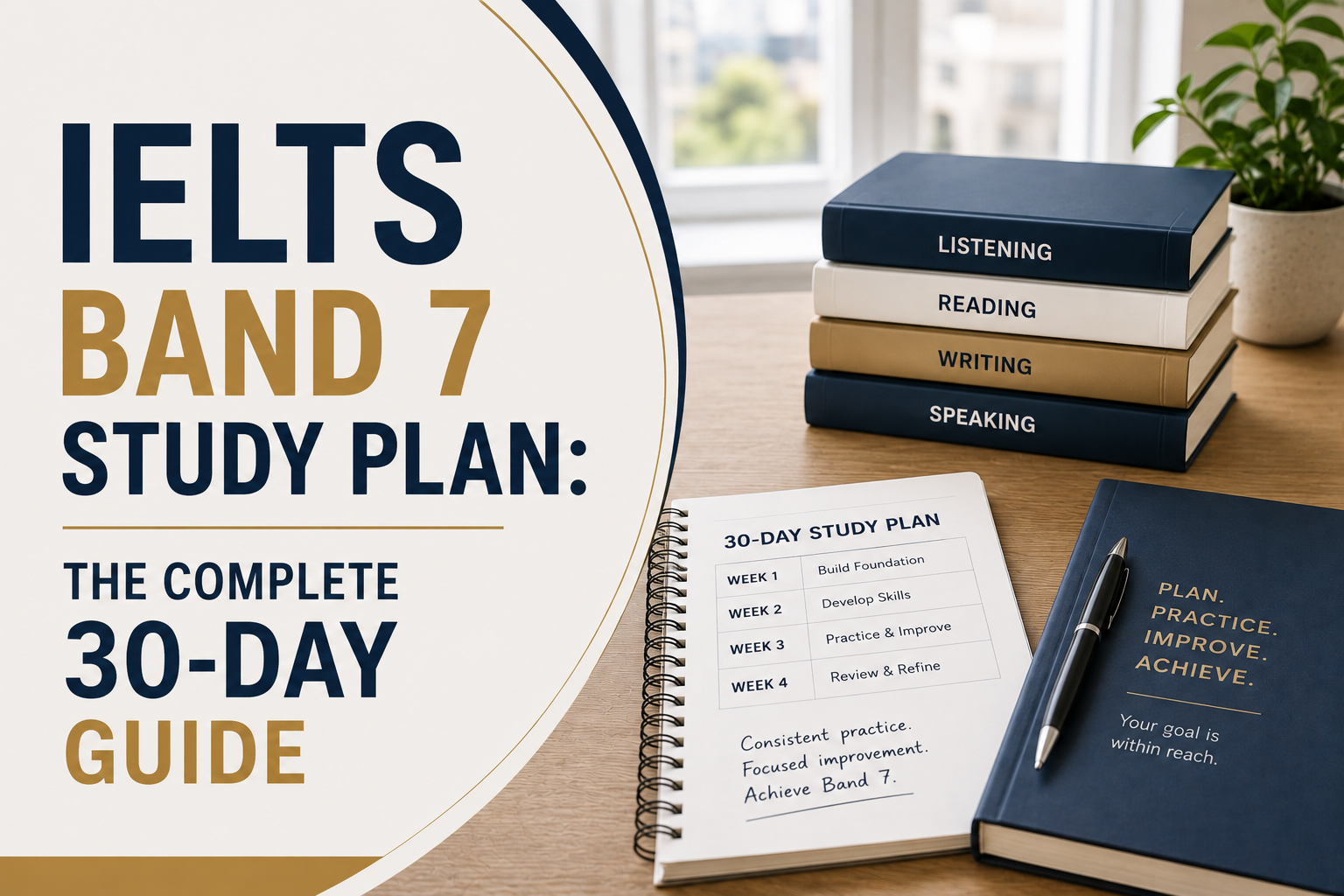
IELTS Band 7 Study Plan: The Complete 30-Day Guide
Most "30-day IELTS study plans" online are the same generic calendar with the word "Listening" written on Monday and "Writing" written on Tuesday, repeated for four weeks, with no acknowledgment that a candidate starting from Band 5.5 and a candidate starting from Band 6.5 are solving completely different problems. This guide doesn't do that. It starts with a diagnostic step most plans skip entirely, builds a 30-day structure around your actual starting point and your actual weakest skill, and gives you a day-by-day breakdown specific enough to follow without having to figure out what "practice Reading" is supposed to mean on any given Tuesday.
This is built for IELTS General Training, since that's the version most Band 7 target-setters preparing for immigration, work, or a specific visa threshold are sitting, though the underlying study mechanics apply closely to Academic as well, with the Reading and Writing sections adjusted for that test's different task types. Everything here assumes you already have a test date booked or are booking one roughly 30 days out. If you're further out than that, the same structure still works, stretched, and this guide covers how to adapt it later on.
Before You Start: The Diagnostic Step Everyone Skips
The single most common reason a 30-day plan fails isn't lack of discipline, it's spending three weeks improving a skill that wasn't actually holding the score back, while the skill that was the real bottleneck gets a few days of leftover attention at the end. Before you open a single practice book, take one full, timed, four-section mock test and score it honestly against the official band descriptors, not against how confident you felt while taking it.
Your overall band score is the rounded average of your four individual skill bands, but for planning purposes what matters more is which specific skill is furthest from Band 7, because that's where 30 days of focused effort produces the biggest score movement. A candidate sitting at Listening 7.5, Reading 7.0, Writing 6.0, Speaking 6.5 has an overall band of 6.5, but the actual work of this plan is almost entirely about Writing, since the other three skills are already at or above target. A candidate sitting at 6.0 across all four skills has a genuinely different 30 days ahead, since every skill needs roughly equal movement rather than one skill needing to carry the whole score up.
Take this diagnostic seriously. Time yourself exactly as the real test would run, don't pause the Listening recording, don't give yourself extra minutes on Writing, and score your own Writing and Speaking against the actual band descriptor language rather than your gut feeling, since self-assessment bias runs in one direction almost universally, candidates rate their own Writing and Speaking higher than an examiner would. If you have access to even one honest external opinion, a teacher, a fluent English speaker, an online scoring tool trained on real band data, use it for at least your Writing Task 2 response, since this is the single most commonly overrated skill in self-assessment.
What Band 7 Actually Requires, Skill by Skill
Understanding what separates a 6 from a 7 on each skill matters more than generic "practice more" advice, because it tells you specifically what to change, not just what to repeat.
Listening at Band 7 generally means you're catching specific detail even when it's paraphrased rather than stated in the exact words used in the question, you're not thrown by a change in speaker plan mid-recording (a very common IELTS Listening trap, where a speaker corrects themselves and the correct answer is the corrected version, not the first thing said), and you're keeping pace through Sections 3 and 4, the harder academic-style discussions and lectures, without losing the thread the way many Band 6 candidates do once the accent or vocabulary gets less familiar.
Reading at Band 7 generally means you're finishing all three passages within the 60-minute window with time to actually check uncertain answers, rather than rushing the final passage or leaving several questions blank because time ran out. It also means you're handling True/False/Not Given and Yes/No/Not Given questions reliably, since these specific question types are where Band 6 candidates lose disproportionate points through a systematic misunderstanding of what "Not Given" actually means, not through vocabulary gaps.
Writing at Band 7 requires clear progress across all four scoring criteria at once, task achievement or response, coherence and cohesion, lexical resource, and grammatical range and accuracy, since a strong score in one area doesn't compensate for a genuinely weak one elsewhere. Practically, this means a Task 2 essay with a clear, consistently maintained position, ideas that are extended and supported rather than just stated, logical paragraphing with smooth linking between ideas rather than mechanical "Firstly, Secondly, Thirdly" transitions, a range of vocabulary used naturally rather than forced advanced words wedged in incorrectly, and a mix of sentence structures, some complex, some simple, with only occasional grammatical slips rather than frequent ones.
Speaking at Band 7 generally means speaking at length without noticeable effort or hesitation, using a flexible range of connected language, some less common vocabulary used with reasonable accuracy, a mix of simple and complex sentence structures, and pronunciation that's clear enough that a listener isn't working to understand you, even if some sounds or intonation patterns aren't fully native-like. Many Band 6 candidates have the vocabulary and grammar range for a 7 but lose the score to hesitation, over-reliance on memorized answers that don't quite fit the actual question asked, or a habit of giving short answers that don't extend naturally.
The 30-Day Structure: How This Plan Is Built
This plan runs in four phases rather than four identical weeks, because the type of work that moves a score from 6 to 6.5 in the first ten days is different from the type of work that moves it from 6.5 to 7 in the final ten.
Days 1 to 3 are diagnostic and foundation, establishing your actual starting point and closing any basic gaps, vocabulary ranges, grammar patterns, question-type familiarity, that would otherwise slow down every later phase. Days 4 to 15 are skill-building, working through Listening, Reading, Writing, and Speaking in a rotation weighted toward whichever skill your diagnostic flagged as weakest, with daily practice specific enough to target the actual mistakes Band 6 candidates make rather than generic drilling. Days 16 to 24 shift into integrated practice, full-length timed sections and increasingly full mock tests, since isolated skill practice only gets you so far before you need to practice performing under the actual time pressure and format of the real exam. Days 25 to 30 taper toward the test itself, with full mock tests early in this window and lighter, confidence-building review in the final two to three days rather than cramming new material right up to test day, since fatigue in the final 48 hours costs more than it gains.
| Days | Phase | Focus |
|---|---|---|
| 1-3 | Diagnostic & Foundation | Full mock test, honest scoring, identify weakest skill, close basic vocabulary and grammar gaps |
| 4-9 | Listening & Reading Intensive | Question-type drilling, timed section practice, error-pattern review |
| 10-15 | Writing Intensive | Task 1 and Task 2 structure, timed responses, external feedback, rewriting |
| 16-21 | Speaking Intensive & Integration | Recorded mock interviews, fluency work, first full-length integrated mock test |
| 22-27 | Full Mock Cycle | Two to three complete four-section mocks, targeted review of remaining weak points |
| 28-30 | Taper & Test Day Prep | Light review, logistics check, rest, confidence-building light practice only |
This phase structure assumes a starting point somewhere around Band 6 to 6.5 with one or two skills lagging behind the others. If you're starting meaningfully lower, Band 5 to 5.5, or if all four skills are roughly equal and all need to move a full band, read the section later in this guide on when 30 days genuinely isn't enough, since setting an honest expectation now saves you a wasted month and a disappointing test-day result.
Days 1 to 3: Diagnostic and Foundation
Day 1. Take a complete, timed, four-section mock test in one sitting, replicating real exam conditions as closely as you can, a quiet room, no pausing the Listening audio, strict timing on Reading and Writing, and if at all possible a recorded Speaking response to a set of practice questions rather than skipping Speaking because there's no examiner in the room. Score every section immediately afterward against the actual band descriptors. Write down, in one sentence each, what specifically went wrong on your two weakest sections, not "I need to practice more Reading" but "I ran out of time on passage three and left four questions blank" or "I lost track of the Section 4 lecture around the halfway point and guessed the rest."
Day 2. Review your Writing Task 1 and Task 2 responses from Day 1 against the official band descriptors line by line, criterion by criterion. If you have any access to external feedback, a teacher, a study partner with strong English, an IELTS-trained scoring tool, get a second opinion on these two responses specifically, since Writing self-assessment is the least reliable of the four skills to judge on your own. Separately, review your Listening and Reading answer sheet against the actual audio script or reading passages, not just the answer key, and identify whether your wrong answers cluster around a specific question type, matching, multiple choice, True/False/Not Given, or whether they're scattered without a clear pattern. A clustered pattern means you have a fixable, specific gap. A scattered pattern usually means a more general pacing or comprehension issue that needs broader practice.
Day 3. Based on what Days 1 and 2 revealed, write out your actual weak-point list, ranked, and set your specific Band 7 targets for each of the four skills individually, not just an overall target. Spend today closing the most basic gaps that would otherwise slow down every later phase: if your grammar has recurring, systematic errors, subject-verb agreement, article use, verb tense consistency, spend today on targeted grammar review rather than IELTS-specific practice, since fixing a systematic grammar issue improves your Writing and Speaking scores simultaneously and every day after this one will be more efficient once it's addressed. If your vocabulary is the more pressing gap, spend today building topic-specific vocabulary banks around the common IELTS Speaking Part 1 and Writing Task 2 topic areas, education, technology, environment, work, health, rather than generic word lists.
Days 4 to 9: Listening and Reading Intensive
This block assumes Listening and Reading are among your weaker skills; if your diagnostic showed these two are already close to or above Band 7 and Writing or Speaking are the real gap, swap this block and the Writing block that follows, since the plan's phase order is a default, not a fixed rule. The underlying logic, spend concentrated days on your two weakest skills before moving to full integrated practice, stays the same regardless of which skills you're targeting first.
Days 4 and 5, Listening. Work through Section 1 and Section 2 style practice first, even if these aren't your weak point, to build a habit of near-perfect accuracy on the easier sections, since Band 7 candidates typically drop very few points here and any points lost in Sections 1 and 2 make Sections 3 and 4 carry unrealistic pressure to compensate. Then move to Section 3 and 4 style practice specifically, focusing on maintaining concentration through longer stretches of connected speech and on catching corrected or restated information, a common trap where a speaker gives one answer and then corrects themselves, with the correct answer being the correction, not the original statement. Practice with a genuine range of accents, British, Australian, North American, since real test recordings aren't limited to one accent family and candidates who've only trained on one accent type get caught off guard.
Days 6 and 7, Reading. Drill True/False/Not Given and Yes/No/Not Given questions specifically for one full session, since this is consistently where Band 6 candidates lose points that aren't actually about vocabulary or comprehension, they're about a systematic misunderstanding of what "Not Given" means versus "False." Then move to timed full-passage practice, tracking exactly how long each of the three passages takes you, since a Band 7 Reading performance requires finishing all three passages with time to review, not just getting through the questions eventually. If you're consistently running out of time, practice skimming for structure before reading in depth, identifying where in each passage specific information is likely to appear based on paragraph topic sentences, rather than reading every word of every passage linearly.
Days 8 and 9, integration and error review. Take one timed Listening section and one timed Reading passage back to back under realistic conditions, then spend the rest of each day reviewing errors specifically, going back to exactly where in the audio or passage you lost the answer and understanding why, a paraphrase you missed, a distractor answer that sounded right but wasn't, timing pressure that made you guess. This error-pattern review is where the actual score improvement happens, more than the practice volume itself, since repeating the same type of mistake without diagnosing why it happens doesn't fix it.
Days 10 to 15: Writing Intensive
Day 10, Task 1 structure. For IELTS General Training, Task 1 is a letter, formal, semi-formal, or informal depending on the prompt, and Band 7 requires clearly covering all the bullet points in the prompt, using a tone appropriate to the specified relationship and purpose, and organizing the letter with a clear opening, body, and closing. Spend today studying the specific structural expectations for each letter type and writing one full timed letter, 20 minutes, roughly 150 words minimum.
Day 11, Task 1 feedback and rewrite. Get your Day 10 letter reviewed, by a teacher, study partner, or scoring tool, against the actual band descriptors, then rewrite it addressing the specific weaknesses identified rather than starting a new letter from scratch. Rewriting the same piece with targeted fixes teaches you more per hour than writing a new piece from zero, since you're directly practicing the fix rather than hoping it appears naturally in fresh writing.
Days 12 and 13, Task 2 structure and practice. Task 2 is the higher-weighted writing task and the one most candidates find harder to move from 6 to 7, since it requires not just correct grammar and appropriate vocabulary but a genuinely well-developed argument. Study the common Task 2 question types, opinion essays, discussion essays, problem-solution essays, advantage-disadvantage essays, since each has a slightly different expected structure, and write one full timed essay, 40 minutes, 250 words minimum, focusing on a single question type per day so you're building structural familiarity with one pattern at a time rather than mixing types.
Day 14, Task 2 feedback and rewrite. Same process as Day 11: get external feedback on your Day 12 or 13 essay against the actual band descriptor criteria, task response, coherence and cohesion, lexical resource, grammatical range and accuracy, then rewrite the same essay addressing the specific weaknesses flagged rather than writing something new.
Day 15, timed double session. Write both a Task 1 letter and a Task 2 essay back to back under the real 60-minute combined time limit, replicating actual exam pressure, since managing your time across both tasks in one sitting is a skill in itself, separate from writing either task well in isolation. Many candidates who write strong individual essays in practice underperform on test day specifically because they mismanage the 60-minute split between the two tasks.
Days 16 to 21: Speaking Intensive and Integration
Days 16 and 17, Speaking Part 1 and Part 2. Part 1 covers familiar personal topics, home, work, study, hobbies, in a short question-and-answer format, and Band 7 here means extending your answers naturally with relevant detail rather than giving one-sentence responses that force the examiner to keep prompting you. Part 2 is the individual long turn, speaking for one to two minutes on a given topic after one minute of preparation using the provided cue card. Record yourself answering a range of Part 1 questions and at least three Part 2 cue card topics, then listen back critically for hesitation, repetition, and whether you actually covered all the points the cue card asked for.
Days 18 and 19, Speaking Part 3 and fluency work. Part 3 is a two-way discussion of more abstract questions connected to the Part 2 topic, and this is typically where the biggest gap between Band 6 and Band 7 Speaking shows up, since it requires giving developed, reasoned answers to less predictable questions rather than relying on a memorized or rehearsed response. Practice extending Part 3 answers with a clear opinion, a reason, and an example or elaboration, rather than a short direct answer alone. If hesitation and filler words, "um," excessive "like," long pauses, are a recurring issue in your recordings, practice speaking continuously for 60 to 90 seconds on random everyday topics specifically to build comfort with sustained, unscripted speech, separate from IELTS-specific practice.
Day 20, full mock Speaking interview. Do a complete, timed, three-part mock Speaking test in one sitting, ideally with another person asking the questions rather than working from a script alone, since real interaction adds a layer of unpredictability that pure self-practice doesn't replicate. Record it if possible and review against the band descriptors afterward.
Day 21, first full integrated mock test. Take a complete four-section mock test, Listening, Reading, Writing, and Speaking, all under real timed conditions in a single day if your schedule allows, or split across the day with Speaking done separately as the real test often is. Score it honestly and compare directly against your Day 1 diagnostic scores. This comparison is the most useful data point in the entire plan: it tells you which of the first three weeks' work actually moved the needle and which skill still needs more attention in the days remaining.
Days 22 to 27: The Full Mock Cycle
This is the block where the plan shifts from building skills to rehearsing performance under real conditions, and it's also where you make any necessary adjustments based on what Day 21's mock revealed.
Days 22 and 23. Spend these two days on targeted review of whatever your Day 21 mock flagged as still below target, using the same specific, error-pattern-driven approach from earlier blocks rather than generic re-practice. If Writing is still lagging, write and get feedback on one more full Task 2 essay. If Speaking is still lagging, record and review another full mock interview. Resist the urge to spread this time thinly across all four skills; concentrated work on the actual remaining gap is more effective than diluted review of everything.
Day 24. Second full integrated mock test, timed, all four sections. Compare against both Day 1 and Day 21 to see your trajectory across the full month, not just your most recent result.
Day 25. Review Day 24's mock in detail, the same error-pattern process as before, and address the single most impactful remaining gap directly.
Day 26. Light, targeted practice on your two weakest remaining areas, roughly half a day's worth of focused work rather than a full mock. This is also a good day to review your Writing Task 1 and Task 2 structural templates and your Speaking Part 2 approach one more time, since familiarity with structure under pressure matters more in the final week than raw new material.
Day 27. Third full mock test if your remaining schedule allows it, or a lighter half-mock, one Writing task plus one Speaking mock plus a timed Reading or Listening section, if a full mock feels like too much this close to the real test. By this point, the goal shifts from score-chasing to confidence-building and habit reinforcement.
Days 28 to 30: Taper and Test Day Preparation
Day 28. Confirm all test-day logistics: your exact test center address, what time you need to arrive, what identification you need to bring, and whether your Speaking test is scheduled the same day as the other three sections or on a different day, since this varies by test center. Do light review only, no new full mock tests, since fatigue this close to test day costs more than any marginal new practice gains.
Day 29. Very light review, a handful of vocabulary flashcards, a quick read of your Writing templates, a few Speaking Part 1 questions answered out loud for warmup. Prioritize sleep and rest over additional study today. Many candidates undo genuine month-long progress by cramming heavily in the final 48 hours and arriving at the test center exhausted rather than sharp.
Day 30, test day. Arrive early, bring your identification, and trust the preparation you've done rather than second-guessing your approach at the last minute. If nerves are an issue, remind yourself specifically what you know rather than dwelling on what you don't, since anxiety tends to focus attention on gaps rather than strengths right when you need the opposite.
The Working Professional Variant: Compressing This Into Evenings and Weekends
The 30-day structure above assumes something close to full-time study availability, which isn't realistic for most working professionals preparing for Express Entry, a skilled visa, or any other pathway where IELTS is one requirement among many competing for your time. Here's how to adapt the same phase structure to a working schedule without stretching the actual calendar past 30 days.
Weekday evenings, roughly 90 minutes to two hours after work, are enough for one focused skill-practice session, one Listening section, one Reading passage, one Writing task, or one Speaking practice round, following the same day-by-day content outlined above but compressed into a single task per evening rather than the fuller sessions a full-time student could manage. This means the 30-day plan's content effectively spreads across weekday evenings for skill-building work.
Weekends carry the heavier load: this is when full mock tests, which need an uninterrupted two-and-a-half to three-hour block, actually fit into a working schedule. Structure your weekends around the mock-test days from the plan above, Day 1's diagnostic, Day 21's first full mock, Day 24's second full mock, Day 27's third mock, since these are the sessions that genuinely need a large uninterrupted block, while shorter skill-specific practice fits into weekday evenings around them.
If two hours on a weeknight genuinely isn't available on some days, protect Writing and Speaking practice specifically over Listening and Reading when you have to choose, since Writing and Speaking require active production and feedback that's harder to compress into short, fragmented sessions, while Listening and Reading practice, a single timed passage or section, fits more naturally into a shorter 30 to 40 minute window if that's all a given evening allows.
One adjustment specific to working professionals: build in one full rest day per week rather than trying to maintain seven-day intensity for a full month on top of a full-time job, since burnout partway through the plan does more damage to your eventual score than one lighter day per week costs you. A sustainable five or six days of focused practice per week for 30 days consistently outperforms an unsustainable seven-day pace that collapses into skipped sessions by week three.
Listening: The Specific Mistakes Keeping Candidates at Band 6
Five patterns show up repeatedly in Band 6 Listening performances that this plan's Listening days are specifically built to address.
Ignoring accent variety is the first. IELTS Listening recordings draw from a genuine range of English accents, British, Australian, New Zealand, North American, and candidates who've only trained with one accent type, commonly British if they've studied from British-published materials exclusively, get measurably slower at processing an unfamiliar accent under time pressure, costing them answers not because they didn't know the content but because their ear needed an extra half-second to adjust that the test doesn't wait for.
Missing the question shift is the second, and it's specific to how IELTS Listening is constructed: the order of answers generally follows the order of the recording, but within that, speakers frequently self-correct, give a piece of information and then revise it, and the correct answer is the revision, not the first thing said. Candidates who write down the first mentioned answer and move on before hearing the correction lose points on exactly the kind of question the test is designed to test, careful listening versus surface-level catching of the first relevant-sounding word.
Over-relying on keyword-spotting is the third. Band 6 candidates often listen for the exact word that appears in the question, then panic when the recording uses a paraphrase instead, a synonym, a reworded phrase, a different grammatical structure expressing the same idea. Band 7 listening means recognizing the same idea when it's expressed differently, not just pattern-matching identical vocabulary.
Not using the pre-reading time effectively is the fourth. Each section provides a short window before the recording starts, or between question groups, to read the upcoming questions, and candidates who don't use this time to predict what kind of answer they're listening for, a number, a name, a location, spend the actual recording time processing the question at the same moment they need to be processing the answer, effectively listening to two things at once and doing both worse than if the question had already been understood in advance.
Neglecting Sections 3 and 4 in practice time is the fifth. Sections 1 and 2 are generally more accessible, everyday and social contexts, while Sections 3 and 4 shift into academic discussions and monologues with denser vocabulary and more complex sentence structures. Candidates who spend most of their practice time on Sections 1 and 2 because those sections feel more comfortable end up under-practiced exactly where the test gets harder, which is backwards from where practice time delivers the most score improvement.
Reading: Why Time Management Costs More Points Than Vocabulary Gaps
The most common Band 6 Reading pattern isn't a vocabulary problem, it's a time management problem that looks like a vocabulary problem from the outside. A candidate who understands 90 percent of a passage's vocabulary but spends 25 minutes on the first passage instead of 20 arrives at the third passage with only 10 or 15 minutes left, rushes it, and leaves several questions unanswered or guessed. The resulting low Reading score looks like a comprehension issue but is actually a pacing issue, and no amount of additional vocabulary study fixes a pacing problem.
Practice tracking your time explicitly, passage by passage, rather than only checking the clock at the very end. A reasonable target is roughly 17 to 20 minutes per passage including the time to answer its questions, leaving a small buffer for review. If you're consistently over that per-passage target, the fix isn't reading faster in a way that sacrifices comprehension, it's reading more strategically: skim the passage's structure first, noting what each paragraph covers, before diving into the questions, so you already have a mental map of where specific information is likely to be when a question asks for it, rather than re-reading the whole passage from scratch every time a new question comes up.
True/False/Not Given and its Yes/No/Not Given cousin deserve dedicated practice separate from general Reading practice, because the mistake pattern here is conceptual, not comprehension-based. "False" means the passage states the opposite of the question's claim. "Not Given" means the passage simply doesn't address the claim at all, one way or the other. Band 6 candidates very commonly mark "Not Given" as "False" when they can't find explicit confirmation, treating absence of a stated answer as if it were a stated contradiction, which is a specific, fixable misunderstanding once you've drilled enough examples to internalize the distinction.
Writing: Why Task Response Matters as Much as Grammar
A well-known trap for candidates targeting Band 7 in Writing is over-indexing on grammar and vocabulary polish while under-indexing on task response, the criterion that assesses whether you've actually answered the question fully and developed your ideas with genuine depth. A grammatically clean, vocabulary-rich essay that doesn't fully address every part of the question, or that states ideas without developing them with explanation, example, or evidence, caps out well below Band 7 regardless of how clean the sentences are, because task response is scored independently and a weakness there isn't offset by strength elsewhere.
For Task 2 specifically, read the question twice before starting, and if it has multiple parts, many Task 2 prompts ask you to discuss two views and give your own opinion, or asks a question with two distinct sub-questions, make sure your essay plan explicitly addresses every part, not just the part that's easiest to write about. A common Band 6 essay picks the more comfortable half of a two-part question and writes confidently about only that half, which caps task response regardless of writing quality elsewhere.
Development matters as much as coverage. A paragraph that states a claim, "Remote work improves employee wellbeing," and then immediately moves to the next claim without explaining why, giving a specific example, or addressing a likely counterpoint, reads as underdeveloped even if the sentence itself is grammatically perfect. Band 7 paragraphs typically follow a claim with at least one or two sentences of genuine development, an explanation of the mechanism behind the claim, a concrete example, or an acknowledgment of a nuance or exception, before moving to the next idea.
For Task 1 letters specifically on General Training, tone consistency is a scoring factor many candidates underweight. A formal letter to an unknown company should maintain formal register throughout, not slip into casual phrasing partway through because the writer ran out of formal vocabulary under time pressure, and an informal letter to a friend that stays stiffly formal throughout similarly misses what the task is actually testing, appropriate register for a specified relationship and purpose, not just grammatical correctness in the abstract.
Speaking: Moving Past Memorized Answers
The most common ceiling on Speaking scores at Band 6 is over-reliance on memorized or heavily rehearsed answers that don't quite fit the actual question asked. Examiners are trained to notice when a response sounds recited rather than spontaneous, a shift in rhythm, unnaturally polished phrasing that doesn't match the rest of the candidate's speech, or an answer that addresses a slightly different question than the one actually asked because it's been adapted from a memorized template rather than generated fresh. This caps both fluency and coherence and task response indirectly, since a memorized answer that doesn't precisely fit the question asked reads as evasive or off-target even when delivered smoothly.
The fix isn't avoiding preparation, it's practicing flexible response patterns rather than fixed scripts. Prepare structures, how to open an answer, how to extend a point with an example, how to signal a shift to a related idea, rather than memorizing full answers to predicted questions word for word. This gives you the scaffolding to speak fluently while still genuinely responding to whatever specific question comes up on test day, rather than forcing a memorized answer onto a question it doesn't quite fit.
Part 2's long turn benefits from a specific practice habit: using the full one-minute preparation time to jot down a handful of keywords across each of the cue card's bullet points, not full sentences, since writing full sentences during prep time eats into the minute without leaving room to plan how you'll connect the points, and reading from written sentences during the actual response makes speech sound stilted rather than natural. A keyword-based outline lets you speak more naturally while still covering everything the cue card asked for.
Part 3 rewards genuine, developed opinions over safe, minimal answers. When asked a more abstract question, examiners are listening for whether you can extend an idea, give a reason, offer an example, and often address a counterpoint or nuance, not just state a one-line opinion and stop. Practicing this specific extension pattern, opinion, reason, example, brief acknowledgment of a different view, gives Part 3 answers the depth that separates a 6 from a 7 far more reliably than any specific vocabulary upgrade does.
How to Score Your Own Mock Tests Honestly
Listening and Reading are the easier two to self-score, since both have fixed correct answers, but even here, score every mock the same way you'd be scored on the real test, no partial credit for an answer that's close but not exact, since IELTS Listening and Reading scoring is generally strict about exact matches, correct spelling, and staying within stated word limits on short-answer questions.
Writing and Speaking self-scoring is harder and where most candidates overestimate. Work through the actual public band descriptor documents, not a simplified summary, criterion by criterion, and for each one ask specifically what evidence in your response supports a given band rather than what band the response "feels like" it deserves. A genuinely useful habit: before checking your own instinct, find one specific sentence or feature in your response that would justify each criterion's score, since if you can't point to specific evidence, the score you're giving yourself is probably optimistic.
If you have any access to a second opinion for Writing and Speaking specifically, even a single review from a qualified source partway through the plan, use it, since self-assessment bias on these two skills is well-documented and consistent: candidates rate their own Writing and Speaking meaningfully higher than trained examiners do, more so than on Listening and Reading where the answers are objectively right or wrong.
The Adjustment Protocol: What to Do If Day 21's Mock Shows You're Off Track
Day 21's full mock test exists specifically to catch a plan that isn't working before it's too late to adjust. Here's how to read the result and respond.
If your overall band score on Day 21 is at or above your Day 1 diagnostic by roughly half a band or more, the plan is working, continue as structured through the remaining mock cycle and taper phases.
If your score has moved less than expected, or one specific skill hasn't moved at all despite a full week of focused work on it, the most common cause is misdiagnosed error patterns rather than insufficient practice volume. Go back to the actual mistakes in your Day 21 mock, the same detailed review process used throughout this plan, and check whether the errors are a different type than what you assumed you were fixing. A candidate who spent a week drilling vocabulary for a Writing gap that was actually a task-response and development issue will see limited movement despite real effort, because the effort was aimed at the wrong target.
If you're now nine days from the test and still meaningfully below target on a specific skill, prioritize the fix that will move your score the most rather than trying to address everything remaining. For Writing and Speaking, this usually means focusing entirely on task response and coherence, structure, development, addressing the actual question fully, since these move scores faster in a short window than vocabulary or grammar polish does. For Listening and Reading, this usually means focused timing and question-type drilling on whichever specific question type is producing the most errors, rather than broad additional practice across everything.
If the gap is large, more than a full band below target with nine days remaining, be honest with yourself about whether this specific test date is still the right one. Sitting a test you're not ready for, when postponing and adding another few weeks of preparation is realistically available to you, often costs more in wasted fees and a discouraging result than the few weeks of additional preparation would have cost. This isn't the answer anyone wants at Day 21, but an honest assessment here is more useful than an optimistic one that leads to a disappointing test-day score.
Common Mistakes Candidates Make on a 30-Day Plan
Studying all four skills equally every single day, rather than weighting time toward the actual weakest skill identified in the diagnostic, is the most common structural mistake. Even distribution feels balanced and safe, but it means your strongest skills get practice time they don't need while your weakest skill, the one actually holding your overall score down, gets the same limited daily allocation as everything else.
Practicing only in isolation, individual Listening sections, individual Reading passages, individual Writing tasks, without ever rehearsing the full, integrated, timed test experience until the actual test day, is the second common mistake. Skill-specific practice builds the underlying ability, but performing under the actual combined time pressure and format of a real four-section test is a distinct skill that only gets built by doing full mock tests, which is why this plan schedules them explicitly rather than treating them as optional extras.
Skipping error review in favor of practice volume is the third. Doing ten Reading passages without carefully reviewing why specific answers were wrong produces far less improvement than doing five passages with genuinely thorough review of every mistake, since volume without diagnosis just repeats the same errors at a slightly faster pace rather than fixing them.
Cramming heavily in the final 48 to 72 hours before the test, after weeks of more moderate pacing, is the fourth, and it's counterproductive specifically because fatigue on test day costs more than last-minute review gains, a trade candidates consistently misjudge under pre-test anxiety.
Ignoring Speaking practice because there's no examiner available to practice with is the fifth. Speaking is one-quarter of your overall score and the skill most damaged by under-practice, since fluency and natural extension genuinely require spoken repetition, not silent reading or writing practice, to build. Recording yourself alone is a meaningfully worse substitute than practicing with another person, but it's a far better substitute than skipping spoken practice entirely, which is what happens by default when no study partner is available and the candidate quietly lets Speaking practice slide in favor of the other three skills.
Does Computer-Delivered vs Paper-Based IELTS Change This Plan?
The core skill-building work in this plan applies identically regardless of which delivery format you're sitting, since the actual Listening, Reading, Writing, and Speaking content and band descriptors don't change between computer-delivered and paper-based IELTS. A small number of practical adjustments are worth building into your mock-test practice specifically.
On computer-delivered IELTS, Listening runs with only about two minutes to review your answers at the end, rather than the separate ten-minute transfer window paper-based candidates get to move answers from a question booklet to an answer sheet. If you're sitting on computer, practice your mock Listening tests the same way, answering directly as you listen rather than planning to go back and transfer or fix answers afterward, since that extra transfer buffer simply doesn't exist in the computer-delivered format.
Typing speed and on-screen editing become a practical factor for Writing on computer-delivered IELTS that doesn't exist for handwritten paper-based responses. If you're not used to typing a full essay under time pressure, build in at least one or two of your Writing practice sessions typed rather than handwritten, on whatever device and keyboard layout you'll actually use on test day if possible, since candidates who've only ever practiced handwriting occasionally lose real time fumbling with an unfamiliar typing pace or on-screen formatting during the actual test.
Reading and Speaking format and timing are functionally the same between the two delivery modes, so no specific adjustment to this plan's Reading or Speaking days is needed based on delivery format alone.
A Worked Example: Meera's 30 Days From Band 6.0 to Band 7.0
Meera, a working software tester preparing for a skilled-worker visa application, sat a diagnostic mock on Day 1 and scored Listening 6.5, Reading 6.0, Writing 5.5, Speaking 6.5, an overall Band 6.0. Her diagnostic review showed her Reading errors clustered heavily around True/False/Not Given questions and around running out of time on the third passage, while her Writing feedback flagged weak task response on Task 2, ideas stated but not developed, and inconsistent tone on Task 1 letters.
Following the working professional variant of this plan, she spent weekday evenings on Reading question-type drilling and Writing task-response practice specifically, the two areas her diagnostic flagged as furthest from target, rather than splitting time evenly across all four skills. Weekends carried her full mock tests on Days 1, 21, and 24, along with longer Writing feedback and rewrite sessions that needed more uninterrupted time than a weeknight allowed.
Her Day 21 mock showed real movement: Reading up to 6.5 with meaningfully fewer True/False/Not Given errors, Writing up to 6.5 with noticeably more developed Task 2 paragraphs, Listening steady at 6.5, Speaking up slightly to 7.0 from consistent Part 3 extension practice. Her adjustment for the remaining nine days focused entirely on Writing task response, since it was still her lowest score and the one with the clearest remaining gap. By Day 27's mock, Writing had moved to 7.0. Her actual test result several days later came in at Listening 7.0, Reading 6.5, Writing 7.0, Speaking 7.0, an overall Band 7.0 after rounding, hitting her target with Reading landing just under 7 individually but not dragging the overall band below target given where her other three skills landed.
Her experience illustrates the plan's core logic in practice: the biggest score movement came from the two skills her diagnostic flagged as weakest, not from evenly distributed effort, and the Day 21 checkpoint let her redirect her final nine days toward the one skill still lagging rather than continuing a plan that had already done its job on the other three.
A Second Worked Example: When the Plan Needs to Adjust Mid-Stream
Rohan started his 30 days with a diagnostic of Listening 6.0, Reading 6.0, Writing 6.5, Speaking 6.0, an overall Band 6.0, roughly even across all four skills rather than one clear outlier. He followed the standard full-time structure through Days 1 to 15, splitting time across Listening, Reading, and Writing roughly evenly given how close his scores were to each other.
His Day 21 mock came back at Listening 6.0, Reading 6.0, Writing 7.0, Speaking 6.5, an overall Band 6.5, movement, but slower than he'd hoped and with Listening and Reading essentially flat. Reviewing his error patterns at this checkpoint revealed something the initial diagnostic hadn't fully captured: his Listening and Reading errors weren't primarily about question-type confusion or timing, they were about a genuine vocabulary gap in academic and less-common everyday topics, meaning the drilling he'd done on question mechanics hadn't addressed the actual underlying issue.
With nine days left, Rohan made a deliberate trade-off: rather than trying to fix a genuine vocabulary gap in nine days, which is a slow-moving problem under the best circumstances, he focused his remaining time on maximizing his strongest and most improvable skills, Writing and Speaking, while doing light maintenance practice on Listening and Reading rather than an intensive push unlikely to move a vocabulary gap meaningfully in such a short window. His logic: an overall Band 7.0 needs an average across four skills, and pushing Writing and Speaking further past 7 while accepting Listening and Reading might land closer to 6.5 than 7 was a more realistic path to his target average than an unrealistic last-minute Listening and Reading transformation.
His actual result landed at Listening 6.5, Reading 6.5, Writing 7.5, Speaking 7.0, an overall Band 7.0 after rounding. Rohan's case illustrates something the Meera example doesn't: sometimes the honest, data-driven response to a Day 21 checkpoint isn't doubling down on your weakest skill, it's recognizing when a specific gap won't close in the time remaining and reallocating effort toward where the realistic score gains still are, while accepting a lower score on the skill that genuinely needed more than nine days to fix. This is also why this guide has been explicit throughout: the diagnostic and checkpoint process matters more than blindly following any fixed day-by-day schedule, since the right adjustment depends on what your actual data shows partway through, not on a generic template.
When 30 Days Genuinely Isn't Enough
This plan works well for candidates starting around Band 6 to 6.5 with a clear gap in one or two specific skills. It's worth being honest about when a 30-day window is too tight to responsibly promise a Band 7 outcome, since setting an unrealistic expectation costs more than adjusting the timeline upfront.
If your diagnostic mock places you at Band 5 or 5.5 across most skills, you're generally looking at needing to move a full 1.5 to 2 bands, and this kind of movement typically requires more sustained time than 30 days allows for most learners, closer to 60 to 90 days of consistent, well-structured practice. Attempting to compress that into 30 days usually produces partial progress and a disappointing test-day result rather than the hoped-for jump.
If all four skills are roughly equally weak, rather than one or two skills lagging behind stronger ones, the diagnostic-driven, weakest-skill-first approach this plan relies on loses some of its efficiency advantage, since there's no single skill to concentrate disproportionate time on. This doesn't mean 30 days is impossible in this situation, but it does mean expectations should be more moderate, and extending the timeline if your schedule allows is worth seriously considering.
If you have very limited daily availability, under 45 minutes on most days, even the working professional variant of this plan compresses further than it can meaningfully sustain, since some of the plan's core activities, full mock tests, extended Writing and Speaking feedback cycles, genuinely need larger blocks of time that can't be infinitely subdivided into smaller and smaller daily fragments without losing their value. In this situation, a longer timeline with the same weekly rhythm, rather than a compressed 30-day version, is usually the more realistic path to the same target score.
None of this means 30 days can't work for a lower starting point or a more limited schedule, results vary by individual, and some candidates do move faster than these general patterns suggest. It means going in with a clear, honest sense of the odds given your specific starting point, rather than assuming any starting point can reach Band 7 in 30 days with enough effort alone.
A Glossary of the Terms This Guide Uses
Band score. IELTS's 0 to 9 scoring scale, in half-band increments, used for each of the four individual skills and for the rounded overall score.
Band descriptors. The official criteria IELTS examiners and scoring systems use to assign a specific band to a Writing or Speaking response, covering distinct criteria like task response, coherence, vocabulary range, and grammatical accuracy.
Task response (Writing). The criterion assessing whether a response fully addresses every part of the question and develops ideas with adequate explanation, example, or support, rather than just stating them.
Coherence and cohesion. The criterion assessing how logically ideas are organized and how smoothly they connect to each other, through paragraphing, linking words, and logical progression.
Lexical resource. The criterion assessing vocabulary range and how naturally and accurately that vocabulary is used, rather than vocabulary complexity alone.
Grammatical range and accuracy. The criterion assessing both the variety of sentence structures used and how accurately they're used, with a mix of simple and complex structures generally scoring higher than either extreme alone.
Fluency and coherence (Speaking). The criterion assessing how naturally and continuously a candidate speaks, including hesitation, self-correction, and logical connection between ideas, as distinct from vocabulary or grammar.
Diagnostic mock test. A full, timed practice test taken specifically to establish a starting baseline across all four skills before beginning focused preparation.
General Training vs Academic. The two IELTS versions; General Training's Listening and Speaking sections match Academic, while Reading and Writing use different task types suited to workplace and everyday contexts rather than academic study contexts.
How This Guide Was Researched
The test format details in this guide, section timing, question structure, and the distinction between computer-delivered and paper-based transfer time, are checked against IELTS's own official test-format pages and IDP's own computer-delivered IELTS explainer. The band descriptor summaries reflect the general, publicly understood structure of IELTS's official scoring criteria rather than direct reproduction of the full descriptor text itself. The worked examples, Meera and Rohan, are illustrative composites built to demonstrate how the diagnostic-and-checkpoint approach plays out in practice, not documented individual case studies, and are presented as such rather than implied to be verified real candidates.
Free Resources and How to Use Them
You don't need paid coaching to run this plan, though it can help, particularly for reliable Writing and Speaking feedback, since those two skills are the hardest to self-assess accurately. Official IELTS practice materials, published by the test's own administrators, are the single most reliable source for realistic question formats and difficulty calibration, since third-party practice material sometimes drifts from actual test difficulty over time in ways that give a misleading sense of readiness.
For Listening and Reading specifically, timed practice sections and full mock tests matter more than volume of disconnected practice questions, since the skill you're actually building is sustained comprehension and pacing under real time pressure, not just familiarity with vocabulary in isolation. BandLadder's free IELTS practice tools cover all four skills with timed, exam-format practice, which fits directly into the diagnostic-and-mock structure this plan is built around, and is a reasonable starting point if you don't already have a preferred practice source.
For Writing and Speaking feedback specifically, since self-assessment bias is well-documented on both skills, prioritize getting any external read you can access, whether that's a teacher, a study partner with strong English, or an AI-based scoring tool trained on real band-score data. An imperfect external opinion still corrects for the specific blind spots self-assessment alone can't, since it's genuinely difficult to hear your own hesitation patterns or spot your own underdeveloped paragraphs with the same clarity an outside listener or reader can.
The Role of AI Feedback in a Self-Study Plan
AI-based scoring and feedback tools have become common in IELTS and PTE preparation, and it's worth being specific about where they genuinely help in a plan like this one and where they don't fully replace other forms of feedback. Where AI feedback tools are strongest: consistency and speed. An AI tool can score a Writing response or transcribe and assess a Speaking recording within minutes, which matters in a compressed 30-day plan where waiting days for a teacher's feedback on Day 11's Task 1 letter would eat directly into the time meant for Day 12 and 13's Task 2 work. This speed advantage is real and is one reason a self-study plan on a tight calendar leans on these tools more than a longer, teacher-led course might need to.
Where AI feedback has real limits: judging whether an argument is genuinely well-reasoned versus superficially structured, and judging natural Speaking delivery, whether hesitation reads as thoughtful pausing versus genuine fluency breakdown, are areas where human examiner judgment and AI scoring can diverge, since these involve exactly the kind of contextual, whole-response judgment that's hardest to fully automate. The practical takeaway: use AI feedback tools for the volume and speed advantage they genuinely offer, especially for the multiple rewrite cycles this plan calls for on Days 11 and 14, but treat at least one or two feedback checkpoints, ideally around the Day 21 mock, as worth getting a second, human opinion on if you can access one, precisely because that checkpoint is where you're making real decisions about how to spend your final nine days.
Building a Realistic Daily Schedule Around This Plan
The day-by-day breakdown in this guide describes what to work on, not necessarily how many hours each day requires, since that varies by starting level and how efficiently a given day's work goes. As a rough guide for a full-time preparation schedule, expect two to three hours on skill-building days, Days 4 through 20, split across focused practice and review, three to four hours on full mock-test days, since a complete four-section mock plus a Speaking round genuinely takes most of an afternoon once you include review time afterward, and one to two hours on lighter review days near the plan's start and end.
Build in a consistent time of day for practice rather than fitting it in wherever gaps appear, since IELTS, particularly Listening and Speaking, benefits from consistent daily exposure more than the same total weekly hours compressed into fewer, longer sessions. A candidate who practices Listening for 30 minutes most days maintains sharper real-time processing than one who does three hours once a week, even though the total weekly time might be similar.
Protect your mock-test days specifically on your calendar in advance, Days 1, 21, 24, and 27 in the full-time version, or your equivalent weekend slots in the working professional version, since these are the checkpoints the entire plan's adjustment logic depends on. A mock test skipped or rushed because of a scheduling conflict removes the exact data point you need to know whether the plan is working.
If You've Already Tried a 30-Day Plan Once and It Didn't Work
If this isn't your first attempt at a focused study sprint and a previous one didn't produce the score movement you needed, it's worth diagnosing why before assuming a repeat attempt with more willpower will produce a different result. Three patterns explain most repeat-attempt shortfalls.
The first is a plan that wasn't actually built around a real diagnostic, generic content covered in a fixed order regardless of individual weak points, which wastes time on skills that didn't need the attention and under-serves the skill that actually needed it. If your previous attempt followed a one-size-fits-all calendar rather than starting from an honest diagnostic mock, that alone could explain a disappointing result even with genuine daily effort.
The second is inconsistent or absent feedback on Writing and Speaking specifically, practicing in a vacuum without any external check on whether the changes you were making were actually the right ones. Self-directed improvement on these two skills without any outside signal tends to plateau, since it's hard to fix what you can't accurately perceive as wrong in your own output.
The third is treating the 30 days as a fixed script rather than something to adjust based on a mid-point checkpoint. A plan that doesn't build in a Day 21-style checkpoint, and the willingness to genuinely change direction based on what it shows, tends to keep running the same approach for the full 30 days even when the early evidence suggests it needs to shift, which is a structural flaw in the plan itself rather than a failure of effort on the candidate's part.
If your previous attempt is missing one or more of these three elements, a genuine diagnostic start, real external feedback on Writing and Speaking, and a built-in mid-point checkpoint with the willingness to adjust, addressing that gap specifically is likely to produce a meaningfully different result than simply repeating the same approach with more discipline.
How This Plan Compares to Other 30-Day Study Plans You'll Find Online
Most published 30-day IELTS study plans use the same underlying structure this one uses in broad strokes, a rotation through the four skills building toward mock tests near the end, because that structure is genuinely sound. Where this guide differs is in three specific, deliberate choices.
First, this plan starts with an explicit diagnostic and builds the following weeks around your actual weakest skill rather than a fixed rotation that gives every skill equal time regardless of where you're starting from. Many published plans present a single calendar for every reader, Listening on Monday, Reading on Tuesday, Writing on Wednesday, repeated weekly, without acknowledging that a candidate with strong Listening and weak Writing needs a fundamentally different time allocation than one with the reverse profile.
Second, this plan includes an explicit mid-point checkpoint, Day 21's full mock, with a specific adjustment protocol for what to do if the results show you're off track, rather than presenting a single fixed 30-day script with no built-in mechanism for recognizing and correcting a plan that isn't working partway through.
Third, this guide separates a full-time version from a working-professional version explicitly, rather than presenting one calendar and leaving working candidates to figure out on their own how to compress it, since a meaningful share of Band 7 target-setters are preparing around a full-time job, not as full-time students with unlimited daily study hours.
None of this means other published plans are without value, many cover the same core skill-building content this guide does. The specific gap this guide is built to close is the diagnostic-first, checkpoint-driven structure that adjusts to your actual starting point and actual progress, rather than a single generic calendar applied uniformly regardless of where any individual candidate is actually starting from.
Frequently Asked Questions
1. Can I really go from Band 6 to Band 7 in just 30 days? For many candidates starting around Band 6 to 6.5 with a clear, identifiable weak point in one or two skills, yes, this is a realistic window given consistent, diagnostic-driven daily effort. For candidates starting lower or with all four skills roughly equally weak, 30 days is a tighter timeline, covered in the section above on when 30 days genuinely isn't enough, and a more honest expectation may involve a longer runway.
2. What if I don't have time to take a full diagnostic mock test on Day 1? The diagnostic is the single most important step in this entire plan, since everything after it depends on knowing your actual weak points rather than guessing. If a full four-section mock genuinely isn't possible on Day 1, do it as early as physically possible, even Day 2 or 3, rather than skipping it, since starting the skill-building phases without this data significantly reduces how efficiently your remaining days are spent.
3. Should I focus only on my weakest skill and ignore my strongest ones completely for 30 days? Not completely. Even your strongest skill needs some maintenance practice to avoid losing sharpness, particularly Listening and Speaking, which are more perishable skills than Reading or Writing over a few weeks of neglect. The plan weights time toward your weakest skill without eliminating the others, light maintenance on strong skills, concentrated work on weak ones.
4. How many hours a day does this plan actually require? For the full-time version, expect two to three hours on most skill-building days and three to four hours on full mock-test days. The working professional variant compresses skill-building sessions to roughly 90 minutes to two hours on weekday evenings, with full mock tests reserved for weekends when a longer uninterrupted block is available.
5. I'm starting from Band 5.5. Should I still try this 30-day plan? You can use the same structure, but read the section on when 30 days isn't enough first and set your expectations accordingly. Moving from 5.5 to 7 is a 1.5-band jump, and while not impossible in 30 days for some learners, it's a tighter timeline than moving from 6 to 6.5 to 7, and a 45 to 60 day version of the same phase structure is often more realistic.
6. Does this plan work for IELTS Academic as well as General Training? The Listening and Speaking sections are identical between Academic and General Training, so those parts of this plan apply directly. Reading and Writing use different task types on Academic, more academic-style passages and a data-description Task 1 rather than a letter, so you'd need to substitute Academic-specific practice materials for the Reading and Writing days while keeping the same overall structure and pacing.
7. What if I get a lower score on my Day 21 mock than my Day 1 diagnostic? This happens occasionally and doesn't necessarily mean the plan has failed, mock test difficulty can vary slightly between different practice tests, and test-day factors like fatigue or an unfamiliar topic can affect a single mock's result. Look at the error pattern specifically rather than just the overall number, if the same fundamental issues from Day 1 are still present, that's the signal to worry about, not a single lower score in isolation.
8. Is it better to do a little bit of everything every day, or focus intensely on one skill per day? The plan is built around focused single-skill or paired-skill days rather than a little of everything daily, because concentrated attention lets you actually work through error patterns in depth rather than skimming the surface of four skills simultaneously. Full mock-test days are the exception, where you deliberately practice all four together to build integrated exam-day stamina.
9. How do I know if my Writing self-assessment is accurate? You generally can't fully verify this without an external opinion, which is exactly why this plan repeatedly recommends getting outside feedback on Writing and Speaking specifically wherever possible, a teacher, a study partner, or a scoring tool trained on real band-score data, since self-assessment bias on these two skills is well-documented and runs in a consistently optimistic direction.
10. Can I use this plan if my test is only 3 weeks away instead of 30 days? Yes, compress the phase proportions rather than trying to fit all 30 days of content into 21, prioritize the diagnostic on Day 1, cut the skill-building phase to roughly a week per weak skill instead of a week and a half, and preserve at least two full mock tests before test day, since the mock-and-checkpoint structure matters more than hitting an exact day count.
11. What's the single highest-impact change I can make if I only have a few days left before my test? For most candidates this close to test day, reviewing and internalizing Writing Task 1 and Task 2 structural templates, and doing a couple of full-length, timed Speaking mock interviews, produce more reliable last-minute score protection than trying to learn new vocabulary or grammar structures this late, since structure and delivery confidence are easier to solidify in a few days than genuinely new language ability.
12. Should I take practice tests from multiple different sources, or stick to one? A mix is generally useful, since relying entirely on one source risks the practice difficulty drifting from real test calibration in either direction, too easy or too hard, without you realizing it. Official practice materials should form your core diagnostic and mock-test benchmark, supplemented by other reputable sources for daily skill-building volume.
13. How much does vocabulary really matter for Band 7 versus grammar and structure? All four Writing and Speaking criteria are scored independently, so vocabulary range matters, but it's one of four criteria, not the deciding factor alone. A candidate with strong grammar, structure, and task response but a more limited vocabulary range can still reach Band 7, while a candidate with impressive vocabulary but weak task response or disorganized structure typically can't, since a weakness in any one criterion caps the overall band for that skill.
14. Is it worth memorizing model essays for Writing Task 2? Memorizing full model essays is risky, since examiners are trained to notice responses that don't address the specific question asked, exactly the problem covered earlier regarding memorized Speaking answers. Studying model essays for structure, vocabulary patterns, and how ideas are developed is useful; memorizing and reproducing one closely regardless of the actual prompt is not.
15. What should I do on rest days, if the plan includes any? The working professional variant explicitly builds in one rest day per week. On a rest day, light passive exposure, listening to English-language podcasts or watching content without active note-taking, is fine and can help maintain some familiarity without the fatigue of structured practice, but the point of a genuine rest day is to actually rest, not to quietly continue studying under a different label.
16. Does my accent when speaking affect my Speaking score? No. IELTS Speaking assesses clarity, whether a listener can understand you without excessive effort, not accent itself, and candidates with strong regional or non-native accents regularly score Band 7 and above provided their pronunciation is clear and their intonation patterns support rather than obscure meaning.
17. How important is it to practice with a timer versus just doing untimed practice? Timed practice is essential for at least the majority of your practice sessions, since a large share of the gap between practice performance and real test performance for many candidates comes from time pressure specifically, not underlying ability. Untimed practice has some value early on for building comprehension without pressure, but shifting to consistently timed practice well before test day is necessary to build genuine exam-condition readiness.
18. What if English isn't widely spoken where I live and I don't have anyone to practice Speaking with? Recording yourself and reviewing critically against the band descriptors is a workable substitute, imperfect compared to live practice with another person, but far better than skipping spoken practice. Online language exchange platforms and video call study groups are also worth exploring if in-person practice partners genuinely aren't available locally.
19. Should I learn British or American spelling and vocabulary for IELTS? IELTS generally accepts both British and American spelling and vocabulary as long as you're consistent within a single response, don't mix "colour" and "color" in the same essay, for instance. Pick one and use it consistently rather than switching between the two within the same piece of writing.
20. How do I stop running out of time on Writing Task 2 specifically? Practice with a strict 40-minute timer and track exactly where your time goes, planning, writing, reviewing, since many candidates who run out of time are spending too long planning or too long on the introduction relative to body paragraph development. A rough allocation of 5 minutes planning, 30 minutes writing, 5 minutes reviewing is a reasonable starting target to practice toward.
21. Is it normal to feel like my score has plateaued partway through the 30 days? Yes, this is common and is exactly what the Day 21 checkpoint is designed to diagnose, whether a plateau reflects a genuinely difficult remaining gap that needs a different approach, or just normal variance between individual practice sessions that will resolve with continued consistent work. Reviewing specific error patterns rather than just the overall score is the way to tell the difference.
22. What's the difference between studying for General Training Writing Task 1 and a general business or formal letter-writing skill I might already have? IELTS Task 1 letters are scored against specific band descriptor criteria, not just general letter-writing competence, so covering every bullet point in the prompt, maintaining consistent appropriate tone, and organizing clearly within a strict 20-minute, 150-word-minimum window matter in ways that general professional letter-writing skill doesn't automatically guarantee. Existing letter-writing ability is a genuine head start, but IELTS-specific practice on the exact task format and time constraint is still worth building in.
23. Can background noise or a poor internet connection during a computer-delivered test hurt my score? Test centers administering computer-delivered IELTS are responsible for providing appropriate testing conditions, and genuine technical issues during a test are something to report to test center staff immediately if they occur. This guide's plan doesn't cover test-center-specific technical troubleshooting, since that's outside the scope of study preparation, but choosing a test center with a reliable reputation, where reviews or word of mouth are available, is a reasonable precaution.
24. How do I know if I'm ready to book my actual test date, versus needing more time before committing? A reasonable readiness signal is two consecutive full mock tests, ideally from your later mock-cycle days, landing at or above your target band with reasonably consistent error patterns rather than wildly different results between the two. If your mock scores are still swinging widely between attempts, or consistently landing below target, that's a signal to extend preparation before locking in a test date, if your schedule allows that flexibility.
25. Does sleep and general health actually affect IELTS performance, or is that just general wellness advice? It has a genuine, specific effect on this particular exam, since IELTS is a roughly three-hour cognitively demanding test, Listening, Reading, and Writing back to back with only brief breaks, and sustained concentration through that length is measurably harder when under-rested. This is part of why the taper phase in Days 28 to 30 explicitly deprioritizes cramming in favor of rest.
26. What's the biggest difference between how I should prepare for Listening versus how I should prepare for Reading? Listening preparation benefits more from accent exposure and real-time processing practice, since you can't pause or reread a spoken recording the way you can revisit a written passage. Reading preparation benefits more from timing and strategic skimming practice, since the challenge is less about processing speed for any single sentence and more about managing limited time across three full passages.
27. Should I prepare Speaking Part 2 answers for every possible cue card topic in advance? No, this drifts toward the memorized-answer problem covered earlier. A more effective approach is preparing flexible structures and a broad base of vocabulary and personal examples across common topic areas, family, work, education, technology, travel, that you can adapt to whatever specific cue card comes up, rather than trying to pre-write full answers to an exhaustive list of possible topics.
28. How much does my first language affect how long this plan will realistically take? Candidates whose first language shares more grammatical and vocabulary overlap with English, or who've had more prior exposure to English in daily life, sometimes move through this plan's skill-building phases somewhat faster than candidates with less prior exposure. This isn't a fixed rule and individual variation is significant, but if you're finding certain days consistently take longer than the plan assumes, adjusting your overall timeline rather than rushing through material you haven't actually absorbed is the better trade-off.
29. What if I get sick or have to skip several days partway through the plan? Resume from wherever you left off rather than trying to compress the missed days into the remaining ones on top of the regular schedule, since compressed cramming of multiple days' content tends to produce worse retention than simply extending your overall timeline by the number of days missed, if your test date allows that flexibility. If your test date doesn't allow flexibility, prioritize the mock-test checkpoints and your identified weakest skill over trying to cover everything.
30. Is there a minimum starting band score below which this plan doesn't apply at all? The underlying diagnostic-and-checkpoint structure applies at any starting level, but the timeline expectation should adjust for lower starting points, covered in detail in the section on when 30 days isn't enough. There's no hard cutoff below which the approach becomes irrelevant, only a point below which 30 days specifically becomes an unrealistic window for reaching Band 7.
31. Do I need to buy expensive prep materials, or can free resources genuinely get me to Band 7? Free, high-quality resources, official practice materials and reputable free platforms, can genuinely support a full diagnostic-driven plan like this one, particularly for Listening and Reading where fixed-answer practice doesn't require paid feedback. Paid resources add the most value specifically around Writing and Speaking feedback, where an external opinion is hardest to source for free, so if budget is limited, prioritizing any paid feedback toward those two skills specifically is a reasonable way to allocate it.
32. What should I do the night before the test? Light review only, confirm your test-day logistics one final time, and prioritize a full night's sleep over any additional practice. Avoid starting anything new the night before, new vocabulary, new practice tests, since it adds pressure without meaningful benefit this close to the exam.
33. How accurate are online IELTS band score predictors and AI scoring tools? Quality varies significantly between tools, and even the better ones are trained approximations of official scoring rather than a guarantee of your actual test-day band. Treat any AI-predicted score as a useful directional signal, whether your response is roughly in the right range, rather than as a precise, guaranteed number, and where possible cross-check against at least one other feedback source, especially for a high-stakes decision like whether to keep or postpone a booked test date.
34. Can I switch from this 30-day intensive approach to a slower, more relaxed pace partway through if I realize I have more time than I thought? Yes, and if your test date genuinely has flexibility, extending your timeline once you realize 30 days is tighter than necessary is a reasonable adjustment. The core structure, diagnostic first, weakest-skill-first phases, mid-point checkpoint, mock-test cycle before test day, scales to a longer timeline by extending each phase proportionally rather than needing a completely different plan.
35. Does this plan account for test anxiety, or is it purely about skill-building? It's primarily skill-building, but the mock-test cycle serves a dual purpose beyond just measuring progress, repeated exposure to real timed exam conditions genuinely reduces anxiety for most candidates by making test day feel familiar rather than novel. If anxiety remains a significant issue despite consistent mock practice, that's worth addressing directly, through relaxation techniques or professional support if it's severe, alongside rather than instead of the skill-building work this plan covers.
36. What's a realistic number of full mock tests to take across the full 30 days? This plan schedules four, Day 1's diagnostic, Day 21's first integrated mock, Day 24's second, and Day 27's third, which balances getting enough checkpoint data against not spending so much time on full mocks that it crowds out the skill-building and error-review work those checkpoints are meant to inform.
37. If I'm retaking IELTS after a previous attempt, does this plan change at all? Use your previous actual test result as your starting diagnostic data point if it's recent and representative of your current level, though it's still worth taking one fresh diagnostic mock, since your level may have changed since that previous attempt, and your previous result doesn't tell you the specific error patterns behind each skill's score the way a detailed diagnostic review does.
Tracking Your Progress: A Simple Daily Log
A plan this specific is easier to follow with a simple daily log rather than relying on memory of what you covered and what you noticed three weeks into a busy month. You don't need anything elaborate, a notebook or a basic spreadsheet works fine, but track four things consistently across the 30 days.
First, log what you actually practiced each day against what the plan called for, since the gap between the intended schedule and what actually happened is useful information on its own, particularly if certain days consistently get skipped or cut short, which usually signals either an unrealistic time estimate for that day's content or a scheduling conflict worth addressing directly rather than repeatedly working around.
Second, log your specific errors from each practice session, not just a score, but the actual pattern, "missed two True/False/Not Given questions in passage two," "ran out of time on Task 2, only got through three of four planned paragraphs," "hesitated heavily on Part 3 questions about environment topics specifically." This is the raw material the error-pattern review process throughout this plan depends on, and it's much easier to spot a recurring pattern across many days when it's written down consistently rather than relying on memory of how each individual session felt.
Third, log your four mock-test scores, Day 1, 21, 24, and 27, side by side so you can see your actual trajectory across the month at a glance, rather than only comparing each new mock to the one immediately before it. Seeing all four together makes it much easier to spot whether a specific skill has genuinely plateaued across multiple checkpoints, which matters more than any single flat result in isolation.
Fourth, log how you're feeling about your own confidence and readiness at each checkpoint, briefly, not as a rigorous data point but as a way of catching anxiety or burnout patterns building up over the month before they affect your actual practice quality. A candidate who notices they've felt increasingly anxious and unfocused across the last week of logged entries has caught something worth addressing directly, through more rest, a lighter few days, or outside support if needed, rather than pushing through and hoping it resolves on its own.
This log doesn't need to take more than a few minutes per day to maintain, and its value compounds specifically at the checkpoints, Day 21's review and any final adjustment decisions in the last nine days are meaningfully easier to make well when you have 20 days of specific, written error patterns to look back through rather than a vague general sense of how the month has gone.
A Few More Questions Worth Answering
38. Do I need to disclose my target score or reason for taking IELTS when I book the test? Generally no, IELTS booking doesn't typically require you to state a specific target score or the reason you're taking the test, since the test itself is identical regardless of your purpose, immigration, study, or work. This guide's focus on Band 7 specifically reflects a common target threshold for several immigration and professional pathways, but the actual test and preparation approach don't change based on why you're taking it.
39. Should my 30-day plan look different if I'm preparing for IELTS purely for university admission rather than immigration? If university admission is your goal, you'd generally be preparing for IELTS Academic rather than General Training, which changes your Reading and Writing task types as covered earlier, but the overall diagnostic-driven, checkpoint-based structure of this plan applies identically regardless of which specific pathway is motivating your Band 7 target.
40. What's a realistic number of practice essays to write across the Writing-intensive days? This plan schedules roughly four to six full timed Writing pieces across Days 10 through 15, split between Task 1 and Task 2, with feedback and rewrite cycles built in rather than just accumulating new, unreviewed essays. Quality of feedback and revision matters more here than raw essay count, six essays with genuine feedback and rewriting teach more than fifteen written and never reviewed.
41. How do I practice Speaking if I feel embarrassed talking to myself or recording my own voice? This is a common initial discomfort that tends to fade with repetition. Starting with low-stakes topics you're genuinely interested in, rather than jumping straight into formal IELTS cue cards, can make the first few recorded sessions feel less awkward, and the discomfort of hearing your own recorded voice specifically tends to lessen noticeably after the first several sessions.
42. Is it normal for my Writing score to improve slower than my Speaking score during this plan? Yes, this is a common pattern, since Speaking improvement often shows up faster with concentrated practice, more natural extension, reduced hesitation, while Writing improvement, particularly on task response and coherence, tends to require more repeated feedback-and-rewrite cycles before it shows up clearly in scoring. This isn't a sign the plan isn't working for Writing, just a difference in how quickly each skill typically responds to focused practice.
43. Can I do this plan using only a smartphone, without a computer? Yes, for most of the plan's content, Listening audio, Reading passages, Speaking recording, a smartphone is entirely sufficient. The one area worth considering a computer for is Writing practice if you're sitting the computer-delivered version of the real test, since practicing to type on a full keyboard under time pressure, rather than a phone's on-screen keyboard, more closely replicates actual test-day conditions.
44. Does taking this plan seriously guarantee I'll hit Band 7? No study plan can guarantee a specific outcome, since actual results depend on your starting point, how consistently you follow the plan, how accurately you diagnose and address your specific weak points, and some normal test-day variance that affects any candidate. What this plan offers is a structured, diagnostic-driven approach that gives you the best realistic shot at Band 7 within 30 days for a starting point in the range this guide is built around, not a guarantee independent of those factors.
45. What if my score plateaus and stays flat across all four mock-test checkpoints, not just one? A flat trajectory across all four checkpoints, Days 1, 21, 24, and 27, is a stronger signal than a single flat data point and suggests something more fundamental than a specific fixable error pattern, possibly an unrealistic timeline for your actual starting point, or a diagnostic that hasn't correctly identified what's actually holding your score back. At this point, seeking a genuinely independent outside assessment, ideally a qualified teacher's fresh look at your recent Writing and Speaking, rather than continuing to self-diagnose, is worth the investment.
46. Should I stop practicing skills I've already reached Band 7 or higher on, to save time for weaker skills? Reduce, but don't fully stop. A skill that's reached target can slip without any maintenance at all over several weeks, so light ongoing exposure, even 15 to 20 minutes a few times a week, is worth preserving even as the bulk of your time shifts toward whichever skill still needs the most work.
47. How do I stay motivated across a full 30 days without losing momentum partway through? Visible progress data helps more than willpower alone, which is part of why the daily log and the four mock-test checkpoints matter beyond their diagnostic value, seeing concrete movement between Day 1 and Day 21 is genuinely motivating in a way that vague daily effort without any measurement often isn't. Breaking the month into the four phases covered earlier, rather than thinking of it as one undifferentiated 30-day stretch, also helps, since each phase has its own clear focus and its own natural sense of completion.
48. Is there a best time of day to practice each skill? No strong universal rule applies here, though some candidates find Speaking practice easier earlier in the day before mental fatigue sets in, and Writing feedback review, which requires careful, unhurried attention, works better in a calmer, less rushed part of the day than right before sleep. Consistency in timing matters more than any specific time of day being objectively superior.
49. What should I do if two of my four skills are tied for weakest after the diagnostic? Address both within the skill-building phase rather than picking one arbitrarily, either by running them concurrently across the same block of days if your schedule allows, or by giving each roughly half of the days originally allocated to a single weak skill. The Day 21 checkpoint will show you whether this split allocation is working for both or whether one genuinely needs more concentrated time than the other.
50. Do the specific day numbers in this plan need to be followed exactly, or can I rearrange them? The specific day numbers are a default structure, not a rigid requirement. What matters is preserving the underlying logic, diagnostic first, weakest skills addressed with concentrated time before broader integration, a genuine mid-point checkpoint with room to adjust, and a taper before test day rather than cramming through the final 48 hours. Shifting individual days around within that logic, based on your own schedule or how quickly a particular block of practice is going, is entirely reasonable.
51. Can I combine this plan with a formal coaching class I'm already enrolled in? Yes, this plan's structure, particularly the diagnostic, error-pattern logging, and checkpoint mock tests, works well alongside formal coaching rather than as a replacement for it, since a class provides structured teaching and feedback while this plan provides the self-directed scheduling and progress-tracking framework around it. Coordinate the two so your class's content and your self-study days aren't duplicating the same material without adding anything new.
52. What if my target isn't Band 7 specifically, but a different band, like 6.5 or 7.5? The entire structure, diagnostic, phased skill-building, checkpoint, mock cycle, taper, applies regardless of your specific target band. Only the intensity and starting-point expectations shift, a Band 6.5 target from a 6.0 starting point is a smaller jump than this guide's default Band 7 target, while a Band 7.5 or 8 target from 6.5 or 7 is a proportionally bigger one requiring more realistic time and more concentrated feedback cycles.
53. Is this plan's approach different for candidates whose overall band is being pulled down by one specific low skill versus one whose skills are all close together but below target? Yes, and this is exactly what the Day 1 diagnostic is designed to reveal. A single low outlier skill benefits from concentrated remediation on that one skill specifically, similar to Meera's example earlier. Skills clustered together but uniformly below target benefit from more even effort across all four, similar to Rohan's example, since there's no single skill whose improvement alone would move the overall score disproportionately.
54. Does retaking practice tests I've already done help, or should every mock be a fresh, unseen test? For the four scheduled full mock tests, Days 1, 21, 24, and 27, use fresh, unseen tests each time, since a repeated test inflates your score through familiarity with the specific content rather than genuine skill improvement, giving you a misleading read at exactly the checkpoints where you need an accurate one. For daily skill-building practice outside those four checkpoints, revisiting a previously used passage or recording specifically to review a mistake you made is fine and useful.
55. Is it worth joining a study group or preparing entirely alone? A study group can help most directly with Speaking practice, since it solves the practice-partner problem covered earlier, and can add some accountability for staying on schedule. It's not a requirement for this plan to work, solo preparation with disciplined use of recording, logging, and outside feedback where available can produce the same results, but if a reasonably serious study group is available to you, it's a reasonable addition rather than a distraction from the core plan.
56. How do I handle a Writing or Speaking topic on test day that I never practiced or expected? This is common and expected, since IELTS deliberately draws from a broad topic range precisely so that memorized, topic-specific answers don't work well. This is part of why this plan emphasizes flexible structures and adaptable vocabulary over topic-specific memorization throughout, an unfamiliar topic handled with a solid general structure, a clear position, developed reasoning, relevant examples drawn from your own general knowledge or experience, still scores well even without prior specific preparation on that exact topic.
57. Should I be concerned if my mock test scores from different providers give noticeably different results for the same skill? Some variance between different mock providers is normal and expected, since calibration isn't perfectly identical across every practice source. If the variance is large, more than half a band consistently on the same skill, weight your official practice material results more heavily than third-party sources, and treat persistent large discrepancies as a signal to seek an outside human opinion rather than trying to average conflicting numbers yourself.
58. Does this plan assume I'm preparing for my first-ever IELTS attempt, or does it work the same way for a third or fourth attempt? The structure works the same regardless of how many previous attempts you've had, though repeat test-takers often have an advantage going in: a real, recent official score report to use as diagnostic data instead of, or alongside, a fresh mock test. If you're on a third or fourth attempt, it's also worth being honest about whether previous attempts followed a genuinely diagnostic, checkpoint-driven approach like this one, since repeating the same untargeted preparation a third time tends to produce the same disappointing result a third time.
59. Is there any harm in following this plan even if my target is lower than Band 7, say Band 6.5? None. The plan's underlying structure, diagnose first, weight time toward the actual weakest skill, build in a genuine mid-point checkpoint, taper before test day rather than cramming, holds regardless of target band, and if anything a lower target from a similar starting point generally makes 30 days a more comfortable window rather than a tighter one.
Where to Go From Here
A 30-day plan works when it's built around what your actual scores show, not around a generic assumption that every candidate needs the same amount of Listening practice as Writing practice as Speaking practice. The diagnostic on Day 1 and the checkpoint on Day 21 are the two moments in this plan that matter most, not because the days in between don't matter, but because they're what turn a fixed calendar into a plan that actually responds to your real starting point and your real progress.
If you're about to start, take the diagnostic mock test seriously before anything else, resist the pull to jump straight into practicing your favorite or most comfortable skill, and build your first two weeks around what the diagnostic actually shows rather than what you assume your weak points are. Most candidates have a rough instinct about which skill is weakest, and that instinct is right more often than not, but the specific error patterns behind the score, not just the number itself, are what actually tell you where 30 days of focused effort will move the needle most.
The two worked examples in this guide, Meera's concentrated single-skill push and Rohan's mid-plan reallocation, aren't meant to suggest one approach is generally better than the other. They're meant to show that the right response to your own data, whether that's doubling down on a clear weak point or redistributing effort once a checkpoint reveals a gap won't close in time, depends on what your actual mock scores and error patterns show, not on picking whichever story feels more appealing in the abstract. The plan gives you the structure to gather that data on schedule; what you do with it at Day 21 is the part only you can decide, based on your own numbers.
If your test date is still flexible and your diagnostic suggests a longer runway would serve you better, extending this same structure over 45 or 60 days rather than forcing a 30-day compression is a legitimate choice, not a failure to commit. The goal was never to finish in exactly 30 days for its own sake, it was to reach Band 7 with a plan that actually reflects where you're starting from and adjusts honestly along the way.
BandLadder's free IELTS practice tools cover all four skills with realistic, timed practice formats, which makes running this exact diagnostic-and-checkpoint structure straightforward without needing to piece together practice materials from multiple sources.
Sources
- IELTS: General Training Test Format and Sections - IDP: How Computer-Delivered IELTS Works - IELTS: Scoring in Detail, Band Scores Explained - IELTS: Writing Band Descriptors and Key Assessment Criteria - British Council: IELTS Speaking Band Descriptors